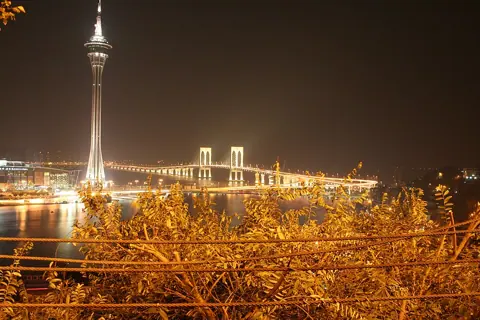
Four centuries of administration left Macau three kinds of trace: buildings you can walk into, traditions the government has formally listed, and a legal system that carried over intact in 1999. The first is a walking route; the other two explain what you are looking at.
What exactly is inscribed?
A defined set of 30 components, not a district. UNESCO describes the property as a group of 22 principal buildings and public spaces, inscribed in 2005 under criteria (ii), (iii), (iv) and (vi), covering 16.1678 hectares with a 106.791-hectare buffer zone. The Cultural Affairs Bureau's own description counts 8 squares and 22 historic buildings plus the streets connecting them, across 1.23 square kilometres.
The list runs from A-Ma Temple at the southern end of the peninsula to Guia Fortress on the hill, taking in St Lawrence's, St Joseph's Seminary, the Dom Pedro V Theatre, the Sir Robert Ho Tung Library, St Augustine's, the former Leal Senado Building, Sam Kai Vui Kun, the Holy House of Mercy, the Cathedral, Lou Kau Mansion, St Dominic's, the Ruins of St Paul's College, Na Tcha Temple, a surviving section of the Old City Walls, Mount Fortress, St Anthony's, the former Casa Garden, and the Protestant Cemetery.
Which interiors are worth the stop, and when are they open?
Six, and the hours are less uniform than the map suggests. These are the officially published times as of 17 September 2026.
| Site | Hours | Closed | Admission |
|---|---|---|---|
| Mandarin's House | 10:00 to 18:00, no entry after 17:30 | Wednesdays | Free |
| Lou Kau Mansion | 10:00 to 18:00, no entry after 17:30 | Mondays | Not stated officially |
| Macao Museum, in Mount Fortress | 10:00 to 18:00, last entry 17:30 | Mondays | MOP 15, MOP 8 students |
| Museum of Sacred Art and Crypt | 09:00 to 18:00, no entry after 17:30 | Closes 14:00 Tuesdays | Free |
| Guia Fortress and Information Centre | 09:00 to 18:00, no entry after 17:30 | Not stated | Free |
| Mount Fortress and gardens | 07:00 to 19:00 | Not stated | Not stated officially |
Two have visitor caps that change how you plan. Mandarin's House admits a maximum of 200 people to the complex at one time and 60 inside the Yu-Qing-Tang and Ji-Shan-Tang halls, with Cantonese guided tours on Saturdays at 14:30 and 15:30 limited to 20 places. Lou Kau Mansion accepts a maximum of 30 visitors per session, and its second floor opens only at weekends and on public holidays, capped at 10 per session with a compulsory guided tour.
What does a sensible walking order look like?
South to north, ending uphill. The squares — Barra, Lilau, St Augustine's, Senado, Cathedral, St Dominic's, Company of Jesus and Camões — are open 24 hours, as is the Old City Walls section, so they cost you nothing in timing and can absorb the gaps between the ticketed interiors.
- Start at A-Ma Temple and Barra Square, then Lilau Square and Mandarin's House — but not on a Wednesday
- Continue through St Augustine's Square to the Dom Pedro V Theatre and the Ho Tung Library
- Cross to Senado Square and the former Leal Senado Building, then Lou Kau Mansion — but not on a Monday
- Take St Dominic's, the Cathedral, then the Ruins of St Paul's and the Museum of Sacred Art
- Finish at Mount Fortress and the Macao Museum, or push on to Guia Fortress before its 17:30 cut-off
For a broader walk there is an official version. The tourism office publishes a 120-minute World Heritage Tour in the Central District covering 15 sights, a 90-minute Art and Cultural Tour in St Lazarus Parish covering 5, a 90-minute Portuguese Ambiance Tour at Taipa Island covering 8, and a 50-minute Tranquility Tour in Coloane Village covering 7.
Which traditions are officially protected?
Twenty-four items sit on Macao's Intangible Cultural Heritage List, inscribed by executive orders in 2019 and 2025, and six of them are Portuguese or Macanese.
| Item | Number | Group |
|---|---|---|
| Patuá Theatre | 4 | 2019 |
| Procession of the Passion of Our Lord | 8 | 2019 |
| Procession of Our Lady of Fátima | 9 | 2019 |
| Macanese Gastronomy | 12 | 2019 |
| Portuguese Folk Dance | 16 | 2025 |
| Confection of Custard Tarts | 21 | 2025 |
Macanese Gastronomy is also on China's national Representative List of Intangible Cultural Heritage, alongside Patuá Theatre. Macau itself was designated a UNESCO Creative City of Gastronomy in 2018 — the third such city in China — and the government ran 2018 as the Macao Year of Gastronomy.
As of August 2026, 98 items were recorded on the wider Inventory of Intangible Cultural Heritage with 24 inscribed on the List, and as of March 2024 there were 165 classified immovable properties in Macau.
What did Portuguese rule leave that you cannot photograph?
The legal architecture, which transferred almost wholesale. The Basic Law is explicit, and the wording rewards reading closely.
Article 9 provides that in addition to the Chinese language, Portuguese may also be used as an official language by the executive authorities, legislature and judiciary. Article 8 maintains the laws, decrees, administrative regulations and other normative acts previously in force in Macao, except any that contravene the Basic Law or are later amended. Article 145 adopts the previously in force laws as laws of the Region and keeps documents, certificates and contracts valid under them valid, recognised and protected.
What this guide does not cover
Three things visitors expect to read about here are absent because no official source could be found for them.
The calçada portuguesa — the black-and-white wave pavement — is one of Macau's most photographed features, and no statement from the Cultural Affairs Bureau, the Municipal Affairs Bureau or the tourism office about where it is laid, how it is maintained or whether it is protected could be retrieved. The blue-and-white bilingual street tiles are in the same position: no published rule on Portuguese and Chinese street naming, and no bureau statement about the signs themselves, could be obtained.
Admission fees are confirmed as free only for Mandarin's House, Guia Fortress and the Museum of Sacred Art and Crypt, and as priced only for the Macao Museum. For the Leal Senado Building, the Moorish Barracks veranda, Lou Kau Mansion and Mount Fortress, no official page states either a fee or "free", so none is claimed here.
Finally, this guide does not call Macau a civil-law jurisdiction. That description is accurate in ordinary usage but the Basic Law does not use the phrase, so the verbatim articles above stand in its place.