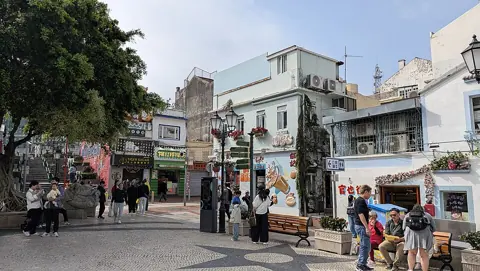
Rua do Cunha (官也街) did not grow its snack shops over centuries. The tourism office dates the change to one decision in 1983, when the street became Macao's first pedestrian zone, and several of the Taipa food shops most often listed by the government are not on Rua do Cunha at all.
This guide sets out what the official record says about how the street changed, what the tourism office and the economic development bureau say is worth eating, and which named shops actually have Rua do Cunha addresses. It also covers the heritage buildings a few minutes away and how public-holiday pedestrian zones affect getting there. The founding years quoted for shops are their own claims, repeated by the government, and are marked as such.
What the official record says
The only official explanation for Rua do Cunha's snack shops is a single sentence on the tourism office's page for the street. It says the street "was turned into the first pedestrian zone in Macao in 1983. Since then, it becomes a popular place for shops selling desserts, almond biscuits, egg rolls, coconut flakes and peanut candies, some of which you can buy as souvenirs."
The Chinese version of the page makes the sequence explicit: in 1983 官也街 was made a pedestrian zone, then Macao's first, and "從此街內不少手信店、甜品店逐漸開業", from then on many souvenir and dessert shops gradually opened on the street. It lists specialty dishes, traditional pastries, nougat (牛軋糖) and desserts. The Portuguese version gives the same 1983 date.
No official document on the pedestrianisation itself was found, so the date rests on the tourism office's text. The tourism office also does not say why the zone was created, and the Municipal Affairs Bureau's street database, which is the likeliest place for a naming history of the street, would not load. Who "Cunha" was, and when the street took the name, are therefore not answered here.
The tourism office describes the street today as a narrow pedestrian street "in the heart of Taipa village" with "countless famed old restaurants" and says it is "always packed with tourists". It suggests a stay of 30 to 45 minutes, gives suggested hours of 8am to 11pm, and tags the street for "Visitor Flow" and "Souvenirs", grouping it in a crowd-forecast area with the Museum of Taipa and Coloane History, Pak Tai Temple and Tin Hau Temple.
The streets around it are part of the same picture. The tourism office's Portuguese Ambiance Tour notes that Rua do Cunha "is surrounded by many specialty restaurants and retail shops", points to a mural on Rua do Sol by a local illustrator with "Lucky Cat" characters in a paper-cutting style, and describes neighbouring Calçada do Quartel as a lane of coloured buildings and graffiti with cafés, snack bars and cultural and creative shops.
The market that anchored the street
The street's other 1983 event was a new market. The Cultural Affairs Bureau's heritage record for the old Taipa market says the municipal market fell into disuse in the 1970s and that "位於官也街與地堡街交匯處的新街市於1983年落成": the new market at the junction of Rua do Cunha and Rua do Regedor was completed in 1983.
Both events fall in the same year, but no official source links them causally. What the records do show is that Rua do Cunha acquired a pedestrian street and a working market at its end within the same year, which is the setting the tourism office describes shops moving into.
The old market itself, now called Feira do Carmo (嘉模墟), sits at the junction of Rua Direita Carlos Eugénio and Rua do Cunha. The bureau's record, citing the Official Gazette of 14 September 1886 and an archive document, says it was founded around 1879 and rebuilt in 1886 into its present form: a central four-pitched pavilion with a Western form, a Cantonese tiled roof and petal-edged fascia boards that show South or Southeast Asian influence.
The tourism office's English and Portuguese pages instead date the old market to the "early 19th century". The Cultural Affairs Bureau cites archival sources for its 1879 and 1886 dates, so this guide uses those.
In 2003 the municipal authority converted the old market into a leisure square, and the bureau now calls it Taipa's only surviving early public market. The tourism office says a Taipa flea market sets up stalls in the square every Sunday; the Chinese page describes it as a government-run weekly market promoting local cultural and creative work.
One shop history takes the food trade in this corner back further. The economic development bureau's profile of Mercearia de Mok Yi Kei says that in the 1920s "the town centre of Taipa was in the vicinity of today's Rua do Cunha and Rua do Regedor" and that hawker stalls packed the area, one of them the shop's predecessor. That is the business's own origin story relayed by the government, not an independent history.
What the tourism office says to eat
The tourism office names a short list of Macao snacks and describes each, and those descriptions are the official guide to what is on sale around Rua do Cunha. The table below combines the foods the Rua do Cunha page names with the tourism office's descriptions from its food pages.
| Name | Local name | What it is | Price range |
|---|---|---|---|
| Pork chop bun | 豬扒包 | "A Macao-style burger" of grilled pork in a crispy bun, no vegetables or sauce | Not published |
| Almond cookies | 杏仁餅 | "Some of Macao's most popular traditional cookies"; dry, eat with a drink | Not published |
| Beef jerky | Not given in the source | "One of Macao's specialty snacks", also made from chicken and pork | Not published |
| Egg puffs | Not given in the source | "A type of waffle", crisp outside and soft inside | Not published |
| Serradura | Not given in the source | Whipped cream layered with cookie crumbs, eaten with a spoon | Not published |
| Egg rolls | Not given in the source | Named on the Rua do Cunha page as a shop staple | Not published |
| Nougat | 牛軋糖 | Listed on the Chinese Rua do Cunha page | Not published |
| Coconut flakes and peanut candies | Not given in the source | Named on the Rua do Cunha page as souvenirs | Not published |
The pork chop bun is the dish the tourism office explains most carefully: "a Macao-style burger in a crispy baked baguette with thickly sliced grilled pork meat in between", different from a hamburger because "it doesn't have vegetables or sauce, but just meat". The Cultural Affairs Bureau added pork chop bun making to Macao's intangible heritage inventory in 2026.
Serradura is the dessert the tourism office ranks with the egg tart, describing "a soft whipped cream with cookie crumbs layered on top to be eaten with a spoon" and calling it "one of the best snacks of both Portugal and Macao". Almond cookies, the tourism office warns, are dry enough that "it's recommended that you eat it with a drink".
No official price is published for any of these foods on Rua do Cunha. How snack prices are shown and weighed, and what to check on a tag, is covered in the guide to the Taipa snack shop price decoder.
Shops named by government, and where
The shops that official sources name around Rua do Cunha come from one scheme: the economic development bureau's Distinctive Shops programme, whose entries the tourism office repeats in its "Step Out Macao – Taipa" tour. The tour has 44 entries, shops and sights together. Inclusion is a promotional listing, not a quality ranking, and the founding years are the shops' own claims.
Only four of the shops on those lists give Rua do Cunha addresses. Several better-known names sit on Rua do Regedor or Rua Correia da Silva, a short walk away, which matters if you are navigating by street sign.
| Shop | Address (as listed) | Known for, per the listing | Age claimed |
|---|---|---|---|
| Mercearia de Mok Yi Kei | Unit A, 9 Rua do Cunha | Agar jelly, durian ice cream, serradura | Third generation; 1920s hawker roots |
| Casa de Bolos Man Kei | G/F, 23–24 Rua do Cunha | Curry egg rolls | Over thirty years |
| Alua e Comidas Portuguesa Kam In | 1–9B Rua do Cunha | Alua, a Macanese Christmas sweet | Three generations |
| Bitter Sweet | 92 Rua do Cunha | Serradura; spicy sardine bun | Not stated |
| Tai Lei Loi Kei | 35 Rua Correia da Silva | Pork chop bun | Over fifty years |
| Serrdura | 195 Rua do Regedor | Serradura frozen at -18℃ | Established 2003 |
| Kam Va Snacks | G/F, 22 Rua do Regedor | Beef offal | Over twenty years |
| Old Cherykoff Macau | G/F, 22A Rua do Regedor | Nougat said to originate in Russia | Not stated |
Tai Lei Loi Kei's listing calls its pork chop bun "the signature of signatures" and says it uses Brazilian pork chop and marraqueta buns. Bitter Sweet's listing names its owner, Mr De Pina, and says its sardine bun uses "red-canned Porthos sardines". Serrdura's listing says its serradura is "frozen at -18℃", which is the one technical detail in any official description of the dessert.
The lists go well beyond those eight. The economic development bureau and the tourism office also name Estabelecimento de Comidas Heng Kei at 18 Rua de Horta e Sousa, which says it has been established for sixty years and serves macaroni and pork chop buns; Cozinha Pinocchio at 38 Largo dos Bombeiros, which gives 1977 as its founding year; and Restaurante Panda at 4–8 Rua Direita Carlos Eugénio, which says it has been open for twenty-nine years.
The tourism office's own pages add more pork chop buns and noodles. It names Estabelecimento de Comidas Regedor for a "Macanese In-Bone Pork Chop Bun", Tat Veng U Chi Tong Min at 301 Rua do Regedor for shark's fin noodles, and Hong Kei, in a small alley next to Rua do Cunha, which it says has been open for over thirty years. Joc Square, at 69 Rua Correia da Silva, says it opened in Taipa Village in 2016 and is known for a batata cookie.
Souvenir-biscuit chains that do not appear on these lists are not named here, because no official page read for this guide names them and their own websites could not be read. If you want to carry snacks home, the rules and options are set out in the guide to snacks you can carry home.
Heritage within five minutes' walk
Rua do Cunha is not itself a classified heritage street; the Cultural Affairs Bureau's Taipa entries name it only as a boundary of the old market site. The classified buildings around it are close enough to fold into the same visit.
The Taipa Houses (龍環葡韻), five houses built in 1921 as residences for senior civil servants and Macanese families, have been a museum since the end of 1999. The bureau lists them as open 10am to 7pm, with no admission after 6:30pm, closed on Mondays, with free admission and public guided tours on Saturdays from 3pm to 5pm. One house is leased to Lubuds Macau Limited, which runs the restaurant Casa Maquista there to promote Macanese food, open 10am to 10pm.
Since September 2016 the houses have been arranged, west to east, as the Macanese Living Museum, an Exhibitions Gallery, the Creative Casa, the Nostalgic House and a House for Receptions, which is not open to the public. The Creative Casa is leased by public tender to The Universal Gallery and Bookstore. The economic development bureau's page on the houses notes that 龍環, the first half of their Chinese name, is an old name for Taipa.
Our Lady of Carmel Church, above the houses, was built in 1885 for Taipa's Catholics and is the island's only Catholic church, according to the bureau. The tourism office gives its hours as 10am to 12:30pm and 2pm to 6pm.
Pak Tai Temple, built around 1844, anchors the classified ensemble 嘉妹前地/買賣街/客商街/中街 (CT002), which the bureau describes as streets of traditional buildings from the turn of the 20th century. The tourism office says Chinese opera is performed there on the Feast of Pak Tai, the 3rd day of the 3rd lunar month, and recalls that "in the old days, most of the population earned a living by fishing".
The bureau's record adds that the temple also enshrines Wa Kwong, Kam Fa, Kwan Tai, Choi Pak Sing Kwan and Lu Ban, and that inscriptions on its bell and altar carry 龍頭環, 龍環 and 潭仔, all old names for Taipa. The tourism office's Taipa tour dates the nearby Tin Hau Temple to no later than 1785, from a bell inscription, and the bureau's record for Taipa Fortress says it was built in 1846 against pirates and now serves as a Scout headquarters.
The Museum of Taipa and Coloane History occupies the late-19th-century neoclassical former Islands Municipal Council building on Rua Correia da Silva. The tourism office lists it as free, open 10am to 6pm with no admission after 5:30pm, and closed on Mondays.
Taipa's industrial past is a short walk further. The Cultural Affairs Bureau says Macao's firecracker industry grew rapidly from the 1920s, with several factories in Taipa making it an economic backbone from the 1950s to the 1970s. The Former Iec Long Firecracker Factory, about 25,000 square metres and "the only well-preserved heritage site of the firecracker industry in Macao", opened a 400-metre trail on 23 December 2022. It is free, open 6am to 7pm daily (closing at 3pm on Wednesdays), with a maximum of 200 visitors at a time. How that older Taipa sits beside the Cotai resorts is covered in the guide to what the resorts built.
The bureau's opening release for the trail names the factory's founder as 鄧璧堂 and says the project aims to "串聯氹仔舊城周邊豐富的文旅資源", linking the cultural and tourism resources around Taipa Old Town. The trail opened with an exhibition on the history of Macao's firecracker industry and a gift shop, and the tourism office lists a café, Sam's Workshop, inside the factory site serving coffee, light meals and desserts.
Holiday crowds and getting there
On major public holidays the government has closed Taipa Old Town to traffic, and that changes how you reach Rua do Cunha. In 2025 temporary pedestrian zones ran daily from 12pm to 7pm on 1 to 5 May and on 1 to 7 October.
During those zones the bus stops "泉悅花園", "嘉模泳池", "氹仔官也街" (Taipa Rua do Cunha) and "氹仔中葡小學" were suspended from 11am until the last bus. A temporary stop at Largo Governador Tamagnini Barbosa served routes 11 and 28A, and visitors were told to use bus stops on Avenida Olímpica or Estrada da Baía de Nossa Senhora da Esperança near the LRT's Pai Kok Station. An extra route, 26AT, was added in May 2025.
The May 2025 zone ran from the junction of Rua Fernão Mendes Pinto and Rua de Seng Tou, by the Carmo Pool stop, to the junction of Rua Correia da Silva and Rua do Governador Tamagnini Barbosa, by the history museum. The government also held a market in the open car park outside Iec Long, and in October lent the Pine Tree Tail plot to shops for loading.
On ordinary days, the Cultural Affairs Bureau lists bus routes 11, 15, 22, 28A, 30, 33 and 34 as stopping near the Taipa Houses. Whether a pedestrian zone is planned for National Day 2026 was not confirmed from an official notice before publication.
The LRT Taipa Line runs, in order, from Barra through Ocean, Jockey Club, Stadium, Pai Kok, Cotai West, Hengqin, Union Hospital, East Asian Games, Cotai East, MUST and Airport to Taipa Ferry Terminal, according to the operator, which says its timetable was updated in September 2026. The operator describes Pai Kok as serving the residential area, medical institutions and major tourist and entertainment facilities in Taipa.
What this guide does not cover
Who Rua do Cunha was named after is not covered, because the Municipal Affairs Bureau's street database would not load and no other official source explains the name. Snack prices are not given, because no official price survey covers the street, and founding years of individual shops are not verified beyond the shops' own claims as repeated by the government.
The guide does not name souvenir-biscuit chains whose own websites could not be read, and it does not cover visitor numbers for the street, for which no statistics service figure was found. It does not cover the Cotai resorts' food halls, the Taipa Village Art Space, or Sunday flea market opening hours, which no official page gives.