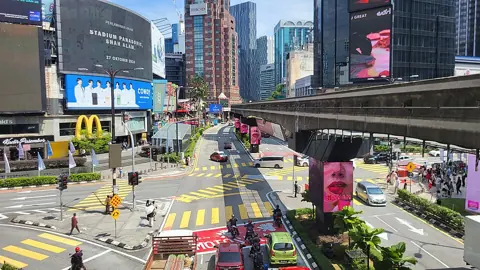
Malaysians made three billion DuitNow QR payments in 2025, double the 1.5 billion of the year before, across almost three million registered touchpoints, and the average Malaysian made 538 electronic payments over the year (Bank Negara Malaysia, Annual Report 2025, checked 16 September 2026). Your phone almost certainly cannot make one of them. The QR sticker on the stall counter is a functioning national payment system that most visitors are locked out of, and that single fact decides how much cash you should be carrying in Kuala Lumpur.
What DuitNow QR actually is
DuitNow QR is Malaysia's national QR payment standard, operated by Payments Network Malaysia Sdn Bhd (PayNet), and it moves money between bank accounts and licensed e-wallets rather than over a card network. The point of a national standard is that a merchant displays one code instead of a wall of them, and any participating Malaysian bank app or e-wallet can pay it. PayNet states that the service is completely free for consumers and requires no registration (PayNet, DuitNow Cross Border QR Payments, checked 16 September 2026).
That design explains why acceptance grew so fast at the small end of the economy. A stall holder needs no terminal, no card acquiring contract and no per-transaction cost; a printed standee is the entire investment. Bank Negara Malaysia's 2025 annual report puts registered touchpoints at almost three million, up from 2.6 million a year earlier. The practical consequence for you is that the merchants least likely to take your card are exactly the merchants most likely to have a QR code you cannot scan.
Which foreign apps can scan it
Only apps issued in six markets can pay a Malaysian DuitNow QR code. PayNet's own developer documentation lists the supported inbound regions as China, Indonesia, Singapore, Thailand, Cambodia and Korea (PayNet, Cross Border Inbound QR, checked 16 September 2026), and PayNet's consumer page shows the matching inbound partner schemes under its "Travelling to Malaysia" panel.
The table below sets each inbound scheme against its home market and against whether Bank Negara Malaysia announced it as a central-bank payment linkage or it appears only in PayNet's commercial partner listing.
| Scheme or app | Home market | How it is documented |
|---|---|---|
| PromptPay | Thailand | BNM linkage, phase 1 live 18 June 2021 |
| QRIS | Indonesia | BNM linkage, pilot launched 27 January 2022 |
| NETS | Singapore | BNM connectivity, launched 31 March 2023 |
| Bakong | Cambodia | BNM linkage, phase 2 launched 8 April 2025 |
| Alipay+, WeChat Pay, UnionPay | China | PayNet partner listing |
| paybooc | Korea | PayNet partner listing |
Sources for the linkage dates are Bank Negara Malaysia's own announcements for Thailand, Indonesia, Singapore and Cambodia, all checked 16 September 2026. Each announcement names specific participating institutions rather than granting a whole country access: the Thailand phase one went live with CIMB Thai Bank and Public Bank Berhad, and the Singapore launch named DBS Bank, OCBC Bank and UOB on the Singapore side. Being from a listed market is necessary, not sufficient — your own bank or wallet has to be a participant.
How much cash to carry
Malaysian ringgit in cash is the instrument that always works, and it is the sensible default for any merchant small enough to have chosen a QR standee over a card terminal. We did not find an official Malaysian source that measures card acceptance merchant by merchant, so any confident percentage you read elsewhere is an estimate rather than a published figure. What the official data does establish is the shape of the problem: acceptance at the small end of the economy has been built on a rail you cannot reach.
The working rule that follows is to treat cash as your food and market budget and the card as your mall, hotel and restaurant budget. Withdraw once, in a reasonable amount, rather than making repeated small withdrawals that each attract your home bank's fixed fee.
Transport payment in Kuala Lumpur runs on its own stored-value arrangement and is not covered in this guide; treat it as a separate purchase to sort out on arrival and check the rail operator's own fare and card pages rather than assuming your bank card will open the gate.
Cards, ATMs and conversion traps
Card payment in Malaysia is straightforward in malls, chain outlets, hotels and sit-down restaurants, but the exchange rate you receive depends on a choice the terminal will put in front of you. If a card machine or an ATM offers to bill you in your home currency instead of ringgit, that is dynamic currency conversion, and the rate is set on the Malaysian side rather than by your own card issuer. Choosing to be charged in MYR leaves the conversion with your issuer, which is usually the cheaper path.
We did not find a Bank Negara Malaysia page setting consumer rules for dynamic currency conversion at Malaysian terminals, so treat this as a mechanism to recognise rather than a right you can enforce at the counter. Say "ringgit" clearly before the transaction is completed, and check the screen before you press confirm.
What SST adds to your bill
Malaysia's Sales and Service Tax is two separate taxes with different mechanics, and only one of them is visible on the bill you sign. Royal Malaysian Customs describes sales tax as "a single stage tax levied on imported and locally manufactured goods, either at the time of importation or at the time the goods are sold or otherwise disposed of by the manufacturer", while service tax is "charged and levied on taxable services provided by any taxable person in Malaysia in the course and furtherance of business" (RMCD, Understanding SST, checked 16 September 2026).
This table compares the two charges you will actually meet as a visitor.
| Charge | Rate | Where you meet it |
|---|---|---|
| Service tax, general | 8% | A line on hotel and most service bills |
| Service tax, food and beverage | 6% | A line on a registered restaurant bill |
| Sales tax on goods | 5% or 10% | Already inside the shelf price |
The 8% general rate and the 6% rate for food and beverage, telecommunication, parking and logistics services were set by the Service Tax (Rate Of Tax) (Amendment) Order 2024, P.U. (A) 64, gazetted 26 February 2024 and in force from 1 March 2024. RMCD's service tax FAQ restates the same split and adds a flat MYR 25 per card charge on credit and charge card services (RMCD, FAQ Service Tax, checked 16 September 2026). Sales tax rates changed on 1 July 2025, with goods listed in the relevant order taxed at 5% and unlisted goods at 10% (RMCD, FAQ Transition of Sales Tax Rate Changes 2025, checked 16 September 2026).
Not every small restaurant charges service tax, because the obligation depends on a registration threshold rather than on the type of food. RMCD's FAQ gives the example of cafeteria food services becoming subject to service tax once the sales value of those services exceeds MYR 1,500,000. A hawker stall is not in that world; a hotel coffee shop is. Rates and thresholds are amended regularly through gazetted orders, so confirm the current position on the MySST portal before you budget around a number.
Why no tourist refund exists
Malaysia operates no tourist refund scheme under SST, and the reason is structural rather than bureaucratic. Sales tax is a single-stage tax collected from the manufacturer or at import, which means the shopper never pays it as a separately identifiable line at the till. There is no tax on your receipt to hand back at the airport, because the tax was settled several steps upstream of the shop.
Royal Malaysian Customs' own Traveler's Guide runs through dutiable goods and rates, duty-free allowances, cash declaration, prohibited imports, green and red lanes, temporary import guarantees and ATA carnets, and the only tax-free shopping route it describes for visitors is the network of duty-free shops at airports, ports, border points and designated state outlets (RMCD, Traveler's Guide, checked 16 September 2026). The guide contains no departure refund counter, and neither RMCD's SST FAQs nor the MySST portal describes one.
The practical consequence is simple. Buy at the duty-free shop if you want the tax-free price, and do not budget on the assumption that a percentage of your shopping comes back to you on the way out.
Before you land
Do three things before you arrive. Check whether your bank or wallet is a participant in one of the six inbound cross-border QR markets, because that answer decides whether you need cash for small merchants or merely prefer it. Plan a single ATM withdrawal or one visit to a licensed money changer rather than several small ones. And tell your card issuer you are travelling, so the first hawker-centre-adjacent card payment does not get blocked.
Three things this guide does not answer. It does not cover transport fares or the stored-value cards that pay them, which is a separate subject with its own operators and its own pricing. It does not cover business SST registration, invoicing or returns, which are matters for a registered person rather than a visitor. And it does not tell you what to tip, because we found no Malaysian government publication that sets or describes a tipping norm; the percentage on a restaurant bill is a gazetted tax, not a gratuity, and should not be read as one.