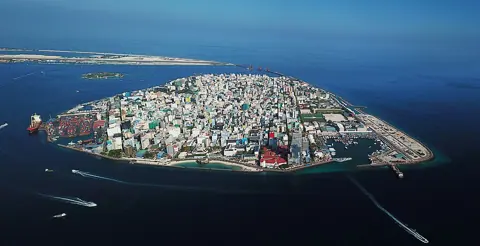
Maldivians and resort guests usually do not share an island. Only about 200 of the country's 1,192 islands are inhabited, according to Visit Maldives, while resorts run on a "one-island, one-resort" model on islands of their own. A guesthouse, by contrast, sits inside a working community, and that is why a guesthouse stay comes with rules a resort does not have.
What changes when you stay on an inhabited island?
The tourism board's 2026 destination guide sets out the local-island norms in four lines: the Maldives is a Muslim country, modest dress is expected in public, bikinis are permitted only on designated bikini beaches "which are clearly marked", and alcohol is available only at licensed resorts and vessels.
- Clothing in the village. The UK Foreign Office advises men and women to keep shoulders covered and avoid short or tight shorts, and to keep arms and upper legs covered when bathing. Australia's Smartraveller says women in Malé and on non-resort islands should cover shoulders and knees.
- Swimming. A bikini beach is a marked stretch of one island, not the whole shoreline. Everywhere else on the island, beach and street dress rules apply. Nudity and topless sunbathing are not allowed anywhere, resorts included, per the UK advice.
- Alcohol. None is sold on inhabited islands. The UK advice warns that possessing or drinking alcohol, or being intoxicated, outside resorts and on inhabited islands can lead to arrest and deportation, and says not to take any alcohol out of a resort.
- Fridays and prayer times. The destination guide notes that many businesses close briefly at prayer times and pause from late morning to early afternoon on Fridays. On a small island that can mean your café and dive shop shut at the same time.
- Ramadan. The UK advice says not to eat, drink or smoke in public during daylight in Ramadan outside holiday resorts. That includes walking through the village with a water bottle.
Why do resort islands and local islands follow different rules?
The split is a planning decision, not a cultural accident. For decades almost all tourist beds were on separate resort islands. Bureau of Statistics data show only 25 registered guesthouses with 476 beds at the end of 2010, rising to 75 in 2012 and 314 by 2015, according to the 2016 Statistical Yearbook.
By the end of 2025 the 2026 Statistical Yearbook counted 973 guesthouses against 186 resorts. Guesthouses are 72% of all registered establishments (973 of 1,343) but only 24.5% of registered beds (16,824 of 68,671). The average resort has about 247 beds, while the average guesthouse has about 17. So a guesthouse stay usually means a small building in a village, not a small resort.
Some islands have many guesthouses. Maafushi, in Kaafu (Malé) Atoll, had 53 guesthouses with 1,944 beds in December 2025, according to Table 10.15. Other islands in the same table have one or two. A busy guesthouse island and a quiet one are very different stays, even under the same rules.
The line can blur. The same destination guide carries a promotional feature on Fiyavalhu, described as the first resort built on a local island (Mandhoo, South Ari Atoll), which serves drinks on a bar yacht anchored in the lagoon "in respect of the island's cultural values". If a property calls itself a resort but sits on an inhabited island, ask exactly where alcohol and swimwear are allowed.
How the two stays compare
| Factor | Guesthouse on a local island | Resort island |
|---|---|---|
| Alcohol | None on the island | Sold at licensed resorts |
| Swimwear | Marked bikini beach only | Normal on resort beaches |
| Meals | Guesthouse plus island cafés | Resort restaurants, often a meal plan |
| Getting there | Public ferry, shared speedboat or domestic flight plus boat | Transfer arranged by the resort |
| Daily life | Village, mosque, Friday pause | Resort only, few outside rules |
| Scale | About 17 beds on average | About 247 beds on average |
How do the costs differ?
The price gap is less about the room than about what you cannot buy elsewhere. On a resort island, the resort is the only seller of meals, drinks, excursions and the transfer. Trans Maldivian Airways, the seaplane operator, states on its FAQ that all its resort transfer bookings are made through partner resorts, so the resort sets that price as well.
On a local island, you can mix: guesthouse breakfast, a café lunch, and a choice between a slower scheduled ferry and a faster speedboat. Visit Maldives says scheduled ferries run from Malé to many atolls, but we could not read the operator's current timetables or fares, so confirm them with your guesthouse. There is no bar bill, because there is no bar.
Taxes are also calculated differently for each type of property. Our guide to Maldives Green Tax and T-GST explains what is added to each kind of bill.
Who each option suits
- Budget and solo travellers: Guesthouses let you pay for a room and buy meals, boats and trips separately. Island size matters: compare how many guesthouses the island has before you book.
- Honeymooners and couples who want a drink at sunset: A resort, or a split stay that ends on one. The alcohol rule cannot be worked around on an inhabited island.
- Families: Both work. Resorts keep everything within walking distance. Guesthouses put children in a lived-in island community, but parents need to plan around the swimwear and beach rules.
- Divers and island-hoppers: Guesthouse islands suit people who want to move around, since public ferries link inhabited islands. On a resort island, excursions depend on what the resort offers.
Before you book
Check three things with the property in writing. First, does the island have a bikini beach, and how far is it from your room? Second, how will you reach the island from Velana airport on your arrival day, and what happens if your flight lands late? Our airport-to-island transfer guide covers what to plan for after dark. Third, do your dates fall in Ramadan? If they do and you want daytime cafés and a beach bar, book a resort for those nights.