Getting there and back by bus
Buses to Puebla leave Mexico City from TAPO, the eastern terminal, and from Terminal Norte, and arrive at CAPU on the north-west edge of Puebla. TAPO is the natural choice because it sits on Metro Line 1 at San Lazaro and faces east towards the Puebla highway. Terminal Norte suits you if you are staying in the north of the city. Service on this corridor is frequent enough through the day that most travellers buy on the day for the outbound leg, but the ADO route page for Mexico City TAPO to Puebla is where to confirm the current timetable, journey time and fare for your date, since these change and vary by service class.
Two things shape the day more than the timetable does. CAPU is not in the historic centre, so allow for a taxi or ride-hailing trip at each end. And the return is the constraint, not the outbound: late afternoon and evening departures back to Mexico City are the busiest of the day, so hold a seat rather than assuming one.
The historic centre and why it is protected
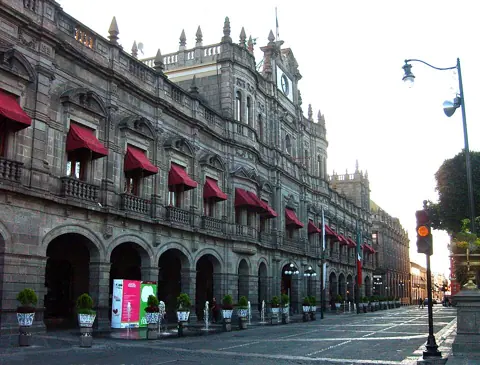
Puebla's historic centre carries UNESCO World Heritage status, inscribed in 1987 under criteria (ii) and (iv) as a city founded from nothing in 1531 whose 16th and 17th century religious buildings and tiled house facades represent a fusion of European and American forms. The grid layout means the centre is genuinely walkable: the zocalo, the cathedral, the tiled Casa de los Munecos, the Biblioteca Palafoxiana and the Capilla del Rosario sit within a few blocks of each other.
The tiles are the reason the centre looks unlike other Mexican colonial cities. Facades covered in azulejos are the local architectural signature, and they are the same craft tradition you can then buy in workshop form.
Talavera and how to tell certified from copy
Talavera is a protected Mexican ceramic with its own denomination of origin and its own Official Mexican Standard, NOM-132-SCFI, published in 1998, which sets the specifications, characteristics and tests a piece must pass to be called Talavera. The regulatory council, the Consejo Regulador de la Talavera, certifies workshops and pieces against that standard, and the protected production zone is defined narrowly, covering the judicial districts of Atlixco, Cholula, Puebla and Tecali in Puebla state. Related workshops in neighbouring Tlaxcala form part of the same recognised craft tradition, which UNESCO lists as intangible cultural heritage alongside its Spanish counterparts.
Practically, that gives you a small set of checks in a shop. Certified pieces come from a named certified workshop, and the workshop will say so and will be able to name its certification; the piece carries the maker's signature, the workshop name and Puebla on the base; the glaze is thick, slightly uneven and cool to the touch rather than glassy and perfectly flat; and the price is high, because the process involves months of settling, two firings and hand painting. A cheap, light, machine-regular blue-and-white piece in a souvenir stall is decorated earthenware in the Talavera style, not certified Talavera, and there is nothing wrong with buying it as long as you know which one you are buying.
Mole poblano, cemitas and when to eat them
Puebla's two defining dishes belong to different meals and different price levels, so plan for both rather than choosing. Mole poblano is the long-cooked sauce of chillies, spices, nuts, seeds and chocolate served over turkey or chicken, and it is a sit-down restaurant dish typically eaten at the main midday meal. The cemita is a sesame-seeded bread roll filled with a breaded cutlet, avocado, stringy quesillo cheese, chipotle and the herb papalo, and it is street and market food, best eaten at a market counter or a specialist cemitas stall.
If you are there between roughly July and September, chiles en nogada are the seasonal reason to eat a proper lunch: a roasted poblano chilli stuffed with a sweet-savoury picadillo, covered in walnut cream and pomegranate seeds. Availability follows the walnut and pomegranate harvest rather than a fixed calendar, so ask before you build a day around it.
The car plants and why the region looks the way it does
Puebla's economy is shaped by vehicle manufacturing more than by any other single industry, which is why the drive in from Mexico City passes industrial parks and logistics yards rather than farmland. Volkswagen's Puebla plant opened in October 1967, occupies a 300-hectare site and currently builds the Jetta, Tiguan and Taos, exporting to more than a hundred countries, and the company describes it as the second-largest Volkswagen Group plant outside Germany. Audi operates a separate plant at San Jose Chiapa, about an hour north-east of the city, building the Q5 for global markets; check Audi Mexico's own site for current model and production details, which change with model cycles.
What that means for a visitor is concrete rather than abstract. It explains why Puebla has a long-standing German corporate presence; why the city has a substantial engineering-focused university sector; why hotel demand mid-week is driven by business travel, so weekday rooms can be tighter and dearer than a leisure destination would suggest; and why the highway corridor is heavy with freight, which is worth factoring into a late return by road. Neither plant is a walk-up attraction. Both are working factories, and any visit is arranged in advance with the company.
Cholula as a half-day add-on
Cholula sits about twenty to thirty minutes west of central Puebla and holds the Great Pyramid, which INAH describes as the largest in surface area in Mesoamerica at 450 metres per side, built in successive phases over a natural rise and dedicated to Tlaloc. The mound is grassed over and topped by the colonial church of Nuestra Senora de los Remedios, which is the image most people recognise before they realise what it is standing on.
Plan around INAH's stated conditions rather than around photographs. The site and its museum open Wednesday to Sunday, 09:00 to 17:00, with last entry at 17:00. The roughly 280-metre interior tunnel is listed as closed to the public until further notice, so do not build the visit around walking through the pyramid. Admission is listed at MXN 210 general, and MXN 105 for Mexican nationals and foreign residents, with the ticket office and tunnel entrance on the south side of Avenida Morelos and the site museum on Calle 8 Norte.
Deciding between a day trip and an overnight
Choose a day trip if your target is the historic centre, one Talavera workshop and one long lunch, and you can leave Mexico City by mid-morning at the latest. Choose an overnight if you want Cholula, the Amparo museum or the Museo Internacional del Barroco, an evening in the centre when the tiled facades are lit, or the seasonal chiles en nogada eaten without watching a clock.
Before you go, confirm three things for your specific date: the current bus timetable and fare on the operator's own page, the opening days of anything you intend to enter, since several Puebla museums close on Mondays and the Cholula site closes Monday and Tuesday, and whether the workshop you want to visit for Talavera receives visitors without an appointment. This guide covers Puebla city and Cholula; it does not cover the wider state, including Cuetzalan, Atlixco or the Popocatepetl volcano region.