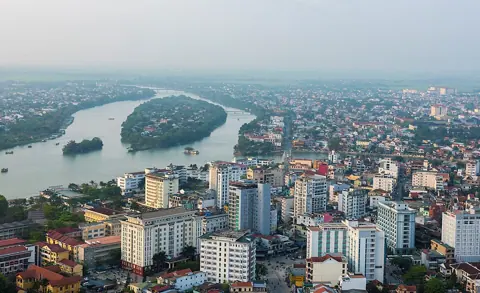
Hue's Nguyen emperors were not buried in a graveyard on the edge of town. Each one commissioned his own walled complex in the hills upstream along the Perfume River, and several used them as retreats while still alive. That is why they are so far apart, and why choosing between them is a real decision rather than a matter of picking the nearest.
The tombs are part of the Complex of Hue Monuments, inscribed by UNESCO in 1993 along with the Citadel and the sites strung along the river. Three of them absorb almost all the visitors: Tu Duc, Khai Dinh and Minh Mang. They are not variations on one theme. They differ in shape, in mood, in how far you travel and in how much you climb.
What separates the three main tombs
The three most-visited tombs belong to emperors of very different eras, and each complex was built to a different idea of what a tomb should be.
Tu Duc reigned from 1848 to 1883, the longest reign of the dynasty, and work on his complex began in 1864 — while he was alive and using it. It is divided into a temple area and a tomb area around Luu Khiem lake, and it holds close to fifty structures inside a stone wall of roughly 1,800 metres. He wrote poetry in the pavilions above the water. The place was built as a residence first and a mausoleum second, and it still reads that way.
Minh Mang, who ruled a generation earlier, did not live to see his own. Construction started in 1840, the emperor died in January 1841, and his successor Thieu Tri put thousands of soldiers and labourers to work finishing it in early 1843. The result is the most disciplined layout of the three: more than twenty-five structures set in strict bilateral symmetry along a ceremonial axis roughly 700 metres long, inside a perimeter wall of about 1,750 metres.
Khai Dinh is the outlier, and the last tomb the dynasty built. He reigned from 1916 until his death in 1925, and construction ran from 1920 to 1931. By then reinforced concrete, French influence and imported materials had reached Hue, and the tomb shows all three. It is small in footprint, dark grey outside, stacked up a hillside in five courtyard levels — and inside, the Thien Dinh Palace at the top is covered in ceramic mosaic. Nothing else in Hue looks remotely like it.
Tu Duc for shade and atmosphere
The tomb of Tu Duc is the one to pick if you want to sit down somewhere pleasant rather than tick off a monument. It is the greenest of the three, laid out around the lake with pines, frangipani and lotus, and there is almost always a bench in shade.
The ground is mostly flat, but the complex is large and the paths wander. You will walk more here than at Khai Dinh, just not uphill. Ninety minutes disappears easily if you follow the paths past the temple buildings, along the water and up to the stele pavilion.
It is also the easiest to reach. Tu Duc lies in the hills just southwest of the centre, closer in than the other two, which matters if you are fitting a tomb around a Citadel day. Come early or in the last hours of the afternoon: it takes crowds badly in the middle of the day, and the light through the pines is worth the timing.
That secrecy is part of the character of the place. It was designed to be lived in and enjoyed, not to be read like a diagram.
Khai Dinh for the interior alone
The tomb of Khai Dinh is the one visitors remember, and it earns that on a single room. The Thien Dinh Palace at the top is decorated in ceramic mosaic, with a dragons-and-clouds painting across the ceiling, a life-size gilded bronze statue of the emperor above the burial chamber, and detail on every surface. It is ornate to the point of excess, and it is genuinely unlike anything else in Vietnam.
The trade-off is the approach. Khai Dinh rises through five courtyard levels on a hillside about 10 kilometres from the centre, and the climb runs to roughly 127 stone steps with no lift and little shade on the way. In Hue's summer heat that is a real effort, and the stairs are the single biggest reason to rule this tomb out or in.
The site is compact, though. Once you are at the top, everything worth seeing is within a few metres, and the whole visit works in 45 minutes to an hour. If your day is short but your legs are fine, this is the highest reward per minute of the three.
Minh Mang for scale and quiet
The tomb of Minh Mang is the most formal complex of the three and the one that best shows what a Nguyen imperial tomb was meant to be. Everything sits on one long axis — gates, courtyards, a stele pavilion, temples, bridges over lakes, and finally the burial mound behind a wall — with the two halves mirroring each other.
Walking it is a long, level procession rather than a climb. Allow more time than you think, because the axis alone runs several hundred metres and the return walk doubles it. There are steps at individual buildings, but nothing on the scale of Khai Dinh.
It sits roughly 14 kilometres from the imperial city, near where two streams meet to form the Perfume River, which makes it the furthest of the three and the one most likely to cost you a whole half-day once you add the road time in both directions. What you get for that is space and relative calm, and a site where the design carries the meaning.
Travel time and effort compared
The table below compares the three tombs on the two things that usually decide it — what kind of place each one is, and what it costs you in time and effort.
| Tomb | Best for | Trade-off |
|---|---|---|
| Tu Duc | Shade, atmosphere, a slow hour | Large grounds; busy in the middle of the day |
| Khai Dinh | One extraordinary decorated interior | Steep stone stairs, little shade on the climb |
| Minh Mang | Formal design, space, fewer people | Furthest out; long level walk along the axis |
Distances here are short in kilometres but slow in practice: these are hill roads with turns, and a taxi, a hired car or a booked motorbike will all take longer than a map estimate suggests. Boat trips on the Perfume River also serve some tombs, and they trade speed for a pleasant ride and a walk up from the landing.
Heat is the other constraint worth planning around. From late spring through summer, midday at any of these sites is punishing, and the difference between a 9am visit and a 1pm one is larger than the difference between the tombs.
Picking one for your day
Two tombs in one afternoon is possible with your own transport if you pair Tu Duc and Khai Dinh, which lie in the same general direction. Adding Minh Mang to that makes for a long, hot day and usually turns all three into a blur.
What to check before you go
This guide does not cover ticket prices, opening hours, combination tickets or current restoration work, all of which change. Check the Hue Monuments Conservation Centre's official site or the Vietnam National Authority of Tourism pages shortly before your visit, and confirm with your driver that the tomb you want is included in the fare quoted rather than assumed.
One last practical note: bring water and sun cover for all three. There is very little bought on site, and at Khai Dinh in particular the climb comes before the shade.