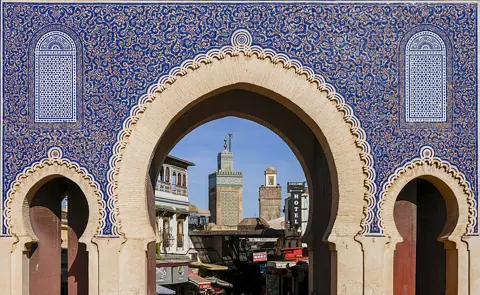
Fes el-Bali had reached its present size by the 12th and 13th centuries, according to UNESCO, which describes it as the capital founded by the Idrisid dynasty between 789 and 808, long before any vehicle needed to pass. That history, rather than a single ban, is why it is car-free: none of the sources consulted for this guide cites a decree that bans cars. When conservation began in earnest, the choice was to protect that fabric and bring in only the vehicles a city of this size cannot do without.
Why can't cars drive into Fes el-Bali?
The UNESCO listing says the Medina of Fez "comprises an urban fabric that has remained remarkably homogenous and intact over the centuries". It also names the pressures on it: "the deterioration of the buildings and the over-populated area". Density figures from two academic studies put the medina at 800 to 1,200 people per hectare. That is a lot of people in houses reached by lanes built for walkers and pack animals.
Widening those lanes would have destroyed what the 1981 inscription protects. The World Bank's 1997 Fez Rehabilitation Project document instead proposed an "emergency network of some 14 km" to improve access for "medical emergencies, fire brigades, security services", prepared by ADER-Fès, the agency in charge of rehabilitating the medina. It gave the target population as 150,500 residents.
Those routes are not open streets. Writing in 2008, urban planner Hassan Radoine said the new networks "are not for common vehicles. They are only for emergency ones (fire vehicles, ambulances, solid waste collection, and so on)", and that new access points made it easier to park cars "outside the pedestrian road network". A 2024 study by El Harrouni reached the same conclusion: improved access points "facilitated parking outside the pedestrian zones".
The Cultural Heritage Finance Alliance's case study gives the engineering detail. By ramping routes over stairs, the project put every corner of the medina within 100 m of a route navigable by golf-cart-sized vehicles. It says emergency access route creation took $6.8 million, or 47.5% of the World Bank loan.
How do you find your way around the medina?
The idea that the medina has no system for visitors is out of date. The Conseil Régional du Tourisme Fès-Boulemane sets out six themed circuits:
- Murailles et Fortifications (walls and fortifications)
- Connaissances et Savoir-faire (knowledge and crafts skills)
- Monuments et Souks
- Palais et Jardins Andalous (palaces and Andalusian gardens)
- Artisanat (crafts)
- Fès Jdid
The council describes three types of panel. Information panels stand at the ends of each circuit and show where you are on the map. Orientation panels are numbered and in the circuit's colour, so you follow one colour and watch the numbers rise. Interpretation panels near the main sights give historical and cultural notes in French, English and Arabic. Each panel carries a QR code linking to an interactive map. The heritage case study counts 700 plaques in this system.
The council's page does not list each circuit's colour, length or starting gate. Find out at the first information panel you reach, and photograph it before you set off.
Which way to explore suits you?
| Approach | Suits | Trade-off |
|---|---|---|
| Self-guided on the circuits | Confident walkers, repeat visitors, second days | You follow one theme at a time; leaving the circuit means finding your own way back |
| Licensed city guide | A first half-day, families, short stays | Costs a fee agreed with the guide; you see the guide's route |
| Met at the gate by your accommodation | Arrival day with luggage, late arrivals | Depends on your host; agree the gate and time in advance |
Morocco's tourism ministry regulates guides under Law 05-12, as amended by later laws up to 19-22. The category for this work is the "guide des villes et des circuits touristiques", who may accompany tourists on foot or by vehicle to sites, monuments, museums and public places. The regional council presents its circuits as complementing a professional guide, not replacing one.
Arriving with luggage or limited mobility
Because cars stop at the access points, the last part of any arrival is on foot. If you are staying inside the medina, ask your riad or guesthouse which gate or car park is closest and whether someone will meet you there. Our riad or hotel guide explains why many medina houses are reached only on foot.
For travellers using a wheelchair, the US State Department notes, as of September 2026, that Moroccan building codes require accessibility but "do not apply to many older buildings". The ramped emergency routes described above show that level paths exist in places, but we found no published step-free map of the medina. Before booking, ask the property to describe the route from the nearest drop-off point, including any steps.
On the day, decide your exit before you go in: note the gate you entered by, save your accommodation's location offline, and pick one circuit colour to follow back if you lose your bearings.