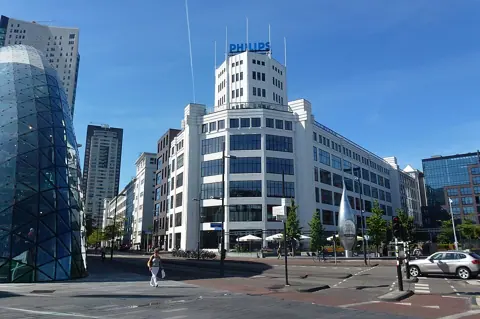
Eindhoven doesn't look like the centre of the global semiconductor industry, and that's part of the point: the company that matters most here, ASML, builds machines almost nobody outside the industry has heard of, for a product — the photolithography systems that print circuits onto computer chips — that never gets a public showroom. The visible layer of Eindhoven's industrial history belongs to Philips, the company ASML grew out of.
From one lightbulb factory to a whole town's identity
Philips began in Eindhoven in 1891, when Gerard Philips produced the company's first light bulbs in a small factory in the city, according to the Philips Museum's own account of its founding. Over the following century, the company expanded from lighting into radio, X-ray equipment, television and eventually digital healthcare technology, and as it grew, it reshaped the town around it — Eindhoven's population, infrastructure and identity became bound up with being a company town in a way that few other European cities were.
That relationship is why so much of what a visitor can see in Eindhoven today isn't a generic "old town centre" but specifically Philips-shaped: a purpose-built museum, a former industrial complex converted into a design district, and a landmark building that started life as the company's own science museum.
The Philips Museum: where to start
The Philips Museum sits at Emmasingel 31, in the centre of Eindhoven, on the site where Gerard Philips made those first light bulbs. According to the museum's own visitor information, adult admission is €13.50 and includes an audio tour, with reduced pricing for children aged 4–17 (€7, including a "Torch Light" treasure hunt activity), students and CJP cardholders (€7), and free entry for children under 3. The museum also offers free admission on Tuesday afternoons from 15:30 to 17:00, with exceptions during Dutch national school holidays and for groups of ten or more — worth checking against the current school holiday calendar if you're trying to time a free visit.
The museum's own description frames its story as one of continual reinvention: from electric light, through radio and X-ray technology, to television and the "dawn of the digital age," ending with Philips' current focus on healthcare technology. It is a company museum in the direct sense — it tells Philips' own history — but it's also the clearest, most concentrated way to understand why this particular Dutch city became an industrial and technology hub in the first place.
ASML: the company that actually matters most, and why you can't visit it
If Philips explains Eindhoven's past, ASML explains why the region still matters enormously today. ASML began in 1984 as a joint venture between Philips and ASM International, spun off specifically to complete a lithography machine project Philips had been developing in-house, and became an independent, separately listed company a few years later. According to ASML's own site, the company now has more than 44,000 employees worldwide and describes itself as an innovation leader that designs and manufactures the lithography machines used to print the circuit patterns inside modern computer chips — a niche most travellers have never heard of, and yet one where ASML is effectively the sole global supplier of the most advanced machines (extreme ultraviolet, or EUV, lithography systems) required to make the most advanced chips on the market.
This matters for a visitor mainly as context, not as an itinerary item: ASML's headquarters and primary manufacturing site is in Veldhoven, immediately adjacent to Eindhoven, and the company does not run a public museum, visitor centre or factory tour. Its own site lists the Veldhoven site as a research, development and manufacturing hub for staff and business visitors, not a tourist attraction. If a tour operator or website claims to offer an "ASML visit," treat that claim with real skepticism — it is not something the company itself advertises.
Strijp-S: the old factory complex you can actually walk through
What you can walk through is Strijp-S, the large former Philips industrial complex on the edge of Eindhoven's centre. Philips used the site for manufacturing and research for much of the 20th century, and after production wound down, the area was redeveloped into housing, offices, creative studios and public space. Strijp-S's own current promotional material describes new residential development on the site as "inspired by the former Philips site" — an indication that this is a redeveloped urban district built around that industrial heritage, not a preserved factory museum. It's worth a walk for the industrial architecture and the way the area has been repurposed, with the understanding that you're seeing adaptive reuse, not an intact working factory.
The Evoluon: a science museum, closed, then reborn
The Evoluon is Eindhoven's most recognisable single building — a UFO-shaped concrete dome that Philips built in 1966 as a public science museum, according to the Next Nature Museum, which now occupies the site. That original museum closed in 1989, and the building spent decades as a private conference and events venue before reopening to the public in 2022 under a new name and a different mission: the Next Nature Museum, which explores the relationship between humans, nature and technology through exhibitions rather than telling Philips' own company story.
The building marked its 60th anniversary in 2026, with the Next Nature Museum running an anniversary programme to mark it, according to the museum's own site. If you visit expecting a Philips retrospective, adjust your expectations — the exhibits inside are now curated around a broader "future of nature and technology" theme, with the building itself, not its current contents, being the direct link back to Philips.
Putting a visit together
A realistic Eindhoven day built around this history starts at the Philips Museum for the company's origin story, continues to Strijp-S for a sense of the physical scale of Philips' former operations, and — if science-museum content interests you regardless of company branding — ends at the Evoluon. ASML doesn't fit into that itinerary directly; its significance is better understood by learning what it does than by trying to see where it's made.
What this guide does not cover
This article covers Philips' history, ASML's role in the chip industry, and what's physically visitable in Eindhoven. It doesn't cover Eindhoven's design events calendar (such as Dutch Design Week) or general transport from Amsterdam or other Dutch cities, which are separate planning questions.