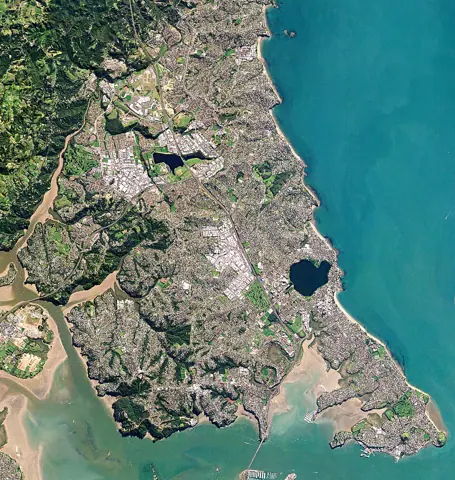
The ferry from Pier 1
The Devonport ferry uses Pier 1 at the Downtown Ferry Terminal, on the harbour side of Quay Street opposite the bottom of Queen Street. Auckland Transport's terminal departure map puts Devonport and Stanley Bay at berth 1B; Bayswater and Birkenhead leave from 1A, a few metres away. Read the berth letter on the gate, not just the pier number.
The published Devonport timetable shows a 12-minute scheduled crossing in both directions. Frequency is half-hourly for most of the day, tightening to every 20 minutes during weekday morning and evening peaks.
First and last sailings differ by day, and Sunday is much shorter at both ends than Saturday.
| Day | First from city | Last from city |
|---|---|---|
| Monday to Thursday | 05:45 | 23:30 |
| Friday | 05:45 | 00:00 |
| Saturday | 06:15 | 00:00 |
| Sunday and public holidays | 07:15 | 22:00 |
Return sailings from Devonport run 15 minutes after each city departure in the off-peak pattern. The last boat back to town is 23:45 Monday to Thursday, 00:30 on Friday and Saturday nights, and 22:15 on Sundays and public holidays.
Paying for the crossing
Three payment methods work on the Devonport ferry, and the cheapest two cost exactly the same. Auckland Transport's ferry fares page lists an adult single to or from central Auckland at NZD 7.80 on an AT HOP card and NZD 7.80 contactless, against NZD 12 in cash. Children aged 5 to 15 pay NZD 4.69 on HOP or NZD 7 cash.
Contactless means a Visa, Mastercard, American Express or UnionPay card, or Apple Pay, Google Pay or Samsung Pay. Tag on and tag off with the same card or device every time, or you risk a default fare.
An AT HOP card costs NZD 5 plus a minimum NZD 1 top-up, and vending machines including the ones at Auckland Airport sell it as a NZD 25 pack with NZD 20 of credit loaded. Concessions — child, student, SuperGold, Community Connect, accessible — exist only on a registered HOP card, never on a contactless bank card.
There is also a same-day day-trip ticket at NZD 23 for adults and NZD 13 for children, sold at the ticket machines and the customer service centre inside the Downtown terminal. It only beats two singles if you are also using the ferry for something else that day, so most half-day visitors should skip it.
Ferry fares versus bus fares
Ferry fares in Auckland are priced by harbour band, not by the numbered zones used for buses and trains. Devonport sits in the inner harbour band alongside Bayswater, Birkenhead and Te Onewa Northcote Point. Buses and trains instead use nine fare zones, where an adult pays NZD 3.00 for one zone, NZD 4.90 for two and NZD 6.50 for three on HOP or contactless.
Cash is not accepted on Auckland buses at all — not coins, not EFTPOS. If you arrive at Devonport wharf without a card and want a bus, you have no way to pay the driver directly, so sort your payment method before you cross.
Buses that continue the ferry fare
A bus taken straight after the ferry is usually free, because of how Auckland Transport prices transfers. The rule on the fare zones page is that ferry fares include bus and train travel within the same zone as the start and end of the ferry route, and AT's own worked example is a Devonport ferry passenger continuing by train to Newmarket for the ferry fare alone.
To qualify you must use the same card or device throughout, tag off and tag on within 30 minutes of each other, and finish the whole journey within 4 hours.
Routes 806, 807 and 814 serve Devonport wharf. The 814 runs to Akoranga Station via Takapuna, which makes Takapuna the easy add-on to a Devonport morning: AT's fare zone map places Devonport and Takapuna in the same Lower North Shore zone, so the transfer should carry no extra charge. Confirm the exact price for your trip in AT Journey Planner before you rely on it.
Walking from Devonport wharf
Everything worth doing on a half-day in Devonport starts at the terminal door and needs no vehicle. The village itself is immediately in front of you: Victoria Road runs uphill from the wharf, and the cafés, bookshops and the Devonport Museum sit within about five minutes on the flat.
Two volcanic cones and a beach are the reason to keep walking. Auckland Council publishes measured routes for both maunga, and neither is a mountain day.
- Takarunga / Mount Victoria — the Mt Victoria path is 2.7 km and about 40 minutes return from King Edward Parade, climbing a summit the Tūpuna Maunga Authority records at 66 metres. Sealed road most of the way, and closed to private vehicles, so it is a steady walk rather than a scramble.
- Maungauika / North Head — the North Head path is 1.8 km and about 40 minutes from Cheltenham Road, which is itself a 15-minute walk from the ferry terminal. Auckland Council rates it manageable with a pram if you follow the old sealed road, though there is a steep section and a stair descent if you want it.
- Cheltenham Beach — the beach path connects to Cheltenham Road on the same side of the peninsula, so it slots into the North Head walk rather than being a separate trip.
- Torpedo Bay — the shoreline between Devonport wharf and the base of Maungauika is flat, sealed and about the same distance as the road route.
Gate hours matter if you plan to be up top late. Maungauika's pedestrian gate runs 6am to 10pm; Takarunga's main entrance gate is 7am to 8.30pm in summer and 7am to 7pm in winter, aligned to daylight saving.
Reaching Takapuna and the busway
The Northern Busway is a separate way onto the North Shore that does not involve the ferry at all. Its two express routes, NX1 to Albany and NX2 to the universities, both leave from the city centre and both meet Auckland Transport's frequent network promise of at least every 15 minutes from 7am to 7pm, seven days. NX1 continues to Hibiscus Coast Station every 30 minutes until 11pm.
Takapuna is not on the busway itself. Route 82 runs between Milford and the city universities via Takapuna, route 83 links Takapuna to the busway and Albany, and route 94 connects Beach Haven to Takapuna.
Bikes, Bayswater and Birkenhead
Bikes travel free on the Devonport ferry with any fare-paying passenger, subject to space on board. Auckland Transport asks you to wheel the bike on and use the racks or hooks, and requires e-bikes and e-scooters to be stored on the back deck rather than inside the cabin because of their batteries.
Buses are far stricter. Full-size bicycles and non-collapsible scooters are barred from every AT bus except NX1 services fitted with front racks, part of an ongoing trial, and the bike must be under 1.9 metres. Folding bikes within 82 x 69 x 39 cm can go on any bus at any time.
Two other inner-harbour crossings reach the Shore for the same NZD 7.80 adult fare. Bayswater lands beside a marina with bus 801 to Takapuna and Akoranga, and Birkenhead lands at the end of Hinemoa Street with bus 917 to Albany. Both are quieter than Devonport and neither has Devonport's concentration of things to walk to, so they suit a return leg or a different view rather than a first visit.
Before you tag on
Check live departures in AT Journey Planner or the AT Mobile app on the morning you travel, and check the AT ferry status page if it is windy — the Devonport crossing is exposed and cancellations are published there.
Two dated items are worth knowing. The City Rail Link opens on 13 September 2026 and brings bus timetable changes in east, west, south and central Auckland; Auckland Transport's notice does not list North Shore routes and does not mention ferries. Separately, AT has announced a renewal of the Devonport wharf with construction due to begin in December 2026, closing Pier 2 and the terminal waiting area in stages while Pier 1 stays open, with a temporary waiting room in place.
Fares and sailing times quoted here were read on Auckland Transport's own pages on 7 September 2026. Treat them as a planning figure and confirm the current number before you pay.