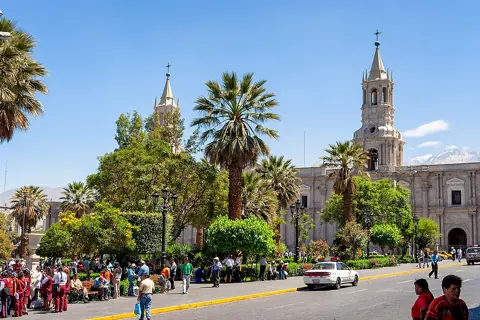
Ingemmet traces Arequipa's building stone to one eruption sequence from a volcano older than Misti and Chachani, whose deposits now cover more than 600 square kilometres around the city. That single fact explains most of what a visitor sees in the centre: the white arches, the unusually thick walls and the carved facades are all worked in this one local volcanic rock. Colca, three hours north, is the same volcanic story told at landscape scale.
What is sillar, and why is Arequipa white?
Sillar is the local name for the rock geologists call the Ignimbrita Aeropuerto de Arequipa. In Ingemmet's March 2021 explanation, it formed about 1.65 million years ago from explosive eruptions that threw out pumice, ash and crystals; the collapse of the emptied magma chamber left a caldera, and water later cut ravines such as Añashuayco, Culebrillas and Chullo through the deposit.
The eruptions left two layers you can learn to tell apart:
| Unit | What Ingemmet describes | What it means on a building |
|---|---|---|
| White ignimbrite | Well solidified, forms vertical walls | The pale stone of the classic "Ciudad Blanca" facades |
| Pink or salmon ignimbrite | Less compact, sits above the white layer | The warmer-toned blocks mixed into some walls |
UNESCO's description of the Historical Centre of Arequipa also calls the rock "white or pink". Ingemmet says most quarries lie near Rodríguez Ballón airport, across districts including Yura, Cerro Colorado and Cayma, and that it works on a geoheritage project promoting geotourism in the Añashuayco quarries. We did not find an official page with visiting hours or prices for the quarries, so book any quarry visit through an operator and ask what it includes.
Why the buildings look the way they do
UNESCO inscribed the centre in 2000 under criteria (i) and (iv), for 166.52 hectares, and it gives the reason in terms of people rather than style labels: the city mixes European and native building techniques, "expressed in the admirable work of colonial masters and Criollo and Indian masons". The features it lists are robust walls, archways and vaults, courtyards and open spaces, and Baroque decoration carved into the facades.
Earthquakes are the other half of the story. UNESCO notes that the site is exposed to seismic and low-intensity volcanic activity, that it evolved through five architectural periods, and that buildings were "repaired many times and rebuilt" without losing their layout or ornament. When a facade looks newer than its date, that is often why.
Arequipa was founded in 1540, according to PromPerú's Arequipa page, which counts more than 500 colonial mansions. Its historic centre page singles out the Jesuit church of La Compañía as colonial Baroque and puts the city at 2,331 m above sea level.
Santa Catalina: a walled sillar complex
The Monasterio de Santa Catalina, founded in 1579, covers 20,000 square metres of sillar architecture. Its hours and prices page lists daily opening from 09:00 to 17:00, extended to 20:00 on Tuesday and Wednesday, when ticket sales and last entry end at 19:00. A foreign adult pays S/50, foreigners aged 7 to 18 pay S/30, and children under 7 enter free with an adult. The monastery estimates one hour with a guide or 1.5 to 2 hours on your own.
The same page advertises S/20 adult tickets on the 10th of each month and the last Sunday of each month, except in the Fiestas Patrias week, but labels this a promotional day for Peruvians, so foreign visitors should not plan around it.
How does the Colca tourist ticket work?
Autocolca sells a single boleto turístico under Laws 24521 and 28537 and Regional Ordinance 141-Arequipa. Its ticket page sets these rates:
| Visitor | Price |
|---|---|
| Foreign adult | S/70 |
| Foreign child, 6 to 15 | S/20 |
| Peruvian adult | S/20 |
| Foreign resident in Peru | S/20 |
The ticket covers the Colca valley in Caylloma (20 districts including Chivay, Yanque and Cabanaconde), the Salinas y Aguada Blanca National Reserve and the Valley of the Volcanoes in Castilla province. It is valid from the day of purchase, can be used once, and gives only the right to visit: no guide, no transport. Carry it with your passport, because Autocolca requires both.
There are three ways to buy it:
- Online, choosing a visit date on Autocolca's electronic ticket page, which Autocolca links from its information portal.
- At the tourist information office at Portal de la Municipalidad 112, Monday to Friday, 08:00 to 15:45.
- At the interpretation centre and ticket control at the entrance to Chivay, every day from 05:00 to 18:00.
A common assumption is that a Colca tour price covers everything. Because the boleto is a separate public fee, ask any operator whether the S/70 is in the quote or collected on the road.
Colca as a day trip or overnight?
PromPerú's English Colca page gives 151 km and 3 hours by bus from Arequipa to Chivay, then 42 km and 1 hour to the Cruz del Cóndor lookout; its Spanish page gives about 3 hours 30 minutes for the first leg. Both describe condors as an early-morning sight.
Add the legs and a same-day visit from Arequipa means roughly 4 to 4.5 hours each way to the lookout, 8 to 9 hours on the road, with a pre-dawn start if you want the morning flights. Sleeping in the valley cuts the lookout run to about an hour and leaves time for villages such as Yanque and Coporaque or the La Calera thermal baths, which PromPerú names.
Altitude is the other variable. PromPerú puts Chivay at 3,200 m, about 870 m above Arequipa's 2,331 m. The CDC's Yellow Book guidance treats about 2,450 m as the level where altitude illness becomes a risk and, once above 3,000 m, advises raising sleeping elevation by no more than 500 m per night. Headache is the main symptom, usually with fatigue, dizziness, nausea or poor appetite, starting 2 to 12 hours after arrival.
| Option | Suits | Trade-off |
|---|---|---|
| Same day from Arequipa | Tight schedules; travellers who sleep better lower down | Long road day; early start for condors |
| One night in Chivay or nearby | Most visitors; condor mornings without a 03:00 departure | First night at 3,200 m after a single-day climb |
| Two nights or more | Walkers, families, visitors who want the villages | More time and lodging cost |
If you arrive in Arequipa by air from sea level and feel headache or breathlessness on the first evening, give it another night in the city before booking Colca; if you feel fine, the overnight tour with an early lookout visit is the stronger choice, and buying the dated e-ticket in advance removes one stop at the Chivay control point.