Warsaw's Old Town Square looks like it has stood for five or six centuries, with narrow gabled townhouses in ochre, pink and grey ringing a cobbled square. Almost none of what you are looking at is that old. The buildings were rebuilt after the district was destroyed during the Second World War, and the reconstruction is precise enough that most visitors never notice.
What actually happened in 1944
Warsaw's Old Town has a documented history stretching back roughly 700 years, according to Poland's official tourism board, but the Second World War changed the district completely. The tourism board's own account is direct about this: the area "was completely destroyed during World War II," and the wider devastation of the city followed the 1944 Warsaw Uprising, a 63-day armed struggle by Warsaw's residents against the occupying German forces. In its aftermath, large parts of the city, including the historic centre, were systematically demolished.
The Museum of Warsaw's account of one specific building group gives a concrete sense of the timeline involved: a set of townhouses on what is known as Dekert's Side of the Old Town Square, which the city had been converting into a museum before the war interrupted the project, were "destroyed during the Warsaw Uprising" and then "rebuilt in 1947-1953," with the museum's first exhibition inside them opening in 1955. That single documented case — destruction in 1944, rebuilding stretching across most of a decade afterward — is representative of what happened across the wider Old Town.
How the rebuilding actually worked
Rebuilding a destroyed historic district from nothing required more than good intentions; it required source material. According to Poland's tourism board, the reconstruction relied in part on 18th-century paintings of Warsaw by the Venetian painter Bernardo Bellotto, commonly known by his uncle's nickname, Canaletto, who had worked in Warsaw and painted the city's streets and squares with enough architectural detail that his canvases could later serve as a reference for rebuilding facades. Combined with surviving architectural plans and photographs, this let the postwar reconstruction aim for a close match to the prewar appearance of the square rather than a free reinterpretation.
This does not mean the square is a stage set with nothing genuine underneath it. Cellars, foundations and occasional structural elements from the pre-war buildings survived in places and were incorporated into the reconstruction where possible. What you are seeing is closer to a careful, historically documented restoration of a destroyed original than either a surviving medieval townscape or an invented one.
Reading the district as you walk through it
Knowing the reconstruction context changes how a few specific things in the Old Town read. The Royal Castle, at the southern edge of the Old Town Square, was rebuilt after the same wartime destruction and today holds royal apartments along with paintings by Rembrandt and canvases by Canaletto himself — the same painter whose earlier work helped guide the reconstruction of the square outside its walls. St John's Cathedral, a short walk from the square, is a Gothic building that suffered the same fate and postwar rebuilding as its neighbours, and still holds the tombs of the last Dukes of Mazovia and memorial plaques to Polish patriots and statesmen predating the war by centuries, carried through the destruction and reconstruction as commemorative objects even where the surrounding stonework did not survive.
The Museum of Warsaw itself, spread across eleven historic tenement buildings around the Old Town Square, tells this specific story in more depth, including a dedicated exhibition on the history of the Old Town houses that walks through what stood on the site before the war, what was lost, and how the postwar reconstruction proceeded building by building.
Beyond the Old Town: how the destruction shaped the wider city
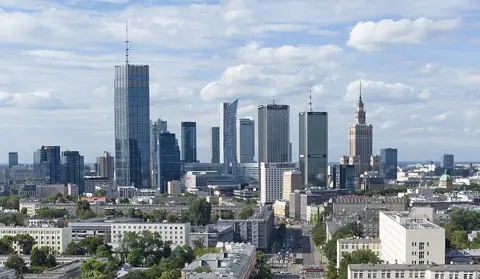
The 1944 Uprising and its aftermath did not stop at the medieval core. Poland's tourism board notes that after the war, large sections of Warsaw were rebuilt in a socialist-realist architectural style rather than reconstructed to match their prewar appearance — the Palace of Culture and Science and the MDM development around Konstytucji Square are the clearest examples, along with the Muranów residential district, which was built directly on the ruins of the former Warsaw Ghetto. That contrast is part of what makes the Old Town's approach distinctive: elsewhere in the city, planners chose to build something new on the ruins; in the historic centre, they chose to rebuild what had been lost as closely as the evidence allowed.
The eastern, right-bank side of the Vistula River, known as Praga, tells almost the opposite story: it was largely spared the wartime destruction that levelled the left bank, which is why its streets, courtyards and building stock are often described as the most architecturally authentic surviving fabric in the city, in direct contrast to the reconstructed Old Town on the other side of the river.
Before you plan your walk
This guide covers the history behind the Old Town's rebuilt appearance. It does not cover current opening hours, ticket prices or booking details for the Royal Castle, St John's Cathedral, or the Museum of Warsaw's branches — check each institution's own site closer to your visit, since hours and admission arrangements change by season.