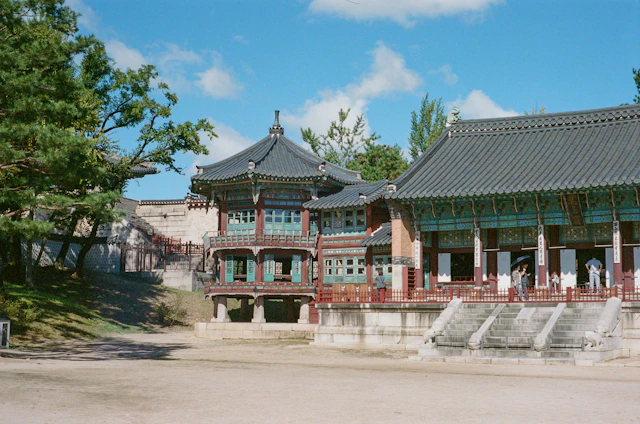
Hanbok free entry is not a rental-shop promotion, and it does not cover every ticket inside a palace. It is a government admission rule that has been in place since October 2013, and the official fee page does not extend it to the separately charged Changdeokgung Secret Garden tour.
This guide explains where the rule came from, how the official guideline defines hanbok, what each palace charges and when it closes, and where wearing hanbok changes nothing. Everything comes from the Royal Palaces and Tombs Center of the national heritage agency, government press releases, Korea.net and the national and Seoul tourism boards. Where only a newspaper reports something, the text says so.
Where the free-entry rule came from
The free-entry rule is a heritage policy, not a tourism discount. A 2019 press release from the Cultural Heritage Administration's palace division, republished on the government's Korea Policy Briefing site, says the agency began free admission for hanbok wearers at palaces and royal tombs "지난 2013년 10월부터" (from October 2013).
The same release gives the reason in four words: the policy exists for the "대중화·생활화·세계화·활성화" of hanbok, meaning popularising it, making it part of daily life, spreading it abroad and reviving it. The palace is the setting; the stated aim is the dress itself.
A 2024 policy article from the renamed agency, 국가유산청, repeats the scope: since 2013 it has offered free admission to hanbok wearers visiting the four main palaces, Jongmyo shrine and the Joseon royal tombs. The same article notes that "hanbok life" (한복생활) was designated a national intangible cultural heritage in 2022.
The agency's name changed along the way. Korea.net reported in February 2024 that the Cultural Heritage Administration would be renamed from 17 May 2024, and later government releases use 국가유산청. The palaces are run day to day by its Royal Palaces and Tombs Center, which publishes the fee, hours and hanbok pages this guide relies on.
The rule has one well-documented revision. Under the first guideline, men had to wear men's hanbok and women women's hanbok to enter free; the 2019 release says concerns were raised that this could infringe human rights, and the National Human Rights Commission recommended a change in May 2019.
The agency then deleted what it called gender-stereotyped rules for "masculine" and "feminine" hanbok. From 1 July 2019, a visitor wearing a hanbok cut for the other sex also enters free, which the release frames as respecting social diversity and freedom of expression.
You may read elsewhere that the gender change came in 2018. The official release that announced it is dated 26 June 2019 and names 1 July 2019 as the start date, so the official record does not support an earlier date.
How popular the rule has become is not something the official pages read for this guide publish. A May 2026 report in The Asia Business Daily, a newspaper rather than an official source, says roughly 300,000 to 400,000 people a year entered free in hanbok when the policy began and that the figure passed 2 million last year.
What counts as hanbok at the gate
The official test is simple: an upper garment plus a lower garment. The Royal Palaces and Tombs Center's English guideline says "Both traditional Hanbok and modernized Hanbok are eligible for free admission" and that "The basic requirement is to wear both an upper garment (jeogori) and a lower garment (skirt or pants)."
An overcoat on its own does not count. The guideline states that "Simply wearing an overcoat (durumagi) is not recognized as Hanbok form; both upper and lower garments must be worn." The 2019 Korean release gives the same example, saying a visitor who has only thrown on a 두루마기 is not treated as wearing hanbok.
The upper garment has to be worn closed. The guideline says "All upper garment (jeogori) ribbon knots(goreum) and buttons should be fastened or tied at all times" and adds, in brackets, that T-shirt-type hanbok is not allowed.
The lower garment has to cover your legs. The rule is that "All types of lower garments (skirt or pants) should cover the legs", and that any hanbok skirt "must be worn with a separate upper garment(jeogori) at all times."
Half an outfit fails. The guideline's own examples are a jeogori with jeans, and a hanbok skirt or trousers with a T-shirt; both "cannot be entitled to free admission." Staff also reserve "the right to refuse entry to any individuals dressed inappropriately or who misbehave."
The table below decodes the garment words you will meet on the guideline and at rental counters. Prices are marked honestly: the heritage agency publishes no rental prices, and the only figures come from the two tourism boards.
| Name | Local name | What it is | Price range |
|---|---|---|---|
| Jeogori | 저고리 | Upper garment; ties and buttons must be fastened | Not published |
| Chima | 치마 | Skirt; must be worn with a separate jeogori and cover the legs | Not published |
| Baji | 바지 | Trousers; must cover the legs | Not published |
| Durumagi | 두루마기 | Overcoat; does not count on its own | Not published |
| Goreum | Not given in the source | Ribbon ties on the jeogori; must be tied | Not published |
| Modernized hanbok | Not given in the source | Contemporary cut; eligible if worn as a full outfit | Not published |
| Rental outfit, about 4 hours | Not given in the source | Rental with hair accessories and purse, per VisitSeoul | 15,000–20,000 won |
| Insa-dong PR Center try-on | Not given in the source | Reservation-only hanbok experience, one outfit per person | 3,000 won |
| Deoksugung gate try-on | Not given in the source | Five-minute Sunday photo outfit; cannot enter the palace | Free |
Two cautions apply to that table. The 15,000–20,000 won rental range comes from a VisitSeoul page first published in 2016; the page was edited in September 2026 and carries a note that information may change, so treat the range as the tourism board's figure rather than a current price list.
The free try-on at Deoksugung's Daehanmun gate is not a way in. VISITKOREA says participants must stay near the gate and that "entering the palace in free hanbok is not allowed."
A newspaper adds detail the official English page does not. The Asia Business Daily report says the agency expects an overlapping collar and identifiable separate top and bottom, and that one-piece dresses or outerwear alone do not qualify. That is a press report; the guideline text quoted above is the version to rely on at the gate.
Palace fees and who already enters free
Hanbok matters most for one group: foreign adults aged 19 to 64. The Royal Palaces and Tombs Center fee page lists as free "만 18세 이하 및 만 65세 이상 외국인", foreigners aged 18 or under or 65 or over, so a teenager or a senior on a foreign passport pays nothing with or without hanbok.
That under-19 rule is recent. Korea.net reported on 31 March 2023 that from 1 April 2023 foreign nationals aged 18 or under could enter the leading palaces and tombs free, "up from age 6." For Korean nationals, the free age band is 24 or under and 65 or over, with ID.
Adult fees are low. The fee page sets Gyeongbokgung at 3,000 won and the Changdeokgung palace buildings at 3,000 won, with groups of 10 or more paying 2,400 won; Changgyeonggung and Deoksugung cost 1,000 won, and Jongmyo 1,000 won.
So for a foreign adult, hanbok saves 3,000 won at the two larger palaces and 1,000 won at the others. Visiting all four palaces and Jongmyo separately would cost 9,000 won at those rates, while the fee page also sells a combined palace ticket for 6,000 won that covers the four palaces and Jongmyo but not the Secret Garden.
Everyone enters free once a month. The fee page lists "매월 마지막 수요일 '문화가 있는 날'", the last Wednesday of each month, as a free day for all visitors, again with the Secret Garden excluded.
The fee page also lists free entry for people on official duty and for registered disabled visitors, with one companion for a severely disabled visitor. It adds that anyone claiming free admission must show the relevant proof, and that discounts do not stack.
Closing days and opening hours
Closing days split into a Monday group and a Tuesday group. The Royal Palaces and Tombs Center hours page lists "월요일: 창덕궁, 덕수궁, 창경궁, 조선왕릉, 숭례문" and "화요일: 경복궁, 종묘, 칠궁(육상궁)".
The same page notes that when a closing day falls on a public holiday, the closure moves to the next weekday that is not a holiday. Check the date before you plan a holiday-week visit around a single palace.
Hours change with the season at the two larger palaces. Gyeongbokgung opens 09:00–17:00 in January, February, November and December; 09:00–18:00 from March to May and in September and October; and 09:00–18:30 from June to August, with last entry an hour before closing each time.
Changdeokgung runs 09:00–18:00 from February to May and in September and October, 09:00–18:30 from June to August, and 09:00–17:30 from November to January, again with last entry an hour earlier. Deoksugung and Changgyeonggung stay open from 09:00 to 21:00 all year, with last entry at 20:00.
Jongmyo works differently from the palaces. On Mondays, Wednesdays, Thursdays and Fridays it admits visitors only on timed tours with a guide, lasting about 50 minutes, with 200 places per slot split between 100 online and 100 on-site; on Saturdays, Sundays and public holidays it opens for free viewing from 09:00 to 18:00, adjusted by season.
Hanbok does not change how Jongmyo works on a weekday. The 2024 policy article lists Jongmyo among the sites where hanbok wearers enter free, but the hours page still sends weekday visitors through a timed guided tour, so plan a hanbok visit there for a Saturday, Sunday or public holiday if you want to walk around at your own pace.
The Joseon royal tombs are covered by the same policy. The fee page lists most Joseon royal tombs at 1,000 won for adults, and the 2024 policy article names the tombs alongside the palaces and Jongmyo in the hanbok policy.
The table below puts the fee, closing day and hanbok status side by side. Hours shown are for September and October, the period this guide was checked in.
| Site | Adult foreign fee | Closed | Sept–Oct hours | Free in hanbok? |
|---|---|---|---|---|
| Gyeongbokgung 경복궁 | 3,000 won | Tuesday | 09:00–18:00, last entry 17:00 | Yes |
| Changdeokgung 창덕궁 buildings | 3,000 won | Monday | 09:00–18:00, last entry 17:00 | Yes |
| Changdeokgung Secret Garden 후원 | 5,000 won | Monday | Timed tours | No |
| Changgyeonggung 창경궁 | 1,000 won | Monday | 09:00–21:00, last entry 20:00 | Yes |
| Deoksugung 덕수궁 | 1,000 won | Monday | 09:00–21:00, last entry 20:00 | Yes |
| Jongmyo 종묘 | 1,000 won | Tuesday | Guided on weekdays; free viewing weekends | Yes |
If Gyeongbokgung is your main target, remember that it shuts on Tuesday while the other three palaces are open. A neighbourhood-by-neighbourhood route through the old city is set out in our three-day Seoul itinerary, which you can reorder around these closing days.
Where hanbok does not help
The Changdeokgung Secret Garden is the clearest exception. The fee page charges 5,000 won for visitors aged 19 to 64 and also 5,000 won for those 65 and over, with 2,500 won for ages 7 to 18, and it lists the only free Secret Garden visitors as "만6세 이하, 유공자(내국인), 장애인(내국인)", meaning children 6 and under and Korean nationals who are national merit recipients or registered disabled.
Hanbok wearers are not on that list, and neither are foreign seniors. The fee page also says the Secret Garden has no group discount and that Secret Garden visitors must also buy a ticket for the palace buildings. The page does not spell out how that second rule applies to someone already entering the palace free in hanbok, so ask at the ticket office.
Places are limited as well as paid. The hours page gives Korean-language Secret Garden tours on the hour from 10:00, finishing with a 15:00 start from November to February and a 16:00 start from March to October, and caps each Secret Garden session at 100 people, 50 booked online and 50 sold on site; foreign-language tours run at fixed times.
Separately ticketed places inside palace grounds are another exception. The fee page says visitors to the art museum inside Deoksugung must buy a Deoksugung ticket and a separate museum ticket, and the page does not say whether hanbok covers the museum ticket.
Some sites need no hanbok at all. The fee page lists Sungnyemun, Sajikdan and Chilgung among places with no admission fee, so the outfit makes no difference there either.
Seoul's fifth palace is a grey area. VisitSeoul lists Gyeonghuigung alongside the four heritage-agency palaces and says "All five palaces waive admission fees for visitors wearing hanbok", while VISITKOREA speaks only of "The four main palaces in Seoul". Gyeonghuigung is not on the heritage agency's fee page, and this guide could not open its operator's page to confirm its admission terms.
How to plan a hanbok palace day
A hanbok palace day works best when you check three things before you rent. The steps below use only the rules on the official pages and the tourism boards' rental information.
Rental location is a matter of convenience rather than rules. VisitSeoul says the Eulji-ro Underground Shopping Center near Myeong-dong and Jongno has several shops that rent hanbok at fixed rates and times, and that rentals include hair accessories and a purse; VISITKOREA says rental shops near the palaces offer traditional and contemporary designs.
For a cheaper try-on without a palace visit, VISITKOREA lists the Insa-dong PR Center's hanbok experience at 3,000 won, by reservation only, with sessions from 10:00 to 12:00 and 13:00 to 17:30, last fitting at 17:00. Its page was last updated on 29 October 2025.
Large groups have one more rule. VisitSeoul notes that groups of 35 or more visiting Gyeongbokgung, Changdeokgung, Changgyeonggung or Deoksugung must apply for group entry on the relevant palace site 15 days ahead, a rule in force since 1 January 2014.
Getting between palaces is easiest on the subway, and the fare card works the same whether you wear hanbok or not. Our guide on how to use a T-money card covers topping up and tapping in.
The agency itself frames the policy around the dress, not the discount. The Asia Business Daily quotes a palace official as saying the purpose of wearing hanbok "should not be solely for free admission, but to promote the value of hanbok"; that quotation comes from the newspaper, not from an official page read for this guide.
What this guide does not cover
Gyeonghuigung's admission terms are not confirmed here. It is run outside the heritage agency's palace system, and the operator pages tried for this guide returned errors, so this guide does not say whether it charges or whether hanbok changes anything there.
Night openings and special events are not covered. No official page read for this guide states whether hanbok wearers enter separately ticketed evening events free, so check each event's own booking page.
The Korean-language version of the hanbok guideline could not be opened; the rules quoted above come from the official English page and the 2019 Korean press release. The National Human Rights Commission's own 2019 release also failed to load, so its recommendation is described only as the heritage agency reported it.
Visitor numbers for hanbok wearers come only from a newspaper report. No official count was found on the pages read, and the guideline's age of publication is not stated on the English page.
Rental prices change by shop, and no official body publishes a price list. The only figures here are the two tourism boards' ranges, one of which dates from a 2016 page. If a day trip beyond the palaces is also on your list, our comparison of Seoul day-trip options covers that separately.