The name "Tha Phae Walking Street" suggests Tha Phae Road, but the Sunday market has not been held there since 2004. Chiang Mai City Municipality moved it inside the gate to Ratchadamnoen Road while it put Tha Phae Road's utility cables underground, and the municipality's 2020 description still places the market there.
The Saturday market is a separate event on a different street, with its own speciality. This guide explains how both work, using the municipality's own history and information page, the provincial tourism office's page and the municipality's recent news, all read on 23 September 2026.
Where the Sunday market really runs
The Sunday market, ถนนคนเดินท่าแพ (Tha Phae Walking Street), is laid out on two streets that cross in the middle of the moated old city. Chiang Mai City Municipality says it runs on ถนนราชดำเนิน (Ratchadamnoen Road) and ถนนพระปกเกล้า (Phra Pokklao Road), which meet in a cross shape at the old city's central junction, สี่แยกกลางเวียง.
The main arm starts at ประตูท่าแพ (Tha Phae Gate) and runs along Ratchadamnoen Road, which lies directly behind the gate, as far as Wat Phra Singh. Phra Pokklao Road crosses it at the central junction, so the market takes a cross shape rather than one straight line.
The municipality gives the Ratchadamnoen section a length of about 1.5 kilometres. It does not publish how far the market extends along Phra Pokklao Road, and no official map could be extracted from its walking-street map page.
Every Saturday and Sunday, the municipality says, it closes part of the roads so that local people can bring handicrafts to sell. That is the whole of the official description of the road closures: no start time for the closure, no list of closed side streets and no diversion map was found.
The municipality also notes that Chiang Mai has many walking streets, selling mostly souvenirs, clothes, food and local products. The Sunday and Saturday markets are the two it describes in detail.
Tha Phae Road itself, outside the gate, is not part of the market in either official description. If you arrive along it, the stalls begin once you pass through Tha Phae Gate into Ratchadamnoen Road.
The municipality calls the Sunday market the best-known and largest of Chiang Mai's walking streets. The provincial tourism office goes further, describing the stretch from Tha Phae Gate along Ratchadamnoen Road as a walking street that "ที่เรียกได้ว่ามีขนาดใหญ่ที่สุดของเมืองไทย", that could be called the largest in Thailand.
Neither claim comes with a measurement. No official source read for this guide counts stalls or visitors, or compares the market with walking streets elsewhere, so "largest" is the tourism office's description rather than a published figure.
Both official descriptions give the same opening hours, "ประมาณ 17.00 - 22.00 น." (about 17:00 to 22:00), on Sundays only. The word "about" matters, because the municipality's own history gives different hours, as the next section explains.
From ten Sundays to a weekly fixture
The market began as a short-run promotion, not a municipal service. According to the municipality's history, posted on its website on 7 December 2020, Thailand's walking-street idea started on Silom Road in Bangkok, as a seven-week prototype for a national "walking street" project.
The municipality's page explains why the idea spread. It says the government concluded that walking streets fitted urban development plans for big regional cities and could be adapted to local needs, promoting tourism, stimulating the community economy and improving quality of life for city residents.
Chiang Mai's first phase ran every Sunday from 3 February to 7 April 2002, ten events in all, under the name "10 มหัศจรรย์ล้านนาที่ท่าแพ" (Ten Lanna Wonders at Tha Phae). The municipality says it was run by a company, บริษัทเจ เอส แอล.
When that series ended, Chiang Mai province gave the job to the municipality. From Sunday 14 April 2002 the municipality ran the market every week, from 13:00 to 22:00, and municipal news items from 2025 and 2026 show it still manages the market.
The move came two years later. The municipality says it was about to move the utility cables on Tha Phae Road underground, so from 31 August 2004 it moved the walking street to Ratchadamnoen Road, set up a performance area at the Three Kings Monument plaza (ลานอนุสาวรีย์สามกษัตริย์), and changed the hours to 15:00 to 22:00. The market kept its old name, ถนนคนเดินท่าแพ, after the move, and both official pages still use it.
The same page then describes the market as running at about 17:00 to 22:00. The page does not explain the difference, and no newer official timetable was found.
| Date | What changed | Source |
|---|---|---|
| 3 Feb–7 Apr 2002 | Ten Sunday events at Tha Phae, run by a company | Municipality history |
| 14 Apr 2002 | Municipality takes over; weekly, 13:00–22:00 | Municipality history |
| 31 Aug 2004 | Moves to Ratchadamnoen Road, about 1.5 km; 15:00–22:00 | Municipality history |
| 11 Dec 2012 | Provincial tourism office lists about 17:00–22:00 | Provincial tourism office |
| 7 Dec 2020 | Municipality page lists about 17:00–22:00 | Municipality information page |
| 6 May 2026 | Walking Street Committee reviews each zone's problems | Municipality news |
The market is managed zone by zone. On 6 May 2026 the municipality reported that Deputy Mayor Photjana Srisilpanan had chaired the monthly meeting of the Chiang Mai Walking Street Committee, attended by committee members from each zone, "เพื่อทบทวนและแก้ไขปัญหาของแต่ละโซน", to review and fix the problems of each zone. The meeting, held in meeting room 1 of building 5 at the municipal offices, also brought in a deputy municipal clerk and the officials responsible.
Safety is part of that management. In August 2025 the municipality reported a visit to the Tha Phae Walking Street by an assistant minister of tourism and sports, Chakkaphon Tangsutthitham, with municipal officials, to follow up on safety measures at tourist sites and hear the views of local businesses.
The Sunday route, stop by stop
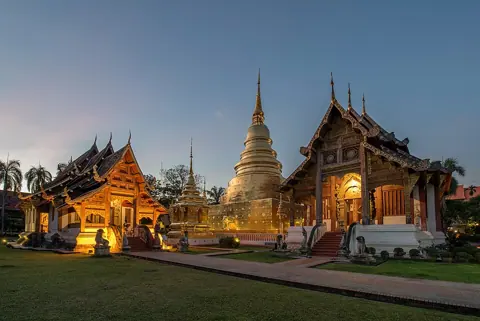
The route passes several temples, and the municipality treats them as part of the market. It names วัดพันอ้น (Wat Phan On), วัดสำเภา (Wat Samphao), วัดพันเตา (Wat Phan Tao), วัดเจดีย์หลวง (Wat Chedi Luang) and Wat Phra Singh, and says temples along the way are decorated with lights and allow selling inside their grounds.
The municipality's list of goods is broad. It includes local products, decorative items and jewellery, clothes, souvenirs, bags, scarves and lamps, along with ordinary fashion goods, and food such as ขนมจีนน้ำเงี้ยว (khanom jeen nam ngiao) or khanom jeen with nam ya sauce, snacks and roti.
The atmosphere is part of the offer. The municipality lists traditional massage booths, portrait artists, live music, cultural performances and busking acts such as living statues, and says some items are one of a kind while some stallholders make their goods by hand in front of you. Its list of highlights for visitors also names the temples along the route as places to stop.
The provincial tourism office's own introduction calls the Sunday market "ดังสวรรค์บนดินของนักชอปปิ้ง", a paradise on earth for shoppers, where you can pick out goods, watch cultural performances and try local food on a street given over to walkers every Sunday.
The provincial tourism office adds a seasonal note, saying the market draws Thai visitors from every region and foreign visitors from Europe and Asia, and that a walk through it is especially pleasant if you come in the cool season.
A 2017 feature on the Tourism Authority of Thailand's newsroom describes the same scene: "Local artists and craftspeople exhibit and sell their work here, and you can buy original fashions, jewellery, silk items and tribal decorations. There are also street performers, and singers." Its advice is to "sit in a nearby cafe and watch the colour and action." The same feature says Chiang Mai town "boasts eateries, galleries and some of Thailand's loveliest temples".
The layout suggests an order for walking it. Starting at Tha Phae Gate and following Ratchadamnoen Road brings you to the central crossroads with Phra Pokklao Road, where you can detour along the cross-arm, and Wat Phra Singh marks the far end of the main arm. The temples and the old city layout are covered in more depth in the guide to Chiang Mai's Lanna heritage.
Wualai on Saturday evening
The Saturday market, ถนนคนเดินวัวลาย (Wualai Walking Street), is on ถนนวัวลาย (Wualai Road), near ประตูเชียงใหม่ (Chiang Mai Gate). The municipality gives the same approximate hours, 17:00 to 22:00, on Saturdays only.
Its character comes from the street itself. The municipality says most of the vendors are local people living around Wualai Road, which is why it is smaller than the Sunday market, and that the road is home to a silverware village that both makes and sells silver.
The municipality's description of what makes Wualai worth visiting is specific. It says the atmosphere is not very different from Ratchadamnoen Road, but that the street's appeal lies in its silverware, silver beating, and a traditional community known for the silver it produces.
Other goods are local products of many kinds, according to the municipality. Neither official source lists food stalls for Wualai separately, and neither gives its length.
| Feature | Sunday: Tha Phae Walking Street | Saturday: Wualai Walking Street |
|---|---|---|
| Street | Ratchadamnoen and Phra Pokklao Roads, inside the moat | Wualai Road, near Chiang Mai Gate |
| Published hours | About 17:00–22:00 | About 17:00–22:00 |
| Size | About 1.5 km on Ratchadamnoen alone; the largest in Chiang Mai | Smaller; vendors mostly local residents |
| Speciality | Wide range of crafts, clothes, food, performances | Silverware from the local silver-making community |
| Temples on the route | Wat Phan On, Wat Samphao, Wat Phan Tao, Wat Chedi Luang, Wat Phra Singh | None named in the sources |
| Parking noted by officials | Around the area; hard to find late | At both ends: by Chiang Mai Gate and on Thipnet Road |
Saturday or Sunday: choosing
If you only have one evening, the official descriptions point to a simple rule. Choose Sunday for range and Saturday for silver: the municipality describes the Sunday market as the biggest, with a broad mix of crafts, clothes, food and performances, and Wualai as smaller, run mostly by residents, with silverware as its particular draw.
Location is the second factor. The Sunday market sits inside the moat, on the old city's main axis, and passes five named temples, so it combines well with an afternoon of temple visits in the old city. Wualai is by Chiang Mai Gate, and the tourism office's parking advice for it is more specific, which may suit visitors arriving by car.
Timing is the same for both on paper: about 17:00 to 22:00. The Sunday market's history also records earlier start times, 13:00 in 2002 and 15:00 from 2004, but neither official page gives a current start earlier than about 17:00.
If you have a full weekend, the two do not clash. Wualai is Saturday only and the Tha Phae Walking Street is Sunday only, according to both the municipality and the provincial tourism office, so you can visit both on consecutive evenings.
Getting there and parking
The provincial tourism office's page covers transport to both markets. It says you can wave down a red songthaew anywhere in Chiang Mai, tell the driver you want the Tha Phae walking street, and pay a fare of about 20 baht.
That fare figure is old. The tourism office's page was published on 11 December 2012, and no newer official fare for the red trucks was found, so treat 20 baht as a historical guide rather than a current price. How the trucks and ride-hailing apps work today is covered in the guide to red trucks, apps and scooters.
For the way back, the same page says tuk-tuks wait at Tha Phae Gate, with the price open to bargaining. It does not give a typical fare, and it does not mention city buses, ride-hailing apps or any shuttle service to either market.
Entry to both markets is free in the sense that no official source mentions any charge; they are public streets closed to traffic. Driving there is possible but awkward. For the Sunday market, the tourism office says you can park around the area, but that if you arrive late you may have to walk some distance because spaces are hard to find.
For Wualai, it says cars can park at the head and the end of the road: beside the road near Chiang Mai Gate and on ถนนทิพย์เนตร (Thipnet Road). No official source gives parking charges.
Payment, prices and what is not published
Payment is a clear gap in the official record. Neither the municipality nor the provincial tourism office says whether stalls accept cards, Thai QR payments or only cash, and no official price list for goods, food or massage at either market was found.
In practice, that means planning for cash. The guide to paying for things in Chiang Mai covers cash and cards in the city.
Stall fees and vendor rules are not public either. The municipality's news confirms that a walking street committee exists and that it works zone by zone, but the committee's rules, stall allocation and any fees charged to vendors were not published on the pages read.
Crowd levels are not measured in any official source read for this guide. The tourism office says the Sunday market draws Thai and foreign visitors, and the municipality calls the markets suitable for children, families, couples, solo travellers and groups, but neither gives visitor numbers or busy times.
The published end time, 22:00, is the only firm limit on the evening. Neither source says what happens when it rains, or whether the markets pause on public holidays or during festivals, so check locally if your visit falls on a major holiday weekend.
| Name | Local name | What it is | Price range |
|---|---|---|---|
| Sunday Walking Street | ถนนคนเดินท่าแพ | Sunday market on Ratchadamnoen and Phra Pokklao Roads | Free entry; no fee stated |
| Wualai Walking Street | ถนนคนเดินวัวลาย | Saturday market on Wualai Road | Free entry; no fee stated |
| Tha Phae Gate | ประตูท่าแพ | Old-city gate at the start of the Sunday market | No fee stated |
| Chiang Mai Gate | ประตูเชียงใหม่ | Old-city gate near the Wualai market | No fee stated |
| Central crossroads | สี่แยกกลางเวียง | Where Ratchadamnoen meets Phra Pokklao | No fee stated |
| Three Kings Monument plaza | ลานอนุสาวรีย์สามกษัตริย์ | Performance area set up in 2004 | No fee stated |
| Wat Phra Singh | วัดพระสิงค์ (municipality's spelling) | Temple at the far end of the Sunday route | No fee stated |
| Wat Chedi Luang | วัดเจดีย์หลวง | Temple on the Sunday route that allows selling in its grounds | No fee stated |
| Thipnet Road | ถนนทิพย์เนตร | Parking spot at one end of the Wualai market | No fee stated |
| Tuk-tuk | Not given in the source | Waits at Tha Phae Gate for rides home | Negotiable; no fare published |
| Khanom jeen nam ngiao | ขนมจีนน้ำเงี้ยว | Food named by the municipality | Not published |
| Silverware | เครื่องเงิน | Wualai's speciality, made on the street | Not published |
| Red songthaew | Not given in the source | Shared red truck to the market | About 20 baht (2012) |
What this guide does not cover
Exact road-closure times, the list of side streets closed and any traffic diversions are not given here, because Chiang Mai City Municipality publishes only that it closes part of the roads on Saturdays and Sundays. The guide also does not include a route map, because the municipality's walking-street map page yielded no usable map or text.
Accessibility is not covered either: neither official source mentions step-free routes, toilets, seating or help for wheelchair users on the market streets, and the guide does not guess at them.
It does not give payment methods, stall prices, massage prices or vendor fees, which no official source publishes, and it does not give visitor numbers or advice on the busiest hour, for the same reason. Chiang Mai's many other walking streets and weekend markets, which the municipality mentions without naming, are outside its scope.
A 2026 municipal news item on keeping order around Tha Phae Gate could not be read because the municipality's website blocked further requests, and a UNESCO Creative Cities page for Chiang Mai could not be found on UNESCO's website, so neither is described.