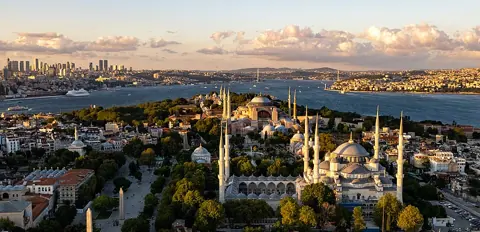
Start by checking which continent your hotel is on
Before booking flights, confirm whether your accommodation is on the European side (the historic peninsula, Beyoğlu, Beşiktaş and most of the well-known tourist districts) or the Asian side (Kadıköy, Üsküdar and neighbouring areas). Istanbul Airport serves the European side more directly; Sabiha Gökçen serves the Asian side more directly. Landing at the airport on the opposite side from your hotel is completely workable — both airports have transport links into the whole city — but it adds a Bosphorus crossing to your transfer, by road bridge, tunnel or ferry, on top of the airport-to-city leg itself.
Istanbul Airport (IST)
Istanbul Airport is the newer, larger airport on the European side, north of the city along the Black Sea coast. According to Istanbul Airport's own transportation section, the airport organises its ground transport into in-city and inter-city categories, covering metro, public bus, taxi, car rental and parking options, alongside live traffic information for travellers timing their own departure. A metro line connects the airport toward the city centre, and HAVAIST operates airport shuttle buses to multiple districts. Because published fares, exact journey times and the current metro line number can change, confirm the specific route, current fare and schedule on the airport's own transportation page before you travel, rather than relying on a fixed number here.
Taxis operate from a marked rank at the terminal. As with any airport taxi rank anywhere, using the official marked queue rather than anyone approaching you inside the terminal is the safer choice.
Sabiha Gökçen (SAW)
Sabiha Gökçen sits on the Asian side of the city, further out from the historic core than Istanbul Airport is from its own side. It's served by its own metro connection and by HAVABUS or HAVAIST shuttle services to central points on both sides of the Bosphorus, plus a taxi rank at the terminal. This guide could not independently verify current specific route numbers, fares or journey times for Sabiha Gökçen's public transport connections from the airport's own materials, so treat any figure you see elsewhere as unconfirmed and check the airport's current transportation page directly, or the İETT public transport authority's site, before you fly.
How İstanbulkart works
İstanbulkart is Istanbul's citywide contactless transit card, intended to work as a single payment method across the metro, tram, public bus (İETT) network and the Şehir Hatları ferries, rather than requiring a separate ticket for each mode. You can typically buy one from vending machines at metro stations and airports and load credit onto it in cash or by card at the same machines. A small non-refundable cost applies to the physical card itself, separate from the transit credit you load onto it — this guide has not confirmed the current card price or per-ride fares, both of which the transit authority updates periodically, so check the balance and fare shown on the machine screen when you buy or top up.
Some airport shuttle services, including certain HAVAIST and HAVABUS routes, may require a separate ticket rather than accepting İstanbulkart directly — check the specific vehicle or route signage, since this varies and this guide cannot confirm a single rule that covers every shuttle line.
Comparing your options into the city
| Option | Best for | Trade-off |
|---|---|---|
| Metro + İstanbulkart | Predictable cost, avoiding traffic | Requires carrying luggage through transfers |
| Airport shuttle bus (HAVAIST/HAVABUS) | Direct routes to specific districts | Less frequent than metro; check current ticketing rules |
| Taxi | Door-to-door, heavy luggage, late arrivals | Highest cost; traffic-dependent travel time |
SIM cards and connectivity on arrival
Both airports have telecom operator counters in the arrivals area where you can buy a local prepaid SIM card, which is often the more practical way to get connected than relying solely on your home carrier's roaming rates. Bring your passport, since Turkish SIM registration requires identification, and be aware that foreign visitors are sometimes limited in how long a tourist SIM remains active on their specific device before requiring re-registration — a detail this guide has not been able to confirm with current specifics, so ask directly at the counter about any device registration limits before buying.
Currency and cash on arrival
ATMs and currency exchange counters are available at both airports if you're arriving without Turkish lira. Exchange rates and fees at airport counters are often less favourable than in the city itself, so exchanging only a small amount for your immediate transport needs — a taxi, a transit card top-up — and doing the bulk of your currency exchange later in the city is a reasonable approach if you have the flexibility to wait.
Before you leave the arrivals hall
Confirm which side of the Bosphorus you're heading to, buy an İstanbulkart if you're taking public transport, and check the specific metro line or shuttle route serving your airport on its own current page rather than an older article, since Istanbul's transit network has expanded in recent years. This guide does not cover transfers to Istanbul's smaller regional airports or connections onward to other Turkish cities.