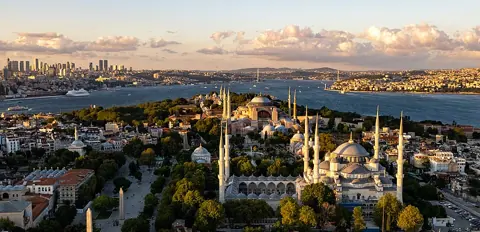
Istanbul is the only city of its size built across two continents, and the water between them is not a symbolic line on a map — it is a working strait that people cross by boat every day the way other cities cross a bridge.
What the Bosphorus actually divides
The Bosphorus is a natural strait connecting the Sea of Marmara to the Black Sea, and the conventional continental boundary between Europe and Asia runs down its centre. Istanbul's western districts, including the old walled city, Beyoğlu and Beşiktaş, sit in Europe. Kadıköy, Üsküdar and the districts stretching toward the airports on that side sit in Asia. This is a geographic convention, not a governed border: there is no checkpoint, no currency change, no separate authority on either bank. It is one municipality, one metro system, one phone network, split by a body of water that happens to also mark where two continents meet by the usual definition.
What the split does change is the shape of daily life. Many residents live on one side and work on the other, which is why the ferries are commuter infrastructure and not a novelty. Traffic on the two Bosphorus road bridges and the Marmaray rail tunnel under the strait can be heavy at peak times, and the ferry remains, for a lot of routes, the fastest and most pleasant way across.
The ferry network as everyday transport
Şehir Hatları is the ferry operator most visitors will use, and it is run under the Istanbul Metropolitan Municipality rather than being a private sightseeing company. Its network covers short Bosphorus crossings — Eminönü to Üsküdar, Karaköy to Kadıköy, Beşiktaş to Üsküdar — along with longer commuter routes up the strait and into the Sea of Marmara, plus a distinct Golden Horn line serving Balat and Eyüpsultan. These boats run on a public timetable, stop at fixed piers, and are used overwhelmingly by commuters rather than tourists, which is exactly why they're worth taking: the fifteen-to-twenty-minute crossing gives you an open-water view of the historic skyline that no bridge or tunnel offers, for the price of an ordinary transit fare.
A separate product, the Bosphorus Tour, is a longer round-trip sightseeing cruise that goes further up the strait toward the second bridge and back, with its own schedule and its own ticket sold at the pier — this is the boat to choose if the point is the ride itself rather than getting somewhere.
Planning your day around a crossing
A crossing takes real time even when the boat ride itself is short. Build in walking time to and from the pier on both ends, and treat the posted departure time as the moment the boat leaves, not the moment to arrive. Commuter ferries on popular routes run frequently through the day but can space out later in the evening, so if your plan for the Asian side depends on getting back to a hotel in Sultanahmet or Beyoğlu at a specific hour, check the return timetable before you commit to dinner across the water.
The road bridges and the Marmaray tunnel are the alternative if the ferry schedule doesn't line up with yours, but neither gives you the same view, and both are subject to Istanbul's often heavy traffic, which the boat sidesteps entirely.
Choosing which side to build your trip around
Most short first-time visits stay almost entirely on the European side, where the historic peninsula, Beyoğlu and the main museums are concentrated within walking distance or a short tram ride of each other. That's a reasonable choice, not a missed opportunity — you can have a complete, satisfying trip without ever taking a boat. Crossing to Kadıköy or Üsküdar makes more sense as a deliberate half-day or evening addition: a food market, a waterfront tea garden, or simply the experience of arriving somewhere by water, rather than a checklist stop.
Ferries as a way of reading the city, not just crossing it
Watching how a commuter ferry actually works tells you something about Istanbul that a bridge crossing never will. Boats dock, a gangplank drops, and a wave of passengers gets off before the next wave boards, all within a couple of minutes at a busy pier like Kadıköy or Eminönü — timed efficiency built around people who do this twice a day, every day, rather than around visitors taking photographs. Standing toward the stern rather than crowding the bow at departure is a small courtesy that keeps you out of the way of that turnover.
Simit sellers, tea vendors and the boat's own small snack counter are part of the ordinary ferry experience, not an add-on for tourists. Buying a simit (a sesame-crusted bread ring) and a glass of tea from the onboard counter for a short crossing is a genuinely local habit worth adopting rather than skipping past.
Seagulls following the boat closely, particularly near Eminönü, are also a fixture of the crossing, drawn by decades of passengers tossing them bread from the deck. It's a minor piece of the ride's character rather than something arranged for visitors.
What this guide does not cover
This article does not cover Marmaray tunnel schedules, the Bosphorus road bridges' toll and traffic conditions, or ferry routes serving the Princes' Islands, which run on a different timetable from the short city-crossing lines described here.