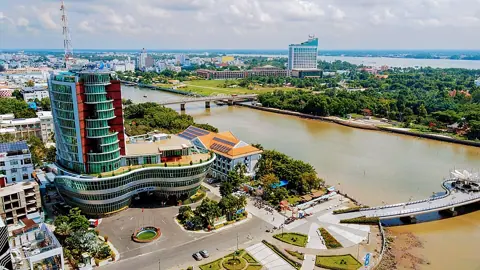
Cai Rang floating market sits on the Hau River outside Can Tho, and its trading culture was recognized in 2016 as a national intangible cultural heritage by Vietnam's Ministry of Culture, Sports and Tourism, but what you'll find there today is a working wholesale trade between boats, not the wall-to-wall spectacle shown in most photos taken a decade ago. Whether the trip is worth it depends on how early you're willing to get up and how you calibrate your expectations going in. This guide covers the timing, the logistics, and the gap between the marketing image and the current reality.
The market runs on wholesale hours, not tourist hours
Cai Rang and Can Tho's smaller markets exist because farmers and traders need to move produce before the day's heat and before retail buyers arrive elsewhere. That means trading activity is heaviest in the early morning and tapers off as the sun climbs. A boat tour that departs after 8am will often catch the tail end of the market rather than its busiest stretch.
This isn't a scheduled show that starts and stops on a timetable for visitors. It's commercial activity that has its own rhythm, driven by supply, weather, and the buyers who show up that day. Confirm current tour departure times with your hotel or boat operator, because they adjust seasonally and the "best" window shifts depending on who you ask locally.
Boat tours are the standard way to see it
You don't walk onto a floating market. Almost every visitor reaches Cai Rang or the smaller markets by boat, either through a fixed group tour booked through a hotel or agency, or by hiring a private boat and boatman directly at one of Can Tho's docks.
A private boat gives you control over departure time, which matters given how time-sensitive the market is. A group tour is usually cheaper per person and simpler to arrange, but the departure time is fixed by the operator, not by you. Confirm current pricing and departure times directly with operators or your accommodation, since these change with the season and with fuel costs.
Private boats hired at the dock are often negotiated in person, and having a sense of typical trip length (usually a few hours, covering the market plus a stop at a canal or small workshop) helps you judge whether a quoted price is reasonable. Ask your guesthouse what a fair range looks like before you negotiate, rather than relying on a fixed number here that may already be outdated.
What you'll actually see versus what the photos promise
Many travelers arrive expecting the market from postcards: hundreds of boats packed tightly together, vendors calling out, a continuous wall of color and noise. That version of Cai Rang was more accurate years ago. Trading volume at Cai Rang has declined over time as road infrastructure has improved and more produce moves by truck instead of boat — local officials cited in Vietnam's Ministry of Culture, Sports and Tourism reporting put the number of trading boats at around 200, down sharply from the market's peak, a decline officials attribute partly to road transport becoming more cost-effective than moving goods by boat.
What you'll more realistically encounter is a meaningful but thinner scene: dozens of boats rather than hundreds, concentrated wholesale trading rather than a market built for browsing, and stretches of quieter river between clusters of activity. Some boats sell drinks or snacks directly to tourist boats, which is a more retail-facing interaction than the wholesale trading happening around you.
None of this makes the visit not worth doing. It does mean you should go treating it as a look at a working river trade in transition, not as a guaranteed spectacle. If your main goal is the most visually dense floating market experience possible, be aware that current accounts describe a smaller scene than older guidebooks suggest, and adjust your expectations accordingly.
Can Tho works best as a one or two night base
Can Tho is the largest city in the Mekong Delta and functions as the practical hub for reaching the floating markets, since most tours and private boats depart from docks in or near the city. Given how early the best market activity happens, staying overnight in Can Tho removes the need for a pre-dawn transfer from elsewhere.
One night is enough if the floating market is your only priority. Two nights gives you room to also visit a fruit orchard, a canal system, or one of the smaller local markets that see fewer tour groups than Cai Rang, without rushing straight back to a bus.
Getting to Can Tho from Ho Chi Minh City
Can Tho does not have the kind of high-speed rail connection that shortens delta travel elsewhere in Vietnam. Road transport, by bus or private van, is the standard way to cover the distance from Ho Chi Minh City, and travel time will vary with traffic and road conditions. Confirm current schedules and journey times with a bus operator or your accommodation rather than assuming a fixed duration.
Can Tho also has a domestic airport with limited routes, which can be worth checking if you're arriving from farther afield within Vietnam rather than from Ho Chi Minh City directly. Confirm current route availability, since regional route networks change.
Within Can Tho itself, the docks used for floating market boats are generally a short taxi or ride-hailing trip from the central hotel area, rather than something you need to plan around days in advance. If your tour or private boat includes hotel pickup, confirm the pickup time the night before, since it will typically fall well before sunrise.
Picking a boat that suits how you like to travel
A larger group boat and a small private boat give you genuinely different mornings on the water, and it's worth thinking about which one you'd rather have before you book either.
A group boat, usually shared with other travelers, tends to follow a fixed route and schedule set by the operator. You'll get a predictable itinerary and a lower cost per person, but less flexibility if you want to linger somewhere or skip a stop that doesn't interest you.
A private boat, hired directly or through your accommodation, costs more per person but lets you set the departure time and adjust the route with the boatman as you go. This suits travelers who want to catch the earliest, busiest trading window without waiting for a group tour's scheduled pickup.
| Boat type | Who it suits | What you give up |
|---|---|---|
| Group tour | Budget-conscious travelers, solo travelers wanting company | Fixed timing, less control over the route |
| Private boat | Couples, families, early risers who want the busiest window | Higher per-person cost, more upfront negotiation |
Neither option is a wrong choice. Match it to whether flexibility or cost is the higher priority for that morning.
What else is around the market
Beyond Cai Rang, Can Tho's boat network reaches smaller local markets, narrow canals lined with houses on stilts, and orchards or workshops that some tours stop at on the way back. These stops tend to be quieter and less visited than the main market, which some travelers find more interesting precisely because there's no crowd of other tour boats around.
A local guide or boat operator will usually know which smaller market or canal stretch is active on a given day, since conditions shift with water levels and season. It's worth asking rather than assuming a fixed route applies every time you go.
Some tours extend into a rice-noodle workshop or a small home business along a canal, where you can see part of a production process up close. These stops are usually brief and add-on rather than the main draw, so if your time on the water is limited, ask upfront how the itinerary splits between the floating market and these secondary stops.
What this guide doesn't cover
This guide does not state current tour prices, specific departure times, or which individual operators are reliable, because all three change often and a wrong number here would be worse than no number. Confirm current pricing and timing directly with your accommodation in Can Tho or with a boat operator once you've picked your travel dates, and ask specifically about that week's trading activity rather than relying on general reputation alone.
It also doesn't cover visa requirements or entry logistics for Vietnam generally — check the current e-visa process on the official Vietnamese immigration site if you haven't arranged entry yet. If you're building a longer Mekong Delta itinerary beyond Can Tho, treat this as one stop in that planning rather than the full route.