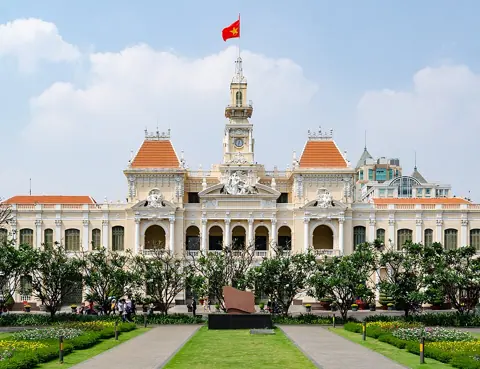
Four sites, one walkable cluster
The central district of Ho Chi Minh City puts the city's twentieth-century history within about fifteen minutes' walk end to end. The War Remnants Museum stands on Võ Văn Tần Street; Independence Palace sits in its own park a few blocks southeast; the Central Post Office and the cathedral face each other across a small square another few blocks on.
That compactness is the whole reason to treat them as one outing rather than four errands. You are not choosing between them so much as deciding the order and how much time each deserves.
Two of the four are institutions with an argument to make about the past. Two are buildings that mainly show you what French colonial administration looked like when it was confident. Knowing which is which before you set off makes the day easier to absorb.
What the War Remnants Museum presents
The War Remnants Museum documents the wars fought in Vietnam and their consequences, and it presents that period from the Vietnamese perspective. It was founded in 1975 under a name that translated as a house for displaying the war crimes of American imperialism and the puppet government, was renamed in 1990, and took its present name in 1995. Vietnam's national tourism authority describes its purpose as collecting, conserving and displaying evidence of war crimes and of the consequences inflicted on the Vietnamese people by foreign forces.
Saying this is not a criticism. National war museums almost everywhere present their own country's account, and this one does so openly. It is simply the context a foreign visitor needs in order to read the captions accurately. Where historians' accounts of particular events differ, the museum generally presents one of them; if you want the debate, you will need to bring it with you.
The collection runs to more than 20,000 documents, artefacts and films, much of it donated by veterans, journalists and overseas contributors, and the galleries lean heavily on war photography. Themed exhibitions are added and rotated, so the room list you find online may not match the one on the wall; the museum's own site is the place to check what is showing. Outside, in the walled forecourt, sit military aircraft, tanks and artillery, which is the part children tend to gravitate to.
Allow between one and two hours. Captions are in Vietnamese and English, and the building is a self-guided museum rather than a tour, so your pace is your own. Ticketing and opening times change, including the recent introduction of online sales, so check the museum's own website on the morning you plan to go rather than relying on a printed itinerary.
Independence Palace and the events of 1975
Independence Palace is the former seat of the government of South Vietnam, and the building you walk through today was inaugurated in October 1966 to a design by the Vietnamese architect Ngô Viết Thụ. It replaced the French colonial Norodom Palace, built between 1868 and 1871, which was badly damaged in a 1962 bombing.
The site is best known for 30 April 1975, when North Vietnamese tanks entered the grounds and a flag was raised over the building, ending the war. Vietnam recognised the palace as a national historical and cultural relic in 1976 and later classified it among the first group of Special National Monuments in 2009. Two tanks stand on the lawn as a memorial to that morning.
What makes the visit unusual is that the interior was largely left as it was. You move through cabinet rooms, reception halls, a cinema and private quarters furnished in mid-1960s style, then down concrete stairs into the command bunker with its map boards, radio equipment and telephones. The effect is less museum than time capsule, and it is the closest thing the city has to a physical explanation of how the war was administered.
Budget an hour to ninety minutes. The tone here is calmer than at the museum: this is a building of decisions rather than consequences, and most visitors find it absorbing rather than upsetting. Audio guides and guided tours are usually available, and this is the one site where a guide genuinely adds something, because the rooms look similar and the chronology is easy to lose.
The colonial landmarks nearby
The Saigon Central Post Office and the Notre-Dame Cathedral Basilica of Saigon face one another on the same square and represent a different, earlier layer of the city's history. The cathedral was begun on 7 October 1877, built with materials shipped from France including the red brick that gives it its colour, and is topped by twin bell towers roughly 60 metres high. A statue of Our Lady of Peace stands in the forecourt facing the boulevard, and it is the usual meeting point for anyone arranging to be found in this square.
The cathedral has been under a long-running restoration since 2017. The programme has been extended more than once and reporting in late 2025 pointed to further work beyond the original schedule, so scaffolding, restricted interior access or Mass-only opening are all real possibilities. Check the current position before you build your afternoon around going inside, and treat a look at the exterior as the realistic baseline.
The post office across the square went up in the late 1880s. Vietnam's national tourism authority credits the design to the French architect Villedieu with Foulhoux as his assistant; you will also see it attributed elsewhere to Gustave Eiffel, an attribution the official account does not support. Step inside for the vaulted hall, the two old painted wall maps of southern Vietnam's telegraph lines and of Saigon itself, and the portrait of Hồ Chí Minh at the far end.
It is still a working post office, handling mail, stamps, postcards and currency exchange alongside the sightseers, which is worth remembering when you raise a camera near the counters. Half an hour covers both buildings comfortably, and there is no ticket to enter the hall.
Sequencing a half day
Heat and mood both argue for the same order. Ho Chi Minh City is hot from mid-morning onward, and the museum is the hardest of the four to take, so put it first while you have energy and shade is less of an issue.
If you only have time for one, choose by what you want to understand. The museum is about the human cost of the war; the palace is about how the southern government worked and how it ended. They are not substitutes for one another.
The Cu Chi Tunnels, a well-known war site outside the city, is a separate half-day or full-day trip with its own transport arrangements and is not part of this walking cluster.
Tone, etiquette and who else is there
These are memorials, not attractions in the ordinary sense, and Vietnamese visitors come to all four for their own reasons. School groups, veterans and families are a normal part of the crowd at both the museum and the palace, and some are visiting places connected to their own relatives.
Dress as you would for any museum or place of worship: covered shoulders and knees will keep you comfortable at the cathedral and are simply more appropriate at the other sites. Keep your voice down indoors. Photography is generally permitted, but consider whether a particular gallery is somewhere you want to be photographing at all.
One practical note that surprises people: the Cu Chi site outside the city operates a firing range where visitors can pay to fire live rounds, and similar incongruities occasionally appear at war-related attractions elsewhere in Vietnam. Nothing of that sort operates at the four central sites here, but it is worth knowing the range exists so it does not catch you off guard if you go on to book that trip.
What to check before you go
This guide deliberately does not give ticket prices, opening hours or closing days, because all three change and a wrong number wastes your morning. Confirm each of them on the site's own website the day before: the War Remnants Museum and Independence Palace both maintain official pages, and the palace's page is run under a Vietnamese government domain.
The single item most likely to change your plan is the cathedral restoration. Verify what is open before you commit to a route that ends there, and have the post office as your fallback indoor stop.
If you want more depth on the palace, look into whether a guided slot is running on the day you visit. It is the one place in this cluster where an hour with a guide changes what you take away.