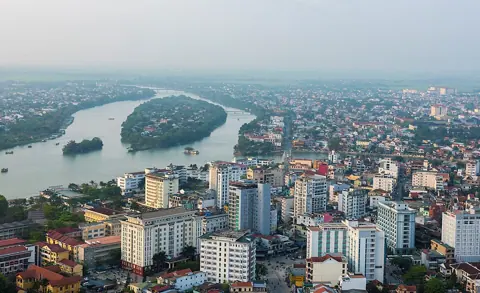
Hue has two very different halves
Hue's year divides into a hot, brighter half and a wet, grey half, and Vietnam's national tourism authority describes the city as having a late rainy season with storms and wet, cool days from September into February, against warm to hot and clear conditions from March to August. It also flags occasional flooding in Hue between September and November, and notes that tropical storms start reaching central Vietnam from September.
Those boundaries are soft. A wet season can start early or run late, and a single storm system can drop more rain in two days than a fortnight of ordinary drizzle. Treat the months as a pattern to plan around, not a calendar to trust.
What makes this matter more in Hue than in many Vietnamese cities is what you came for. The Imperial City is a walled complex of courtyards, gates and open ground. The royal tombs are landscaped hillside sites reached by road, several kilometres out. A river trip is a river trip. There is very little of Hue's headline sightseeing you can do under a roof.
Dry months trade rain for heat
The dry half of the year gives you reliable sightseeing weather and takes back the middle of the day. Vietnam's tourism authority puts July highs around 35C, and the Citadel's stone courtyards hold that heat with almost no shade in the open sections.
The practical answer is to move your day to the ends. Start at the Imperial City close to opening, when the light is low and the paving is still cool, and you get both the temperature and the tour groups on your side. Save the middle of the day for anything indoors or shaded — a museum, a long lunch, your hotel — and go back out mid-afternoon for a tomb or the river.
Tombs are harder than the Citadel in heat, not easier. Several involve climbing steps in the open, and you are often a taxi ride from anywhere with air conditioning. In the hot months, choose one tomb and do it properly rather than chaining three together across the middle of the day.
Wet-season Hue rewards a loose plan
A wet-season trip to Hue works if you stop treating your itinerary as a schedule. The cool, cloudy weather is far more comfortable for walking than August heat, the Citadel empties out, and mist on the pines above the tombs is a large part of why photographers like Hue in the off months.
What you give up is certainty. Rain can be a steady grey drizzle for most of a day or a violent hour that floods the streets and then stops. Neither is a disaster, but both punish a plan built on being in three specific places at three specific times.
Shape a wet-season day like this instead:
Pack for it properly. A cheap poncho beats an umbrella in wind, sandals dry faster than trainers, and anything you would hate to soak belongs in a dry bag inside your day pack, not in an outer pocket.
Flooding is the real disruption
Flooding, not rain, is what actually cancels things in Hue. The city sits on a low river plain, and when heavy rain upstream coincides with high water, low-lying roads and riverside areas can go under while central streets stay usable.
Sites outside the city feel this first. The royal tombs are spread along roads south and west of the centre, so an access road being impassable matters more than whether the tomb itself is open. River boat services stop early when the water rises. The walled Citadel area itself is usually the most robust of the three, being closer in and easier to reach on foot.
Here is roughly how the three site types behave when weather turns:
| Site type | How it holds up in bad weather |
|---|---|
| Imperial City / Citadel | Most reliable to reach; exposed once inside, so rain gear decides your day |
| Royal tombs | Reachable until roads or transport are affected; the first thing worth dropping |
| Perfume River boats | Cancelled earliest, and cancellations can come the same morning |
Shoulder timing is a genuine option
The edges of Hue's seasons are worth considering, because they trade a little of each problem for a little of the other. Late in the dry half you get heat but a low chance of washouts. Early in the wet half you get cooler air and thinner crowds, with rising storm risk attached.
There is no single right answer, only what you are willing to lose. If your trip has one fixed day in Hue and no flexibility, weight it toward the dry months, because a lost day is the whole visit. If you have three or four days and can move things around, the wet months are often the more interesting version of the city, and considerably more comfortable to walk in.
Check these before you travel
Nothing in a seasonal guide replaces a current forecast, and Hue's weather can be settled or serious within the same week of the same month.
Close to your travel dates, look at three things. Check a current local forecast for Hue rather than a general Vietnam one. Check Vietnam's national hydro-meteorological centre at nchmf.gov.vn for active storm and flood warnings, which is where tropical storm tracks and flood bulletins are published. And check the official Hue monuments site or ask your accommodation whether any specific site is closed, since restoration work and weather closures both come and go.
If a storm is forecast for your dates, the useful move is usually not to cancel but to reorder: front-load the outdoor sights into the clear days and accept that one day may be spent indoors.
What this guide leaves out
This guide does not give month-by-month rainfall or temperature figures, because those numbers move and a stale table is worse than none. It also does not cover ticket prices, opening hours or current closures at the Citadel and the tombs — check the official monuments site for those, near your travel date.
You will also find Hue's airport transfer, a one-day Imperial City plan, and which royal tomb suits which traveller covered separately. Your next step here is narrower: pick the half of the year your trip falls in, then decide whether you are planning around heat or planning around rain, because you cannot optimise for both.