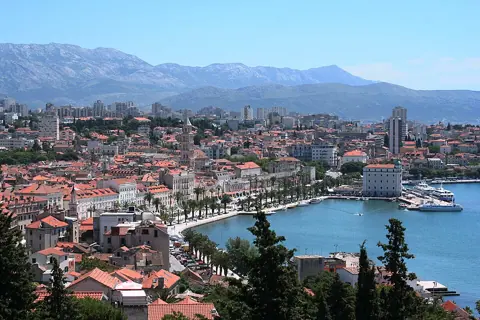
Most places called "ancient ruins" ask you to imagine what daily life once looked like inside them. Diocletian's Palace in Split does not require imagination, because daily life is still happening inside it. Laundry hangs from windows above Roman-era walls, people run bars in vaulted stone rooms, and a working Catholic cathedral occupies what was once a Roman emperor's mausoleum. It is one of the only Roman-era imperial residences on earth that never stopped being inhabited.
An emperor's retirement plan that never emptied out
Diocletian's Palace was built in the early fourth century AD as the retirement residence of the Roman emperor Diocletian, constructed on the Dalmatian coast near his native region. After his death, the palace did not fall into abandonment the way many Roman structures eventually did. Instead, as the Roman Empire's control over the region weakened, local populations — including refugees from the nearby city of Salona after it was sacked — moved into the palace's fortified walls for protection, converting its imperial halls, corridors and courtyards into homes, workshops and streets over the following centuries.
That process of continuous adaptive reuse, repeated across roughly seventeen centuries, is why the palace today reads less like an archaeological site and more like an unusually dense old town that happens to be built inside and around Roman imperial architecture. Split itself effectively grew outward from this nucleus, making the palace not a separate attraction next to the city but the literal origin point of it.
Walking through someone's front door, structurally speaking
Because the palace was never cleared and preserved as an empty monument, walking through it today means walking past actual residences, small businesses and apartment entrances built directly into and around the ancient structure. A doorway that looks like part of a historical facade may be someone's actual front door. Windows overlooking a Roman-era courtyard may belong to an apartment someone rents or owns.
This is different from most palace complexes you might compare it to. Versailles or the Alhambra are preserved as museum spaces with controlled visitor flow and defined boundaries between "visitor area" and "not visitor area." Diocletian's Palace has no single boundary of that kind across most of its footprint — it is simply the old town, with specific individual sites like the cathedral or the substructure halls functioning as separate, ticketed attractions within it.
What is actually a monument versus what is a neighbourhood
Some parts of the complex do function as clearly defined historical sites with their own access and, in some cases, tickets. The Cathedral of Saint Domnius, built around what was originally Diocletian's mausoleum, is a functioning Catholic cathedral that also operates as a major historical attraction, including its bell tower. The palace's substructure — vaulted underground halls that once supported the emperor's private apartments above — is a separate, well-preserved space now used partly for exhibitions and vendor stalls, giving a clearer sense of the original Roman-era engineering than the lived-in streets above.
The Peristyle, the palace's central ceremonial courtyard, functions as a public square today, ringed by cafes and used for occasional events, which is a fairly direct continuation of its original role as the palace's formal gathering space.
Why the UNESCO listing matters here specifically
The palace and Split's historic centre were inscribed on the UNESCO World Heritage List in 1979 as the "Historical Complex of Split with the Palace of Diocletian," a recognition tied specifically to the site's continuous inhabited history — including the medieval cathedral built into the emperor's former mausoleum — rather than to it being a well-preserved but empty ruin. That distinction is part of what makes the site significant among Roman-era remains: it demonstrates an unbroken, adaptive relationship between an ancient structure and the people living in and around it across nearly two millennia, rather than a site that was abandoned, rediscovered, and then curated.
How this compares to other "living" historic sites
A handful of other European sites share something of this same continuously-inhabited character — parts of Rome's old Jewish Ghetto, or sections of historic centres in cities like Bologna, where medieval structures still house ordinary apartments and shops rather than functioning purely as museums. What makes Split's case unusually clear-cut is scale and origin: an entire fortified imperial residence, rather than a general old-town district, became a self-contained inhabited settlement, and its Roman-era walls and gates still define the boundary of that settlement today rather than having been absorbed anonymously into a larger urban fabric over the centuries.
This also explains a detail that surprises some visitors: locals in Split will sometimes refer to specific streets or corners within the palace walls by names or associations that predate any formal municipal address system, since the space has functioned as a genuine neighbourhood — with its own internal logic of streets and landmarks — for far longer than most cities' actual street-naming conventions have existed.
What this guide does not cover
This overview explains why the palace looks and functions the way it does, not current ticket prices, opening hours for the cathedral, bell tower or substructure, or guided tour options, none of which were verified for this piece. Check those directly with the relevant site before building a specific visit plan around them.