Four languages, four regions, not four mixed cities
Switzerland's four national languages map onto distinct regions rather than sitting mixed together everywhere. According to the Swiss government's own overview, German is the main language for over 60% of the population, concentrated in the northern and central parts of the country — this includes Zurich, Basel, Bern and Lucerne. French is the main language of Romandie, the western region that includes Geneva, Lausanne and Neuchâtel. Italian is the main language in Ticino, the southern canton bordering Italy, and in parts of the canton of Graubünden. Romansh, a Latin-derived language with no close relative outside Switzerland, survives in some parts of Graubünden only.
Four cantons — Bern, Fribourg, Valais and Graubünden — plus the town of Biel/Bienne are officially multilingual themselves, which is where you're most likely to see two languages on the same street sign or hear a conversation switch languages mid-sentence.
This means the language question a traveler actually needs answered isn't "what language do Swiss people speak" but "what language is spoken where I'm going" — a Geneva itinerary and a Zurich itinerary sit in genuinely different linguistic worlds, closer in practice to visiting two different countries than to visiting two cities in the same one.
Why Swiss German isn't the German you may have learned
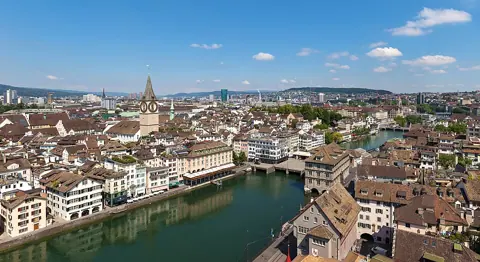
The gap that catches visitors off guard isn't between regions — it's within the German-speaking one. The government's own language page is direct about this: Swiss German, a collection of Alemannic dialects, is the everyday spoken language, while standard German is reserved mainly for writing. That means road signs, restaurant menus, museum labels and official documents in Zurich or Basel are in standard German and will read exactly as expected to anyone who studied the language. What you hear people actually saying to each other on a tram or in a shop is a different matter, since the spoken dialects differ from standard German in pronunciation, vocabulary and grammar strongly enough that native speakers from Germany itself often can't follow a Swiss German conversation without help.
In practice, this rarely creates a communication barrier for a visitor: Swiss German speakers routinely switch into standard German (or English) once they're speaking with someone who isn't a fellow dialect speaker, which is a normal and unremarkable adjustment rather than a favor. Where it does matter is expectations — if your only German is classroom German, understand that overhearing ambient conversation won't work the way it might in Germany or Austria, even though everything written around you will be perfectly legible.
Crossing regions on one trip
If your route touches more than one linguistic region — Zurich to Geneva, or Lucerne to Lugano, connections the country's clock-face timetable makes almost seamless — the practical adjustment is smaller than it might sound, since French- and Italian-speaking Switzerland use standard written French and Italian rather than a parallel dialect situation the way German-speaking Switzerland does. The bigger shift is simply that shop staff, museum guides and transit announcements switch to a different national language entirely once you cross the linguistic boundary, sometimes within a single train journey through a multilingual canton like Valais or Fribourg.
English tends to work as a practical fallback in tourist-facing situations across all four regions, though this guide can't confirm a specific proficiency level or a guarantee that it will work outside cities and established visitor sites, so it's worth having a few basic phrases in the local regional language regardless of which one applies where you're headed.
Reading signs versus following a conversation
The split between written and spoken German is worth restating in practical terms, because it changes what kind of preparation actually helps. If you're worried about reading — train departure boards, museum labels, a menu, a pharmacy sign — standard German (or standard French or Italian, in those regions) is what you'll see, and any preparation in the standard language pays off directly. If you're worried about following what people around you are saying to each other — on a tram, in a shop between staff, at a market — that's where Swiss German dialects take over in German-speaking regions, and no amount of standard-German study fully prepares you for that, because it's a genuinely different spoken system, not an accent on top of the same words.
The good news is that the second kind of difficulty rarely blocks you from doing anything. Swiss German speakers are used to switching to standard German or English the moment they're addressing someone who isn't a fellow dialect speaker, and they do it automatically in tourism, retail and hospitality settings. What it does mean is that overhearing a conversation and expecting to follow it — the way a German visitor might follow ambient French in Paris with some effort — doesn't work the same way once dialect is involved.
A few words that travel further than a phrasebook
You don't need fluency to get real goodwill out of a short greeting in the local regional language rather than defaulting straight to English. In German-speaking areas, "Grüezi" as a greeting and "Merci" (borrowed from French and used casually even in Swiss German) as thanks are both genuinely used locally and land better than a German phrasebook greeting that reads as slightly formal or foreign to Swiss ears. In French-speaking Romandie, standard French greetings and thanks work exactly as they would in France. In Italian-speaking Ticino, standard Italian does the same. None of this substitutes for English working perfectly well in most visitor-facing situations — it's a small courtesy, not a requirement, but it's the kind of small courtesy that Swiss residents in any of the four regions tend to notice and appreciate.
What this guide does not cover
This is an overview of where each national language is spoken and why Swiss German differs from standard German — it does not cover language requirements for longer stays, work or residency, which fall under separate federal and cantonal rules VoyageWindow does not address here.