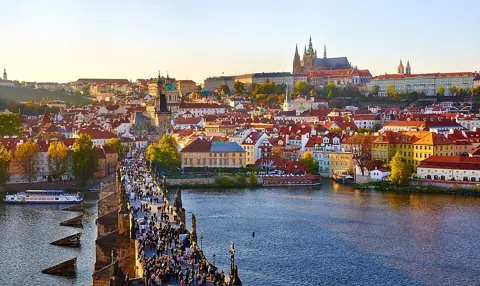
Most descriptions of Prague stop at the historic centre: the castle, the bridge, the old squares. That centre is a small part of the city by area and an even smaller part of where people actually live. Most Prague residents live in outer districts built up mainly in the second half of the 20th century, in apartment blocks that look nothing like the buildings tourists photograph — and the metro system that connects those districts to the centre was built, in large part, to serve them.
What a panelák actually is
A panelák (plural paneláky) is a prefabricated apartment building made from large, factory-cast concrete panels assembled on site, a construction method used extensively across Czechoslovakia and the wider socialist bloc from the 1950s through the 1980s to build housing quickly and at scale. The buildings typically stand eight to fourteen storeys tall, arranged in estates of many identical or near-identical blocks set among green space, with shops, schools and other services planned into the estate rather than scattered through an existing street grid.
The panelák was a practical answer to a real housing shortage, not simply an ideological statement — Czechoslovakia's postwar population growth and urban migration created demand for housing faster than traditional construction could meet, and prefabrication offered a way to build apartments at a pace and cost that conventional brick-and-mortar building could not match.
Where these estates sit in Prague
Prague's largest panelák estates sit on the outer edges of the city, largely built from the 1960s onward as new districts rather than replacements for anything in the historic core. Jižní Město (South City), in Prague's southeast, is one of the largest such estates in the country, built up mainly in the 1970s and 1980s. Other large estates ring the city in different directions, generally in areas that had comparatively little existing development before the building programme began — the estates expanded the city outward rather than replacing the historic centre, which is one of the reasons that centre remained physically distinct and largely undisturbed by this later construction.
How the metro connects to this story
Construction on the Prague Metro began on 7 January 1966, and the first line — what is now Line C — opened in May 1974, initially running nine stations between Florenc and Kačerov, according to Czech public broadcaster Radio Prague International. The network expanded over the following decades into the three-line system used today (lines A, B and C), reaching further into the city's edges as those areas themselves grew.
The timing matters: the metro's expansion through the 1970s and 1980s tracked the growth of Prague's outer housing estates, extending lines outward specifically to connect new, large residential districts — including panelák estates — to the centre and to each other, since car ownership was far lower and public transport was the assumed way most residents would travel to work and back.
That relationship is still visible today. Several outer metro stations sit directly at the edge of, or within walking distance of, large panelák estates, and the design of those stations — often large, functional, and built with the same era's construction techniques and materials as the estates themselves — reflects the same period and planning logic as the housing around them.
What you would actually see there
Riding the metro out to one of these outer stations and walking a short distance from the exit shows a genuinely different Prague from the one in the centre: wide green spaces between buildings, straightforward grid-like pedestrian paths, low-rise shopping centres built into the estate's plan, and long rows of near-identical apartment blocks, sometimes brightened with more recent renovation work — insulation cladding and repainted façades are common on buildings updated since the 1990s.
There is no single "best" estate to visit and no curated visitor site here — this is ordinary housing where people live their daily lives, not a heritage attraction with information panels or admission. Go if you're curious about how the city actually houses most of its population; do not expect an experience built for sightseeing.
Why this distinction is worth knowing at all
None of this is essential to enjoying a short trip built around the historic centre. It matters if you want a fuller picture of what "Prague" actually means beyond the tourist core: a city where the postcard centre is a small, carefully preserved historical district, and the far larger residential city around it was built quickly, functionally, and with a very different set of priorities, within living memory rather than centuries ago. Understanding the panelák and the metro line that serves it tells you more about how most Czechs actually live than another hour in the Old Town does — the two pictures of the city are not contradictory, just very different answers to the same question of what Prague is.
What this guide does not cover
This overview does not cover current metro fares, ticket validity or specific station accessibility, all of which change independently of this history — see VoyageWindow's separate guide to Prague public transport tickets for that information, sourced directly from Pražská integrovaná doprava and the Prague Public Transit Company.