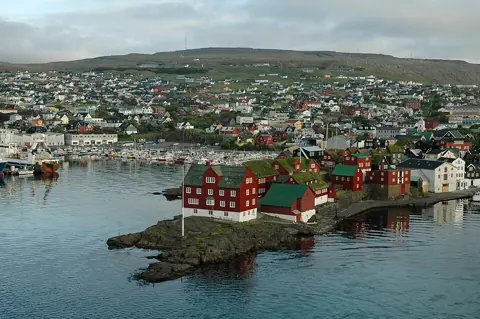
The Faroe Islands have one airport and one direct sea route from mainland Europe, which makes the "how do I get there" question simpler than it looks on a map. What takes more planning is what happens after you land: an internal network of buses, ferries and toll tunnels that connects the islands, run on a schedule that assumes you'll check it before you drive, not after.
Flying in through Vágar
Vágar Airport (FAE) is the only airport in the Faroe Islands, sited on the island of Vágar rather than near Tórshavn — the two are connected by the Vágatunnilin subsea tunnel, putting the airport roughly 45–50 minutes by road from the capital. Atlantic Airways, the Faroese national carrier, operates the airport's core schedule, with routes to Copenhagen along with other Nordic and European destinations that have included Billund, Aalborg, Reykjavík, Edinburgh, Oslo, and a rotating set of seasonal points further south in Europe. Frequencies vary a great deal by route and season — some destinations run several times a week, others only a couple of days a week — so check Atlantic Airways' own timetable for your specific dates rather than assuming a daily service.
Arriving by sea from Denmark
Smyril Line's Norröna ferry sails from Hirtshals in Denmark to Tórshavn, continuing on to Seyðisfjörður in Iceland, on a route that runs weekly through most of the year and twice weekly during the summer season, operating from roughly mid-March to late November. The crossing is built around bringing a car, camper, or motorcycle rather than as a walk-on passenger ferry, and cabins are standard rather than optional, since the Denmark–Faroe Islands leg is an overnight sailing. This route suits travellers already planning a Nordic road trip that includes Iceland, more than it suits a short Faroe-only visit, given the sailing frequency and total transit time compared with flying.
Getting around: buses, ferries and tunnels together
Strandfaraskip Landsins (SSL) is the state operator for both inter-island buses (bygdaleiðir) and ferries (oyggjaleiðir), and the two systems are designed to connect rather than operate separately. Bus routes cover more than twenty lines linking towns across Streymoy, Eysturoy, and the Northern Isles, while SSL ferries handle the islands road tunnels don't reach — Suðuroy in the south, Mykines in the west, Kalsoy, Hestur, Nólsoy, and the more remote Svínoy and Fugloy in the north.
How the tunnel tolls actually work
Four road tunnels run under the sea between the main islands — Vágatunnilin (Streymoy–Vágar), Norðoyatunnilin (Eysturoy–Northern Isles), Eysturoyartunnilin (Streymoy–Eysturoy), and Sandoyartunnilin (Streymoy–Sandoy) — and all four are billed through the same toll operator, P/F Tunnil. As of the operator's own published prices, Vágatunnilin and Norðoyatunnilin charge a flat return-trip rate of DKK 50, while Sandoyartunnilin and Eysturoyartunnilin are priced per one-way crossing, with Eysturoyartunnilin varying by which branch you take at its underwater roundabout junction. A prepaid subscription reduces the per-crossing cost substantially compared with paying one trip at a time.
Renting a car versus relying on buses and ferries
A rental car is the most practical way to see multiple islands in a short trip, since it removes dependence on SSL's bus and ferry frequencies, which are built primarily around residents' commuting patterns rather than tourist sightseeing hours. That said, several of the most visually striking islands — Mykines and Kalsoy among them — either bar cars for visitors during peak season or require a ferry crossing regardless, so a car handles the tunnel-connected core (Streymoy, Eysturoy, Vágar, Sandoy) while ferries remain unavoidable for the rest.
Why a car changes the trip more than in most places
Because SSL's bus network is built around residents commuting to work and school rather than around visitor sightseeing hours, several of the most photographed spots in the Faroe Islands — coastal viewpoints, trailheads for hikes like Trælanípa or the Kallur lighthouse walk — sit well outside any bus stop's reasonable walking distance. A rental car turns a day that would otherwise depend on two or three connecting buses into a straightforward morning drive, which is part of why car rental demand in the Faroe Islands during the short summer season can outstrip supply if you book late.
Before you land at Vágar
Confirm your Atlantic Airways flight status and any Vágar weather advisories the morning of travel, not the night before, since fog can develop and clear within hours. If your itinerary includes a ferry-dependent island, check SSL's live schedule for that specific route once you're on the ground, rather than relying on a schedule you looked up before the trip.