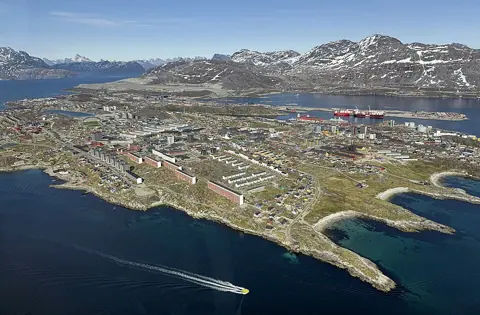
Two very different stories sit underneath Greenland's economy. One is well established and visible if you know where to look: a fishing industry that has underpinned Greenlandic livelihoods for generations and remains the dominant export earner. The other is mostly potential rather than present activity: mineral reserves, including rare earth elements, that have made Greenland a subject of outsized international attention relative to the actual scale of mining happening on the ground today.
Fish: the export that actually exists at scale
Greenland's export economy is built overwhelmingly around fish and shellfish: Statistics Greenland (Grønlands Statistik) states that "the fishing industry provides over 90 per cent of Greenland's export," led by codfish, Greenland halibut, mackerel, crab and prawn, caught both by Greenlandic vessels working coastal and offshore waters and processed through facilities in Greenland's roadless coastal towns. This is not a niche activity — it is close to the entire structure of Greenland's goods exports, a concentration that makes global seafood prices and quota decisions matters of direct national economic consequence rather than a specialised industry question.
Royal Greenland, a state-owned seafood company, is the best-known name in Greenlandic fish processing and export, operating facilities across multiple settlements and selling into international markets under both its own brand and as a supplier to other companies. As with most industrial food processing operations, these facilities are not built or run as visitor attractions.
Minerals: reserves that attract more attention than active mining
Greenland's geology includes a range of mineral deposits, and international attention has focused particularly on rare earth elements — a group of minerals used in electronics, renewable energy technology, and defence applications, for which global supply is currently concentrated in relatively few countries. Greenlandic and Danish authorities, along with international mining and government interests, have discussed and in some cases pursued exploration projects related to these deposits, but large-scale commercial mining operations have not developed at anything like the scale that the international commentary around Greenland's mineral potential might suggest to a casual reader.
This gap between geopolitical interest and on-the-ground activity is itself worth understanding as a visitor: much of what you'll read about Greenlandic minerals in international news coverage concerns exploration rights, environmental review processes, and strategic positioning by outside governments and companies, rather than operating mines you could visit or mineral exports currently moving through Greenlandic ports in significant volume.
Why the Arctic framing matters here specifically
Greenland sits at the centre of a broader set of questions about the Arctic — melting sea ice opening new shipping routes, competition among Arctic and non-Arctic states for access and influence in the region, and Greenland's own strategic position within the Kingdom of Denmark and NATO. These questions have made Greenland a subject of considerable diplomatic and media attention in recent years, well beyond what its population size or current economic output would typically generate for a territory of roughly 56,000 people.
What a visitor actually encounters
In practice, the industry a visitor is most likely to see and taste is fishing, not mining or mineral exploration:
- Working harbours with fishing vessels, visible in most coastal towns without needing a tour.
- Local seafood — shrimp, halibut, and other cold-water species — on restaurant menus, often sourced close to where you're eating it.
- Fish processing infrastructure near larger harbours, visible as industrial buildings rather than anything designed for visitors.
- Occasional local shops selling fish products directly, more common in smaller towns than in Nuuk itself.
Mineral exploration and mining, by contrast, are effectively invisible to a typical visitor's itinerary — there is no equivalent harbourside experience, and this guide does not suggest seeking one out.
Why the fishing industry, not minerals, is what actually employs people
It's worth being direct about the imbalance here: fishing and fish processing employ a meaningful share of Greenland's working population and generate the overwhelming majority of its export revenue today, while mineral exploration employs comparatively few people and has yet to generate export revenue at a scale that would reshape the national economy. International commentary on Greenland's mineral wealth sometimes implies an imminent economic transformation; the on-the-ground reality, as of current, verifiable information, is that fishing remains the industry actually paying wages and running processing plants along the coast, while mining stays mostly a subject of exploration licences, environmental review, and diplomatic discussion rather than active large-scale production.
This gap matters for how you interpret news coverage about Greenland during or around your visit: a headline about a mining agreement or a foreign government's interest in Greenlandic minerals describes a potential future, generally, not a current visitor-relevant industry, whereas a headline about fishing quotas or seafood export prices describes something closer to Greenland's actual present-day economic reality.
What this guide does not cover
This article describes the general structure of Greenland's export economy and the reasons behind international interest in its minerals; it does not provide current export statistics, active mining project details, or analysis of any specific territorial or defence policy dispute. For verified figures, consult Statistics Greenland (Grønlands Statistik) directly, and treat any specific claim about mining activity you encounter elsewhere with the same scrutiny this guide has applied — check it against an official source before relying on it.