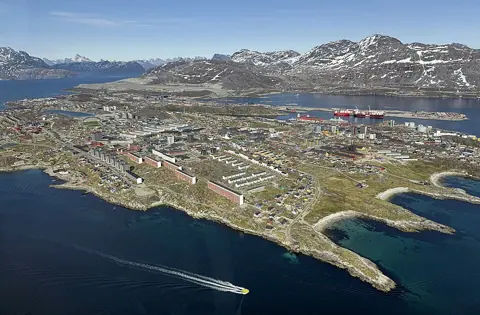
Look at a map of Greenland and you'll see towns scattered along thousands of kilometres of coastline with no lines connecting them. That's not a map that's missing detail — there genuinely are no roads between Greenlandic towns. Each settlement has its own local street network, and getting from one town to the next means a plane, a helicopter, or a boat, every time, for everyone, residents included.
Why the roads were never built
Greenland is the world's largest island, and roughly 80% of its landmass is covered by the Greenland ice sheet, leaving habitable land as a narrow, broken fringe along the coast, further fragmented by fjords, mountains, and open water. Building and maintaining a road network across that terrain, connecting settlements that can be hundreds of kilometres apart with a total national population of around 56,000 people, has never been judged economically realistic by any Greenlandic or Danish administration. The engineering cost per resident served would dwarf anything comparable in mainland Europe, and permafrost and extreme seasonal conditions would make maintenance a continuous expense rather than a one-time investment.
Instead, Greenland built its transport network around aviation and shipping from the start, and that pattern has only deepened as towns and airstrips have grown up independently along the coast rather than around a road corridor.
What replaces roads
Domestic flights operated by Air Greenland connect the country's larger towns, using both fixed-wing aircraft and helicopters depending on the settlement — some smaller communities have an airstrip too short or a location too constrained for anything but helicopter service. Along the coast, passenger and cargo ships supplement air travel, particularly useful for larger loads, and in some regions represent the only scheduled public transport connecting smaller settlements to a larger hub town.
This means a Greenlandic itinerary is built the way an island-hopping trip is built elsewhere: around flight or boat schedules, seasonal availability, and weather, rather than around a road map with driving times.
Self-rule and what it actually covers
Greenland moved from a home rule arrangement, established in 1979, to a broader self-government structure in 2009, under the Act on Greenland Self-Government negotiated within the Kingdom of Denmark. Under this arrangement, Greenlandic authorities — Naalakkersuisut, the Greenland Government, and Inatsisartut, its parliament — have taken over responsibility for most domestic policy areas, administering and legislating for them independently and covering their costs from Greenland's own economy rather than through direct Danish administration. Areas such as foreign affairs and defence remain matters handled at the level of the Kingdom as a whole, coordinated between Nuuk and Copenhagen, with individual Danish government ministries handling Greenland-related matters in fields corresponding to their normal portfolios.
Greenlandic, Danish, and which one you'll actually hear
Greenlandic, known locally as Kalaallisut, is the territory's own language, part of the Inuit language family, and is used in schools, government, and everyday life across most of the country. Danish remains widely spoken as well, a legacy of the long administrative relationship with Denmark and of Danish-language education still present in parts of the school system, and it functions as a practical second language in business, tourism, and administration. English is common in tourism-facing businesses in the larger towns, particularly Nuuk and Ilulissat, but is far less reliable outside them.
What this means for planning a trip
A Greenlandic trip needs to be planned around flight and boat availability first, sightseeing second — the reverse order from most European road-trip planning. Multi-town itineraries should build in flexible days rather than tight overnight connections, since aviation and shipping schedules in Greenland are considerably more exposed to weather disruption than typical European domestic transport. VoyageWindow's guide to Greenland's flight and ferry network covers exactly how that network functions in practice, airport by airport and route by route.
How this shapes everyday Greenlandic life, not just tourism
The absence of inter-town roads isn't just a travel-planning inconvenience — it structures how Greenlandic society itself is organised. Towns function as more self-contained units than they would in a road-connected country, each with its own local infrastructure, retail, and services built to be reasonably self-sufficient rather than dependent on a nearby larger town a short drive away. Family and social ties that would, in a road-connected country, mean an easy weekend visit instead require booking a flight or a place on a coastal boat, and the cost and scheduling of that transport is a genuine, everyday consideration for Greenlanders, not just visitors trying to build an itinerary.
This same pattern also affects how goods reach smaller towns: groceries, building materials, and fuel typically arrive by ship on a scheduled basis, particularly for communities without daily flight service, meaning supply in remote settlements can be tied to shipping schedules more than to a distribution network a mainland European visitor would recognise.
What this guide does not cover
This piece explains the structural reasons behind Greenland's transport pattern and its political status; it does not provide current flight schedules, fares, or entry requirements, all of which should be checked directly with Air Greenland, Visit Greenland, and the relevant Danish and Greenlandic authorities before you travel.