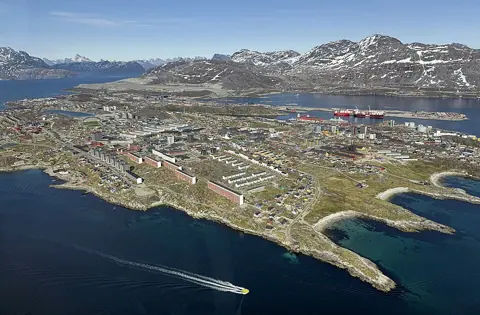
Greenland's transport network was rebuilt around a genuinely new piece of infrastructure recently: an extended runway at Nuuk that turned the capital into a real international gateway rather than a domestic hub reached only via a transfer point elsewhere in the country. That's the headline change. The underlying reality — that towns aren't connected by road, and weather routinely reshapes flight schedules — hasn't changed at all.
Nuuk's international airport
Nuuk Airport (IATA code NUK) opened its extended runway on 28 November 2024, according to Greenland Airports, allowing larger aircraft to operate directly into the capital rather than routing international arrivals through Kangerlussuaq, the former main gateway built on a former US military airfield further north. This shift is still relatively recent — Greenland Airports itself described the first year of operation as involving "a demanding year with a very steep learning curve" as procedures and services adjusted to the new traffic. Expect some continued evolution in international schedules and services at Nuuk as the airport matures, rather than treating it as a fully settled operation on the scale of a major European hub.
Air Greenland operates the core international service to and from Copenhagen, and has been expanding beyond that single route — the airline's own site lists a planned direct Ilulissat–Copenhagen service starting November 2026, alongside connections toward Iqaluit in Canada. Check Air Greenland's current timetable for the exact routes and frequencies in your travel window, since this network has been actively growing rather than staying fixed.
The domestic network: flights and helicopters, not buses
Air Greenland's domestic network links the country's larger towns — among them Nuuk, Ilulissat, Sisimiut, Qaqortoq, and Kangerlussuaq — by fixed-wing aircraft, while a number of smaller and more remote settlements are served by helicopter where an airstrip isn't feasible or long enough. There is no domestic rail or coach network to fall back on, and no road alternative regardless of how the flight or helicopter schedule looks — if the aircraft doesn't go, you don't go, at least not that day.
Coastal boats supplement this network in some regions, particularly for fish and general cargo shipments and for shorter hops between closely spaced settlements, and can be a useful (if slower) option where flight frequency to a specific small town is limited.
Why cancellations are the normal case, not the exception
Greenland's climate and terrain make weather-related delays and cancellations a structural feature of the transport network rather than an occasional disruption. Fog, low cloud, and high wind affect airstrips built into fjords and mountain terrain more severely than they would a flat coastal airport elsewhere, and a settlement's single daily or weekly flight being pushed to the next scheduled day is a normal outcome during unsettled weather, not a service failure.
Building an itinerary that survives Greenlandic weather
A workable approach treats every domestic leg as provisional until the day of travel:
- Book domestic Air Greenland flights with awareness that schedules to smaller towns can run just a few times a week, not daily.
- Leave at least one full buffer day before any international departure if your itinerary includes a domestic flight from a remote settlement beforehand.
- Avoid booking non-refundable, tightly timed activities (a specific glacier or iceberg tour, for instance) on a day immediately following a flight into that town, in case the inbound flight is delayed.
- Check Air Greenland's own app or site for live status on the day of travel rather than relying on a schedule checked days earlier.
What changes once you're actually in Greenland
Once you're on the ground, the most useful shift in mindset is treating your domestic flight or boat schedule the way you'd treat a fixed appointment rather than a flexible convenience — arrive at the airstrip or dock with time to spare, expect check-in and boarding procedures at smaller Greenlandic airports to be less automated than at a major European hub, and keep a printed or offline copy of your booking confirmation, since connectivity in smaller towns can be limited. Tour operators and guesthouses that regularly host visitors in remote towns are generally well practised at helping travellers rebook or adjust plans around a missed connection, precisely because it happens often enough to be routine rather than exceptional.
What this guide does not cover
This article explains how Greenland's air and sea transport network is structured and why disruption is routine; it does not provide current fares, exact flight frequencies, or entry and visa requirements. Check Air Greenland's booking system and the Danish and Greenlandic immigration authorities directly before finalising a trip.