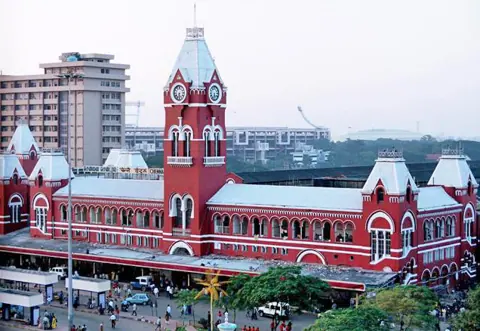
A traveller who has learned a few Hindi phrases before flying to India will find them work in Delhi and stall in Chennai. This is not regional prickliness and it is not an accident of education. It is the constitutional design, and it has a paper trail that is worth reading because it tells you exactly what to expect.
What the Constitution actually says
Article 343(1) reads: "The official language of the Union shall be Hindi in Devanagari script." The key word is Union — the central government, not the country. The Constitution contains no provision designating a national language.
Article 345 gives the other half of the arrangement: "the Legislature of a State may by law adopt any one or more of the languages in use in the State or Hindi as the language or languages to be used for all or any of the official purposes of that State".
The Eighth Schedule, referred to in Articles 344(1) and 351, lists 22 languages: Assamese, Bengali, Bodo, Dogri, Gujarati, Hindi, Kannada, Kashmiri, Konkani, Maithili, Malayalam, Manipuri, Marathi, Nepali, Odia, Punjabi, Sanskrit, Santhali, Sindhi, Tamil, Telugu and Urdu. English is not among them.
Tamil Nadu's own law
The Tamil Nadu Official Language Act, 1956 received the Governor's assent on 19 January 1957. Its long title states that it is "An Act to provide for the adoption of Tamil as the Language to be used for the official purposes of the State", and its section 3 preserves English for state official purposes until the government directs otherwise by notification. Section 4-A makes Tamil the language of civil and criminal courts subordinate to the High Court.
Schools follow a second statute. The Tamil Nadu Tamil Learning Act, 2006 sets the pattern in section 3(2): Part I Tamil, compulsory; Part II English, compulsory; Part III other subjects; Part IV an optional mother tongue for students whose first language is neither Tamil nor English.
There is no third compulsory language in that pattern. This is the two-language formula in statutory form, and it is why a Chennai school leaver has studied English but not necessarily Hindi.
For contrast, the National Education Policy 2020 states at paragraph 4.13 that "the three-language formula will continue to be implemented" with "greater flexibility", and that "no language will be imposed on any State", with the three languages being the choice of states, regions and students.
What the numbers look like on the ground
Census 2011 remains the most recent published language data; the next census is notified for 2027. Its scale is worth stating: 19,569 raw mother-tongue returns were rationalised to 1,369 mother tongues and 121 languages, of which 22 are Scheduled and 99 are not. Scheduled languages account for 96.71 percent of the population.
Nationally, Hindi was mother tongue for 43.63 percent, Bengali 8.03, Marathi 6.86, Telugu 6.70 and Tamil 5.70. English was mother tongue for 259,678 people — about 0.02 percent.
Tamil Nadu is a different distribution entirely.
| Language | Tamil Nadu mother tongue | Chennai mother tongue |
|---|---|---|
| Tamil | 88.37% | 78.34% |
| Telugu | 5.87% | 9.30% |
| Urdu | 1.75% | 4.27% |
| Hindi | 0.55% | 3.43% |
| Malayalam | 1.01% | 2.26% |
| English | 0.03% | 0.22% |
Chennai is measurably more Hindi-exposed than the state as a whole, which reflects its size and migration. Hindi is still only the fourth mother tongue in the city, behind Telugu and Urdu.
The decisive figures are the second-language ones. In Tamil Nadu, 12,145,630 people reported English as a second language — 16.83 percent — and 1,167,664 as a third. For Hindi the equivalents were 542,679 and 587,990, under one percent each. Adding mother tongue, second and third language, English reaches about 18.4 percent of the state against roughly 2.1 percent for Hindi.
Why Tamil carries the weight it does
The Government of India created the category of Classical Language on 12 October 2004, declaring Tamil the first. Sanskrit followed on 25 November 2005, Telugu and Kannada on 31 October 2008, Malayalam on 8 August 2013 and Odia on 1 March 2014. On 3 October 2024 the Union Cabinet approved Marathi, Pali, Prakrit, Assamese and Bengali, bringing the total to eleven.
The original 2004 criteria were high antiquity of early texts over a thousand years, a body of ancient literature considered a valuable heritage by generations of speakers, and an original rather than borrowed literary tradition.
Tamil being first is a fact of dates, not of ranking, but it is a point of real local pride and is worth getting right if it comes up.
What this means for a week in Chennai
Signage, menus, tickets and official forms are typically Tamil and English. Central government offices must deal with Tamil Nadu in English by statute. Hotel and transport staff work in English as a matter of course.
Learning a handful of Tamil words is welcomed for the same reason it is anywhere: it signals you noticed where you are. Nandri for thank you is the one worth having.
What this guide does not cover
Tamil Nadu's stated position on the National Education Policy's three-language formula could not be verified. Every tn.gov.in host was unreachable for this guide, so no state government order or policy statement is cited. What is stated instead is the state's statutory school pattern, which is verifiable.
Signage rules on national highways, railways and airports are omitted. Indian Railways' bilingual or trilingual signage policy could not be retrieved from an official source.
The classical-language list is sourced to a Government of India Cabinet release rather than to a Ministry of Culture gazette notification, which could not be reached.
Second and third language totals for Tamil Nadu and for India were computed by summing every row of the official census data files, since the published tables do not print a single all-India English total.
Census 2011 is fifteen years old at the time of writing. The 2027 census is notified with a reference date of 1 March 2027, and its language tables will supersede everything above.