A traveller who learns Indonesian is learning the right language, and it is worth understanding what kind of language it is. It is not the majority mother tongue. It is the one nearly everybody acquired second, which is precisely why it works so well between strangers.
What the law establishes
Article 36 of the 1945 Constitution states that the language of the state is Indonesian, sitting in the chapter that also covers the flag, emblem and anthem. Law No. 24 of 2009, dated 9 July 2009, then lists the domains where its use is mandatory: legislation, official documents, state speeches, education, public administration, contracts involving Indonesian parties, national and international forums held in Indonesia, workplace communication in both government and private sectors, academic publication, geographic and building names, trademarks, product information, mass media, and public signage.
Presidential Regulation 63 of 2019, signed 30 September 2019, implements it. Article 40 requires Indonesian on public signs, street signs, public facilities and banners, and permits a regional or foreign language only as an accompanying equivalent, a padanan. That is why bilingual signage in Indonesia reads as Indonesian-first rather than as an accommodation. A companion guide sets out what changes in Sumatra.
How many languages there actually are
The government's language agency has identified and validated 718 regional languages, excluding dialects and subdialects, from 2,560 observation points, in mapping work conducted between 1991 and 2019.
An earlier ministry release reported 652 languages mapped, and intermediate figures circulate. The 718 figure is what the current official platform publishes, and the difference appears to be the cut-off year rather than a dispute.
What the census measures, and the distinction that matters
The 2020 census long form asked four separate language questions of the population aged five and over, a base of 253,679,348 people. The results are more interesting than a single number would be.
Almost everyone can speak Indonesian: 248,501,793 people, 97.96 percent. But only 71,971,184, or 28.37 percent, acquired Indonesian as their first language, against 71.38 percent for a regional language. And 74.77 percent use a regional language daily within the family, 72.78 percent with neighbours and community.
The older 2010 census asked the question differently and is useful for the trend: 79.5 percent used a regional language at home against 19.9 percent Indonesian, with the Indonesian share having nearly doubled from 10.7 percent in 1990.
Surabaya specifically
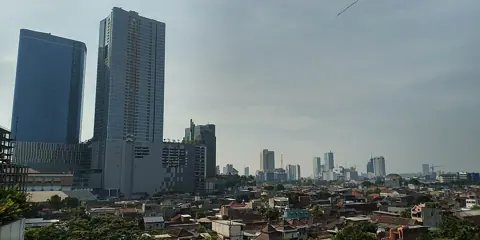
Surabaya recorded 2,874,314 residents in the 2020 census. On the long-form language questions, with a base aged five and over of 2,681,686, the city sits noticeably above the provincial pattern.
In Surabaya 99.69 percent can speak Indonesian, and 37.62 percent acquired it first. In East Java as a whole only 9.39 percent acquired Indonesian first. So the city is where Indonesian has advanced furthest as a first language, in a province where it has advanced least. Even so, 77.82 percent of Surabaya residents use a regional language daily within the family. Our guide to how far Bali diverges covers that separately.
The name of the local Javanese
The language agency maps four Javanese dialects in East Java: dialek Jawa Timur, dialek Osing, dialek Tengger and dialek Solo-Yogya, with dialectometric distances between them of 52 to 64 percent. It places dialek Jawa Timur around Surabaya, east to Jember, north to Malang regency and west to Bojonegoro.
The popular name Suroboyoan does not appear in that mapping, so it is a local usage rather than an official designation. East Java is mapped as having three languages in total: Bajo, Javanese and Madurese, with Bajo confined to one village in Sumenep regency.
English, and what can honestly be said about it
No Indonesian government statistic on the population's English proficiency was found. The census records foreign languages only as an undifferentiated category, 342,459 people nationally as a first language, so no percentage for English appears here.
What is documented is a policy change. From the 2027/2028 school year English becomes a compulsory subject in primary schools nationwide, under the curriculum regulation as amended in 2025, having previously been an elective at that level. It remains compulsory at secondary level. Under Law 24/2009 the medium of instruction stays Indonesian.
The widely quoted EF English Proficiency Index is a private commercial product of EF Education First, built from self-selected online test-takers rather than a probability sample. It is not an Indonesian government measure and is not used as one here.
Script and spelling
Indonesian uses the 26-letter Latin alphabet, which spares a visitor the transliteration problem that Thai, Khmer or Sinhala present. The current official standard is Ejaan Bahasa Indonesia yang Disempurnakan, Edition V, established by a language agency decree dated 16 August 2022, which revoked the previous PUEBI standard. There is a companion piece on the colonial remains in Jakarta.
What this guide does not cover
It teaches no phrases, because pronunciation guidance in text is unreliable. No official normative description of a three-tier ngoko, madya and krama register system was found, so only the dictionary's own labels are reported and madya is not among them. Speaker counts for named regional languages are not given: the statistics agency publishes ethnic-group population, which is a different variable, and its own definition warns the two are not interchangeable. A more recent Surabaya population figure exists but its table could not be read. Whether the signage regulation imposes any size or prominence hierarchy could not be verified. The exact reference date of the census population table is not stated on it.