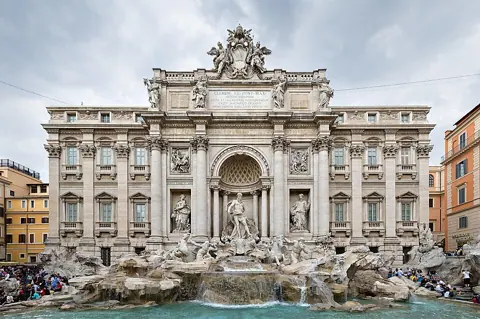
The water coming out of a Roman street fountain is not fountain water. It is the same supply that reaches kitchen taps across the city, delivered by the same company, tested under the same rules, and simply allowed to run continuously into a drain instead of into a sink. Acea's own page on the nasoni states that the water in the fountains is the same that arrives at the taps of Roman homes, subject to rigorous quality control (Acea, I nasoni di Roma e le fontanelle dell'acqua, checked 15 September 2026). So the practical question is not whether the fountain water is drinkable. It is whether Rome's tap water is, and the operator and the published analyses both say yes. The one thing to watch is signage: a fountain marked acqua non potabile is not part of this system, and monumental fountains are a separate matter entirely.
How a nasone actually works
A nasone is a cast-iron post about 120 cm tall weighing roughly 100 kg, with a curved spout from which water runs constantly. Roma Capitale describes the design and the trick that goes with it: at the top of the curve there is a small hole, and if you block the main spout with a finger, the water jets upwards so you can drink from it without touching your mouth to the metal (Roma Capitale, Fontanelle romane: lupi, draghi e nasoni, 17 July 2025, checked 15 September 2026). That upward jet is the whole point of the shape, and it is why Romans drink from a nasone in passing without breaking stride.
The system dates from 1874, when mayor Luigi Pianciani set up public water distribution to improve hygiene and public health. The first cast-iron posts had three dragon mouths rather than one curved spout, and Roma Capitale notes that working three-mouth examples survive in piazza della Rotonda beside the Pantheon and in via delle Tre Cannelle in the rione Trevi. Around 70 travertine fountains with a brass she-wolf head, dating from the 1920s, also still work, in places such as Villa Celimontana and on the Campidoglio.
Newer fountains are not always free-flowing. Acea states that recently designed fontanelle have been fitted with timed taps to limit waste, so if you meet a post that gives water only while you hold something down, that is the current design rather than a fault (Acea, The Nasoni, checked 15 September 2026).
Where Rome's tap water comes from
Rome's drinking water, in the supply zones we checked, is spring water from limestone aquifers rather than treated river water, and which spring you are drinking depends on which part of the city you are standing in. Acea Ato 2 divides Rome and Fiumicino into nine supply zones and publishes a separate analysis sheet for each one, naming the aqueduct that serves it. The largest is the Peschiera-Capore, described on its own zone sheet as a collection of underground sources in limestone aquifers; other zones are served by the Acqua Marcia, by the Nuovo Vergine mixed with Peschiera-Capore, and by the Appio-Alessandrino system.
Three of those zone sheets, all dated July 2026, show how little the water actually varies across the city.
| Supply zone | Aqueduct named on the sheet | Total hardness |
|---|---|---|
| Zone 3 | Peschiera-Capore | 34.6 °f |
| Zone 4 | Nuovo Vergine, mixed with Peschiera-Capore | 34.8 °f |
| Zone 5 | Acqua Marcia | 31.6 °f |
Those figures are French degrees (°f), the hardness scale Italian utilities use, not Fahrenheit. Rome's water is hard, which is why hotel kettles fur up, but hardness carries no legal limit in Italy and the sheets list no guide value against it.
The Peschiera-Capore is the workhorse. Acea Acqua's project page for the aqueduct's doubling gives a flow of 14,000 litres per second, a length of about 130 km and 54 municipalities served (Acea Acqua, Il raddoppio dell'acquedotto Peschiera, checked 15 September 2026). The relevant detail for a visitor is what the zone sheet says about treatment: given the excellent quality of the Peschiera-Capore, no treatment is applied to remove or correct non-compliant chemical parameters, and disinfection is by sodium hypochlorite dosed at the start of the aqueduct.
What the published analyses show
Acea Ato 2 publishes the numbers rather than asking you to take its word for it, and anyone can download them. The company states that the water it distributes is monitored 365 days a year through continuous instrument surveys along the aqueducts and potability analyses from abstraction to household taps, and it invites you to search an address on its map and download a PDF of median values from the previous twelve months (Acea Ato 2, Qualità e potabilità dell'acqua, checked 15 September 2026). The table below takes five parameters from the July 2026 sheet for Zone 3, the Peschiera-Capore zone.
| Parameter | Limit or guide, D.Lgs. 18/2023 | Median value recorded |
|---|---|---|
| Nitrates | 50 mg/L NO3 | 3.03 mg/L |
| Free residual chlorine | 0.2 mg/L Cl2 | 0.16 mg/L |
| Sum of PFAS | 0.1 µg/L | below 0.10 µg/L |
| Lead | 5 µg/L | below 0.2 µg/L |
| Escherichia coli | 0 per 100 mL | Compliant |
Source: Acea Ato 2, Qualità dell'acqua, Comune di Roma e Fiumicino, Zona 3 Peschiera Capore, luglio 2026, checked 15 September 2026. The same sheet records pH 7.60, conductivity 577 µS/cm and a network temperature of 13.0 °C.
The legal frame behind all of this is Legislative Decree 18/2023, Italy's implementation of EU Directive 2020/2184. The Istituto Superiore di Sanità summarises its Article 18 obligation on operators to give consumers adequate and updated information on the production, management and quality of drinking water at least once a year, through accessible channels including bills and apps (Istituto Superiore di Sanità, La legge e i controlli, checked 15 September 2026). Acea Ato 2's zone PDFs are that obligation in practice.
Is the constant flow a waste?
The open spouts are a deliberate engineering choice, not an oversight, and the city has published what they cost. Roma Capitale's climate project page states that the nasoni together discharge less than 1 per cent of the total water put into the network, and that the regular flow helps optimise pressures and water quality, particularly in the outer parts of the network (Roma per il Clima, Le fontanelle dell'acqua pubblica di Roma, checked 15 September 2026). The same page credits them with preventing hygiene problems and odours in drainage networks, and with a public health and social role in the hottest weeks of summer.
Counts differ between official pages, and it is worth knowing that before you quote a number. Roma per il Clima gives over 2,800 nasoni with 300 inside the walls; Roma Capitale's news article gives around 3,000 nasoni with more than 200 in the historic centre; Acea's own pages say over 3,000 drinking fountains citywide, of which more than 200 are nasoni in the historic centre, plus 90 artistic fountains. The order of magnitude is solid. The exact figure is not, and no single official page settles it.
We found no official page setting out a seasonal shutdown policy for the nasoni. Both Acea and Roma Capitale describe them as flowing continuously, and the mechanism for declaring any supply undrinkable is a formal non-potability ordinance, which the Acea Ato 2 zone sheets say is published on Roma Capitale's albo pretorio online rather than announced at the fountain. Individual posts do go dry for works. A city-wide seasonal closure is not something the operator documents.
Which fountains are not for drinking
Not every fountain in Rome is a drinking fountain, and the distinction is not decorative. Acea says it manages 9 of Rome's artistic and monumental fountains, along with their reservoirs and treatment plants, and its page on them does not describe that water as a drinking supply (Acea, Monumental fountains, checked 15 September 2026). Treat the Trevi Fountain, the Fontana dei Quattro Fiumi in piazza Navona and the Fontana delle Naiadi in piazza della Repubblica as monuments, not as taps.
The reverse case is also true and easier to miss. Some of Rome's genuine drinking fountains are not cast-iron posts at all but travertine basins with a brass she-wolf head, and those are in the drinking network. The shape is not the test. The spout and the signage are.
Finding a fountain and a Casa dell'Acqua
Acea runs a free app called Acquea that maps every nasone, fontanella and Casa dell'Acqua in the city. Roma Capitale points visitors to it directly and notes that the information is available in Italian, English and Spanish, along with themed walking itineraries built around water points. That matters more than it sounds, because a nasone is easy to walk past and there is no signage network directing you to the nearest one.
A Casa dell'Acqua is the modern version: a kiosk dispensing free still and sparkling water, with charging points for phones. Acea and Roma Capitale opened one near the via Sacra, in front of the Colosseum entrance on the Metro B side, in June 2024 (Acea press release, 12 June 2024, checked 15 September 2026). Roma per il Clima lists 30 Case dell'Acqua in Rome managed by Acea, plus 14 installed for the 2025 Jubilee at named sites including Stazione Termini, Stazione Tiburtina, Castel Sant'Angelo, Piazza Risorgimento by the Vatican Museums, Santa Maria Maggiore and San Paolo Fuori le Mura.
Before you buy a bottle in Rome
Carry one refillable bottle and treat the nasoni as the default, because the supply is the same one the operator tests and publishes, it costs nothing, and the fountains are dense enough in the centre that you are rarely more than a few minutes from one. Check your own supply zone's sheet if you want the numbers for the address you are staying at, using the map on Acea Ato 2's water quality page.
Two limits on what is written above. Everything here concerns the network Acea Ato 2 operates for Rome and Fiumicino, so it says nothing about Vatican City, which we did not research. And it does not cover plumbing inside individual buildings: the zone analyses describe the water Acea delivers to the property, not what an old internal pipe or a rooftop tank in a given Roman apartment block may do to it afterwards, which is exactly why a continuously flushed street fountain is often the more reliable glass of water.