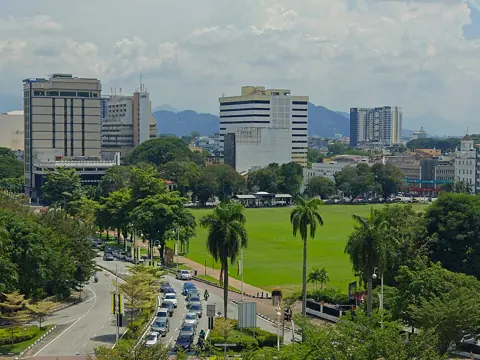
Ipoh is a good place to notice the first of these. It is the capital of Perak, a state of 2.58 million, and it is two hours by train from Kuala Lumpur — comfortably inside the corridor where Malaysian domestic travel is easy. Much of the country is outside it.
This guide sets out what the official statistics and the immigration department publish, which is more than most guides use and less than a full national picture.
The population distribution
The Department of Statistics publishes population by state with a reference date of 1 January 2026.
| State or territory | Population, thousands |
|---|---|
| Selangor | 7,454.2 |
| Johor | 4,224.3 |
| Sabah | 3,767.0 |
| Perak | 2,577.9 |
| Sarawak | 2,539.8 |
| Kedah | 2,237.4 |
| W.P. Kuala Lumpur | 2,082.3 |
| Kelantan | 1,925.3 |
| Pulau Pinang | 1,808.3 |
| Pahang | 1,686.2 |
| Terengganu | 1,260.9 |
| Negeri Sembilan | 1,248.5 |
| Melaka | 1,057.4 |
| Perlis | 297.3 |
| W.P. Putrajaya | 121.4 |
| W.P. Labuan | 101.1 |
Selangor alone holds roughly a quarter of the country's people, and adding Kuala Lumpur makes the Klang Valley conurbation larger than any three other states combined. Perlis, in the far north on the Thai border, has fewer people than a single Kuala Lumpur district.
The statistical figures cover citizens and non-citizens excluding temporary residents, and the department states the next update is due 15 October 2026.
Ipoh's own scale
Ipoh City Council describes the city as the capital of Perak Darul Ridzuan, serving as a centre for administration, commerce, sport, finance, politics, religion and education. Its council boundary covers 643 square kilometres with a population of more than 880,000.
That is the council area rather than the district or the state, and the tin-era buildings inside it carry no stated reference year, so treat it as an order of magnitude. It puts Ipoh at roughly a third of Perak's population inside a sixth of a percent of Malaysia's area — a concentration that is typical of Malaysian state capitals and explains why the rest of a state can feel empty by comparison.
What the rail network actually covers
The Electric Train Service is confined to the electrified double-track West Coast Line between Gemas and Padang Besar, running at up to 140 km/h. KTMB names its major routes as Gemas to KL Sentral to Padang Besar, KL Sentral to Ipoh, KL Sentral to Butterworth and KL Sentral to Padang Besar.
That is one corridor up one coast. It is excellent for Ipoh, Butterworth and the northern border, and it does nothing for the east coast, for Johor beyond Gemas, or for Borneo.
The internal border
The single fact most likely to surprise a visitor is that Malaysia has an immigration control inside its own territory.
The Immigration Department publishes a "Document In Lieu of Internal Travel Document", described as "issued to Malaysians from West Malaysia travelling to Sabah and Sarawak as an alternative to the Malaysian Passport and Restricted Travel Document in accordance with Part VII, Special Provisions For East Malaysia, Immigration Act 1959/63".
Its terms are specific. It is "Valid for a Single Journey. The holder is allowed to enter and remain in Sabah or Sarawak on a Social or Business Visit Pass not exceeding three (3) months." It "can be obtained from all Immigration counters at Sabah and Sarawak airport arrival halls", "No payment is required", and no parental permission is needed. Applicants aged 12 and above present an identification card or police or military identity card; under-12s a birth or adoption certificate.
Read plainly: a Malaysian arriving in Kota Kinabalu or Kuching from the peninsula passes an immigration counter and is admitted on a visit pass, in the same machinery used for entry control, capped at three months.
Departure is documented separately. To leave Sabah or Sarawak for domestic travel, the department requires one of a listed set of identity or travel documents — including MyKad and temporary identity documents, a birth certificate or MyKid — plus a valid pass and a boarding pass as proof of being a genuine passenger.
Planning around all of this
If your trip is confined to the west coast corridor, rail is the efficient spine and the state boundaries are administratively invisible to a traveller.
If it extends to the east coast or to Borneo, the pattern changes: flying becomes the practical mode, and Borneo adds an immigration step at the airport that is not a formality to be walked past.
And if it extends to the smaller states, adjust expectations about frequency rather than distance. Perlis and Labuan are small populations, which shows up as thinner services rather than longer journeys.
What this guide does not cover
The official constitutional list of states and the full set of state capitals is absent. The Federal Constitution could not be retrieved — the legislation portal's document delivery was returning server errors — and the national government portal blocked access. Only Ipoh's status is confirmed here, from Perak's own city council.
Nothing is stated about the Yang di-Pertuan Agong, the rotational monarchy, or which states have hereditary rulers rather than governors, for the same reason.
There is no per-capital mapping of which state capitals ETS reaches, for the reasons in the note above.
Nothing is stated about what a foreign visitor specifically needs when flying to Sabah or Sarawak. The Sarawak immigration department's site was unreachable, and the federal entry-requirements page says nothing about either state. Do not read the Malaysian-citizen mechanism above as applying to you unchanged; check with the Immigration Department before flying.
Immigration autonomy for Sabah and Sarawak is not asserted as a legal principle. What is verified is the mechanism the department publishes and the statute it names.
Gross domestic product per capita by state is not given; the statistics department publishes state GDP without units on the reachable file and no per-capita series was located.