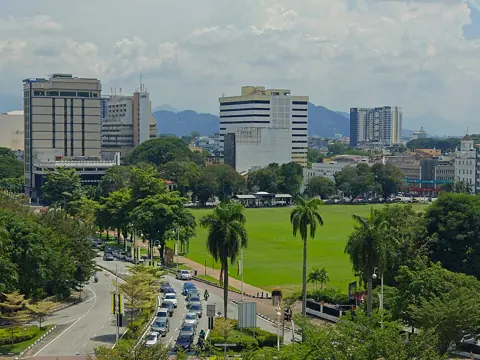
Ipoh grew on tin and looks it, which makes the near-absence of a tin museum surprising. What exists instead is a small number of well-run private and municipal sites with inconsistent public information, and the practical skill is knowing which ones need arranging in advance.
This checklist is organised by what you have to do before arriving.
Book this one, or you will not get in
Han Chin Pet Soo, the Hakka miners' club founded in 1893 by Towkay Leong Fee at No. 3 Jalan Bijeh Timah, is run as a museum by IpohWorld and admits visitors strictly by appointment.
Its published rules: "Entry… is by appointment only", bookings are accepted "up to 30 days ahead", and there is a "limited number of guests at any one time". There is no fixed entry fee on scheduled tours — "visitors will be asked to make a donation for the upkeep of the building" — while commercial tour companies pay RM 10 per adult and RM 5 per child or student. Bookings go through the operator's site or hcps@ipohworld.org.
The state museum is not in Ipoh
Muzium Perak, the state museum, is in Taiping — about an hour and a half north of Perak's capital — and it is the older and better-documented institution.
It opens daily 9am to 5pm, closing only on the first two days of Aidil Fitri and the first day of Aidil Adha, at Jalan Taming Sari, Taiping.
| Visitor | Admission |
|---|---|
| Non-Malaysian adult | RM 5.00 |
| Non-Malaysian child 6 to 12 | RM 2.00 |
| Non-Malaysian child under 6 | Free |
| Malaysian | RM 2.00 |
| Malaysian senior or person with disability | RM 1.00 |
| Malaysian child under 12 | Free |
| Malaysian secondary student in uniform | Free |
Established in 1883, it is described by the Department of Museums as the first museum founded in Malaysia. Its tin connection is a single object with a good story: a replica of the Avalokitesvara statue found in a tin ore mine at Bidor, Perak in 1936.
The department's directory lists exactly two museums in Perak — Muzium Perak and Muzium Matang at Kota Ngah Ibrahim — and no tin mining museum in the state at all.
The city trail, which asks nothing of you
Ipoh City Council publishes a Jejak Warisan heritage trail of five sites: Dewan Bandaraya Ipoh, the Birch Memorial Clock Tower, Majestic Walk at Ipoh Railway Station, Masjid Panglima Bukit Gantang and Masjid Negeri.
For each it publishes an address, a phone number, facility icons for parking, toilets, prayer room and shelter, and map links. It publishes no opening hours, no admission prices and, on most pages, no descriptive history text.
Concubine Lane is not on the trail. The council lists it under commercial and dining alongside Memory Lane, Lorong Seni and Gerbang Malam, without hours or prices, and it has no page of its own.
The council does publish downloadable city maps in three PDF sheets, though it does not say whether any sheet is specifically the heritage trail.
What the council says about how the town grew
The council's own Info Ipoh page gives the chronology, and it reads as a mining boom in dates.
Growth accelerated after 1874. In 1884 the first road was built connecting Gopeng to Kota Bharu and the mining areas. Hospital construction began in 1889. By 1893 more than half the attap houses had been replaced with stone buildings and a Sanitary Board was established. In 1895 the first English lower secondary school was built and Ipoh became the largest town in Perak. The wooden bridge over the Kinta River was replaced with iron in 1900, and between 1905 and 1914 the administrative area expanded across the river to create Ipoh New Town with its railway station, hotel, town hall and post office.
Ipoh became a municipality on 31 May 1962 and a city and state capital on 27 May 1988.
Further afield in Perak
The Archaeological Heritage of the Lenggong Valley was inscribed by UNESCO in 2012 under criteria iii and iv, reference 1396, covering 398.64 hectares with a 1,786.77 hectare buffer. Four archaeological sites in two clusters span close to two million years, with stone-tool workshops dated from 1.83 million years ago to 1,700 years ago, and Perak Man, Southeast Asia's most complete skeleton, radiocarbon dated to 10,120 years ago. UNESCO attributes management to the Lenggong District Council with the Department of National Heritage and Universiti Sains Malaysia, and publishes no visitor centre details.
Rain shapes the season for all of these, and the west coast peaks in autumn. Gua Tempurung, at Jalan Gua Tempurung in Gopeng, is described by Kampar District Council as roughly 1.9 kilometres long and known for guided tour packages, which it does not itemise. It publishes no hours and no prices. Telephone 05-4671020 or 05-4671030.
The industry today, in the only figures available
The statistics department's Economic Census for 2022 covers mineral mining and quarrying as a whole rather than tin specifically: 1,182 establishments, 82.1 percent of the sector, growing 4.5 percent annually since 2015; gross output RM 13.3 billion; value added RM 5.7 billion, up from RM 4.2 billion in 2015; 35.6 thousand persons employed. Perak was among five states exceeding the national growth rate, at 6.9 percent growth in gross output contribution.
No official tin-specific production figure could be obtained.
What this guide does not cover
Kellie's Castle is absent. Its own site returned server errors on repeated attempts, the state development corporation publishes nothing about it, and neither Ipoh nor Kampar council lists it. No operator, hours or prices could be verified, so none are given.
No Perak state tourism information appears at all. The state tourism domain does not resolve and the state government portal was unreachable.
Muzium Darul Ridzuan in Ipoh is not covered. It appears on no reachable official page and is not a Department of Museums institution.
Kek Lok Tong and Perak Cave Temple are not covered; neither appears on any government body's visitor pages.
Han Chin Pet Soo's specific session times and closed days are not given, for the reason above.
Lenggong Valley's visitor centre, hours and fees are absent; the relevant museum page returns an error and no Lenggong museum is in the national directory.
No official statement on the historical scale of Kinta Valley tin mining could be obtained, and no current Malaysian tin production figure exists in the reachable statistics.
The council pages carry recent update dates, but hours and prices are simply not published on them. Telephone before travelling for anything with a number listed above.