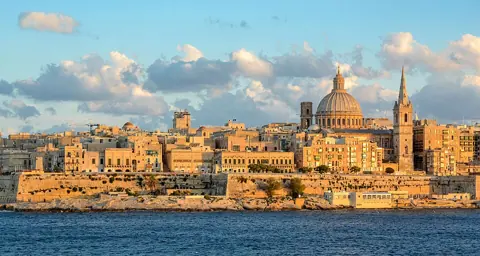
Malta's modern economy runs on three industries that have almost nothing to do with each other and almost nothing to do with the fortress-city history most visitors come to see: online gaming, ship registration, and film production. None of the three is designed to be visited, which is exactly why it's worth understanding what you're actually looking at when you brush up against them.
Online gaming: real regulation, no visible storefront
Malta became one of Europe's established hubs for licensed online gaming companies, and the Malta Gaming Authority (MGA) is the regulator responsible for the sector, describing its role on its own site as ensuring gaming is "fair and transparent, preventing crime, and protecting minor and vulnerable players" across the gaming sectors under its authority. This guide could not confirm from official sources exactly how the licensing framework's history and the reasons companies chose Malta developed in detail, so treat the industry's presence as a well-established but largely invisible part of the economy rather than something you can visit or verify firsthand.
What you will notice, if you look for it, is indirect: a disproportionate number of modern office developments and business parks around Malta's main urban area house gaming and related tech companies, even though none of it presents as a tourist-facing business.
Shipping: why so many vessels fly a Maltese flag
Malta operates as a flag state for international shipping — meaning shipowners from around the world register vessels under the Maltese flag, subject to Maltese maritime law and regulation, regardless of where the ship actually operates or who owns it. This guide could not fetch a current, detailed official source confirming exact registry size or ranking figures, so no specific statistic is claimed here; what's well established is that Malta is one of the more significant flag states globally, and shipping is a real part of the national economy rather than a marginal one.
For a visitor, the clearest place to notice this is Malta's Grand Harbour, a genuinely working port where cargo vessels, tankers and other commercial ships move through regularly — worth a look from one of the harbor-side viewpoints in Valletta or the Three Cities across the water, less as a curated attraction and more as a working piece of infrastructure you can watch from a public vantage point.
Film: Malta as a stand-in for everywhere else
Malta's combination of Mediterranean light, historic fortifications, and coastline has made it a location for international film and television productions for decades, standing in for settings ranging from ancient historical epics to fictional worlds entirely removed from Malta's own geography. Productions have used sites including Fort Ricasoli and Malta's coastal areas as filming locations, drawn by both the physical setting and the country's film-friendly production infrastructure.
The clearest visitor-facing legacy of this is Popeye Village at Anchor Bay, described by its own site as the original film set built for the 1980 Popeye movie. It has since been converted into a family attraction — the site's own material lists live animation shows, mini-golf, boat rides, play areas and a Comic Museum alongside the preserved film-set buildings, with entry priced seasonally (roughly €25 for adults in high season, dropping to around €15 in low season, per the site's own listed rates at the time this was checked).
Telling the visible from the invisible
Of the three industries, film is the only one with a genuine, purpose-built visitor site. Shipping is visible only incidentally, by watching Grand Harbour traffic from a public viewpoint. Gaming has effectively no visitor-facing presence at all beyond office buildings you'd otherwise walk past without noticing. None of that makes any of the three industries less real to Malta's economy — it just means only one of them was ever meant to be looked at by a tourist.
How the three industries relate to each other
Gaming, shipping and film share one underlying reason for choosing Malta despite having almost nothing else in common: a comparatively favorable and stable regulatory and business environment within the European Union, combined with Malta's small size making it administratively easier to navigate than larger jurisdictions. That's a generalization rather than a claim this guide can support with specific verified detail for each sector, but it's the common thread connecting three otherwise unrelated industries that all found a home on the same small island for broadly similar structural reasons.
Taken together, these three industries are a useful reminder that a country's tourist-facing identity and its actual economy don't always overlap. Malta sells itself abroad on history, coastline and village festas, while a meaningful share of its income comes from three sectors most visitors never think about at all.
What this guide does not cover
This guide does not provide registry statistics for Malta's shipping sector, licensing figures for the gaming industry, or a list of specific films and productions shot on the island, since this guide could not confirm current figures for any of these from an official source at the time of writing.