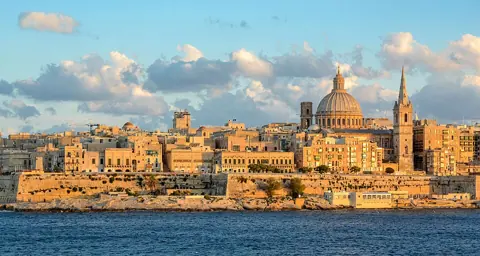
Malta is the only country in the European Union where the local language is Semitic in origin, and the mismatch between how it sounds and how it's written is the first thing that confuses visitors trying to sound out a street sign.
A Semitic language, written the European way
Maltese developed from Arabic roots — specifically from the Arabic spoken in Sicily during the medieval period — and evolved independently over centuries under Norman, Sicilian, Spanish, French and British influence. What makes it unusual isn't just its origin: it's the only official language of the European Union with Semitic roots, according to the EU's own portal, which lists Maltese among the bloc's 24 official languages.
Unlike Arabic, Maltese is written in Latin script rather than the Arabic alphabet, which means a word can look completely unfamiliar to an Arabic reader and completely unpronounceable to a European one, despite the underlying grammar tracing back to the same family. Its vocabulary reflects this layered history too: a core built on Arabic structure, a large share of words borrowed from Italian and Sicilian, and English loanwords woven in more recently, particularly for modern and technical terms.
Why English is everywhere
English sits alongside Maltese as an official language of Malta, a legacy of the island's period as a British colony and later Commonwealth member. That status is not symbolic: English is used throughout government, education, business, tourism and everyday signage, and most Maltese residents are comfortable using it, often switching between Maltese and English within the same conversation depending on context.
For a visitor, the practical result is that you can travel through Malta entirely in English — for directions, at a restaurant, dealing with transport, or reading official signage — without ever needing a word of Maltese. This is different from many European destinations where English is understood but not the default written language; in Malta, English routinely is the default written language, appearing on menus, official notices and transport information as standard rather than as a secondary tourist accommodation.
What you'll actually hear and see
Walking through Valletta or any Maltese town, you'll typically encounter both languages simultaneously — a shop sign in Maltese, a menu in English, a conversation between two locals moving fluidly between both. Street names are usually given in Maltese, but wayfinding and tourist information overwhelmingly appear in English as well, so navigation rarely depends on decoding Maltese script.
- Government and legal documents — bilingual, Maltese and English.
- Restaurant menus and tourist signage — usually English-first or fully bilingual.
- Casual conversation among Maltese residents — commonly Maltese, with English mixed in for certain words or entire phrases.
- Place names — Maltese, and worth learning to recognize even if you can't pronounce them confidently, since they appear on all signage and maps.
This layering also shows up in how place names work across the islands. Many town and street names are Maltese in origin and pronunciation but sit alongside older Italian-derived names still used informally by some residents, particularly older generations, which can occasionally cause a moment of confusion if a local direction uses a name your map doesn't show. Sticking to the official Maltese name printed on signage and in map apps is the more reliable approach for a visitor, even if you overhear an older alternative in conversation.
Why this matters beyond convenience
Malta's linguistic situation is also a quick way to read its layered history: Semitic-rooted Maltese reflecting centuries of Mediterranean and North African contact, heavy Italian influence from Sicily's proximity and the Knights of St John's own Italian-heavy administration, and English from a comparatively recent but deeply institutionalized colonial period. Hearing all of that compressed into ordinary conversation is one of the more distinctive things about spending time in Malta, even if you never learn to speak a word of it yourself.
The Italian layer, often overlooked
Alongside the Arabic-rooted grammar and the English official status, Italian has left one of the least discussed but most persistent marks on Malta's linguistic landscape. Centuries of trade, church administration under the Knights of St John (who were themselves organized along Italian-influenced lines), and Malta's proximity to Sicily embedded a large share of Italian and Sicilian vocabulary into everyday Maltese, well before English arrived with British rule. Older generations in particular often understand spoken Italian reasonably well even without having studied it formally, a legacy of Italian-language television broadcasts historically reaching Malta from across the water. It's a useful thing to know if you happen to speak Italian and English but not Maltese: between the two, you may find more common ground with certain phrases and loanwords than you'd expect walking into an unfamiliar Semitic-rooted language.
What this guide does not cover
This guide does not cover Maltese grammar in any depth or provide a phrasebook, since English alone is sufficient for nearly every visitor situation described here. It also does not address Malta's smaller linguistic minorities or dialectal variation between Malta and Gozo in detail.