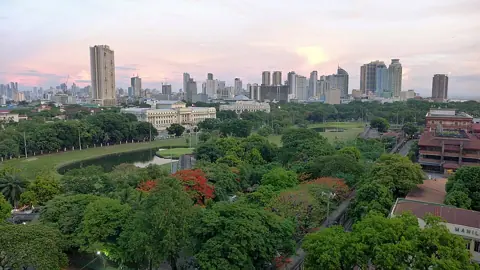
"Fly into Manila, get out of Manila" is one of the most repeated pieces of Philippine travel advice. It is worth testing against what the responsible agencies actually publish, because several of the premises behind it have moved in the last two years while the advice has not.
The airport, and why avoiding it is harder than it sounds
Ninoy Aquino International Airport carried 52,107,504 passengers in 2025, up about 3.5 percent on 2024, across roughly 292,000 flight movements. Only three of its four terminals carried traffic: Terminal 3 at 27.44 million, Terminal 2 at 14.02 million domestic, and Terminal 1 at 10.65 million international. Terminal 4 recorded zero for 2025. Moving between them is its own exercise, set out in the NAIA terminal transfer.
Clark International Airport, the usual proposed alternative, carried 2,753,101 in the same year, up 14 percent. Against the only other Luzon international gateway that publishes figures, NAIA accounted for roughly 93.5 percent of the two airports' combined international passengers.
That is the core of the case for passing through Manila: not that the airport is pleasant, but that the alternative serves a small fraction of the routes.
The airport is now privately operated
The Concession Agreement for NAIA was signed on 18 March 2024 between the Department of Transportation, the Manila International Airport Authority and the SMC-led consortium, and operations transferred to New NAIA Infrastructure Corporation on 14 September 2024. It was the first agreement signed under the new PPP Code.
The published terms are a 15-year concession with a possible ten-year extension, a commitment to share 82.16 percent of future gross revenues with government, and capacity targets rising from 35 million to 62 million passengers a year and from 40 to 48 flights per hour.
Whether that changes the experience is not something a guide can assert. What it does mean is that descriptions of NAIA written before September 2024 describe a different operator.
Ground access changed in late 2024
This is the part of the standard advice most out of date. The LRT-1 Cavite Extension Phase 1 began commercial operations on 16 November 2024, adding five stations: Redemptorist-ASEANA, MIA Road, PITX, Ninoy Aquino and Dr. Santos. Three of those sit in the airport's orbit. Road remains the default for the run from NAIA to Makati.
The rest of the project is not close. As of 31 January 2026 the extension stood at 74.11 percent overall, with Phase 1 complete and Phases 2 and 3 at zero, and the LRTA's own status report records delays in construction for Packages 2 and 3.
LRT-1 itself runs 20.1 kilometres with 25 active stations between Fernando Poe Jr. in Quezon City and Dr. Santos in Parañaque. LRT-2 runs 17.6 kilometres and 13 stations from Recto to Antipolo, carrying 53.287 million passengers in 2024 at a daily average of 147,609.
The city itself, by the numbers
The National Capital Region recorded 13,484,462 residents in 2020 across 619.54 square kilometres, at 21,765 persons per square kilometre, making it the country's most densely populated region. It comprises sixteen highly urbanized cities and the municipality of Pateros. Quezon City alone recorded 2,960,048 and the City of Manila 1,846,513, the latter the densest local government in the country at 73,920 per square kilometre.
Density is the honest explanation for the traffic that drives the skip-Manila advice. It is also why the city has more in it than a transit stop implies.
What is free, and what is measurable
The National Museum Central Complex, comprising the National Museum of Fine Arts, the National Museum of Anthropology and the National Museum of Natural History, states that admission is free, under the museum's own visitor guidelines, and that it opens Monday to Sunday from 9am to 6pm except on selected religious holidays. Groups of twenty or more must book at least three working days ahead. Most of it sits within walking distance of Manila's colonial core.
On the wider economic picture, the Philippine Statistics Authority put tourism at 8.1 percent of GDP in 2025, with inbound tourism expenditure of PHP 698.46 billion, down 6.4 percent year on year, and tourism employment at 7.70 million persons or 15.7 percent of total employment.
So is the advice right
Partly. If the question is whether Manila's airport is congested and its roads slow, the density and traffic figures do not contradict that. If the question is whether a traveller can conveniently route around it, the airport comparison says no for most international itineraries.
The more defensible version of the advice is narrower: do not plan a Manila day that depends on crossing the metro by road at peak hours. A day built around Rizal Park, the free national museums and Intramuros, all within walking distance of one another, is a different proposition from one that assumes the city works like a compact European capital.
What this guide does not cover
Department of Tourism visitor arrival figures for 2024 and 2025 are not given, because they were not retrievable from any official page at verification and the numbers circulating come from secondary reporting. MRT-3's line length, station count, current ridership and fares are likewise omitted, as the operator's pages were unreachable. No MMDA traffic data, number coding rules, hours or covered area are stated for the same reason, and travellers should check those directly before driving. The Metro Manila Subway and North-South Commuter Railway are excluded because no official status figures could be confirmed. Average length of stay is not published in the sources reached.