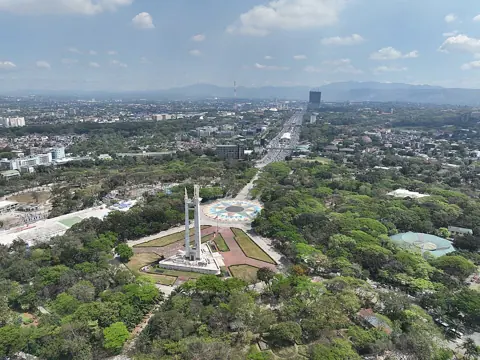
Understand the scale first
Quezon City is one of the largest local government units in Metro Manila by area, and travellers who treat it as a single destination end up making unnecessary journeys.
It contains government offices, universities, large residential districts, entertainment venues and commercial areas that can be a substantial road journey apart. Two attractions both described as being in Quezon City may have nothing convenient in common.
So the planning sequence is: find your specific destination, find the nearest station on any line, then pick the line. Not the other way round.
The three lines and where they touch the city
LRT Line 1 runs the north-south corridor between Fernando Poe Jr. station and Dr. Santos station in Parañaque, serving Quezon City, Caloocan, Manila, Pasay and Parañaque, with 25 active stations. Its northern terminus is inside Quezon City, which makes it the line for destinations at that end.
LRT Line 2 runs east to west from Antipolo in Rizal to Recto in Manila, crossing Pasig, Marikina, Quezon City, San Juan and Manila across 13 stations. It is the line for the city's eastern corridor.
MRT-3 runs along EDSA with 13 stations from North Avenue in Quezon City to Taft Avenue in Pasay. Its North Avenue terminus is the anchor for the north-western part of the city and the transport interchange around it.
One card for all three
The beep stored-value card is accepted on LRT-1, LRT-2 and MRT-3, and can be bought at stations from teller booths or ticket vending machines. Reloading works at stations, at partner terminals, through the beep app, or via mobile wallets.
If you plan more than a couple of rail journeys, buy it on a quiet day rather than during a rush-hour queue. It removes the ticket transaction from every subsequent trip, which matters more at busy stations than the small saving does.
The EDSA busway as a complement
The dedicated busway along EDSA, developed jointly by the transport department and the metropolitan development authority, runs the same broad corridor as MRT-3 with its own stations including Monumento, Balintawak, Quezon Avenue, Kamuning and Santolan.
For destinations along EDSA that are awkward from a rail station, the busway is often the better tool, and because it runs in a separated lane it is less exposed to general traffic than an ordinary bus.
Timing your journey
Two constraints matter.
Rail lines are not late-night services. Operators have published first trains in the early morning and last trains in the evening, with some extended evening timings announced in recent years. Check the last train for your line and direction before you commit to an evening out at the far end of a line.
And peak-hour crowding on these corridors is significant. If you have luggage, a young child or limited mobility, travelling off-peak is not a preference here, it is the difference between a manageable trip and a difficult one.
Putting a journey together
| Your destination | Likely line |
|---|---|
| Northern Quezon City | LRT-1 northern end or MRT-3 at North Avenue |
| Eastern corridor toward Marikina and Antipolo | LRT-2 |
| Along EDSA | MRT-3 or the EDSA busway |
| Somewhere with no nearby station | Rail to the closest point, then a short app ride |
That last row is the pattern most visitors end up using, and it works well. Rail covers the long, congested middle of the journey, and a short booked ride covers the last stretch. Trying to do the whole thing by road is what turns a 40-minute trip into an afternoon.