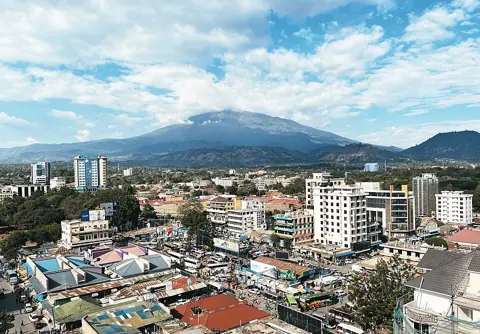
Kilimanjaro National Park earned TZS 95.3 billion in the 2023/24 financial year. That is about 23% of everything Tanzania National Parks (TANAPA) collected across its 21 parks, according to TANAPA's Northern Zone Quick Reference (95,322,778,379 ÷ 410,895,848,872). That is roughly double the TZS 48.0 billion earned by Tarangire, the next northern-zone park. The tariff behind that income is mostly time-based: fees per person per day and per night. TANAPA's history page says this tourism income is ploughed back into running the parks.
What does Kilimanjaro National Park charge a climber?
The figures below come from TANAPA's tariff for 1 July 2023 to 30 June 2024. It is the latest schedule on TANAPA's site that we could read, and the October 2024 Quick Reference still prints it. Kilimanjaro has no low season: the same rates apply from July to June. The schedule states that all charges exclude 18% VAT and that fees, once paid, are non-refundable.
| Charge | Non-EA adult (16+) | Child 5 to 15 | Unit |
|---|---|---|---|
| Conservation fee | USD 70 | USD 20 | per day |
| Public campsite | USD 50 | USD 10 | per night |
| Mandara, Horombo or Kibo hut | USD 60 | USD 20 | per night |
| Upper Barafu Camp | USD 100 | USD 20 | per night |
| Rescue fee | USD 20 | USD 20 | per trip |
Children under 5 pay no conservation fee. Foreign residents of Tanzania pay USD 35 a day and East African citizens TZS 10,000. Tanzanian crew, which covers guides, porters and cooks, pay a separate crew fee of TZS 5,000 per climb. The rescue fee is the only line charged once per climb rather than by time.
How does route length change the park fees?
Because the conservation fee is charged every day, the length of the climb matters more than the name of the route. The examples below are for one non-EA adult. They assume one conservation fee per calendar day on the mountain and VAT applied to every line, as the schedule's note says.
- 5 days, 4 nights in the priced huts: 5 × USD 70 + 4 × USD 60 + USD 20 = USD 610, plus USD 109.80 VAT = USD 719.80
- 7 days, 6 nights at public campsites: 7 × USD 70 + 6 × USD 50 + USD 20 = USD 810, plus USD 145.80 VAT = USD 955.80
- 7 days, with one of the six nights at Upper Barafu Camp: 7 × USD 70 + 5 × USD 50 + USD 100 + USD 20 = USD 860, plus USD 154.80 VAT = USD 1,014.80
The second example costs USD 236 more in park fees than the first, and its two extra days buy acclimatisation time. The CDC Yellow Book 2026 advises that above 3,000 m you should raise your sleeping altitude by no more than 500 m a night. It also recommends an extra night for every 1,000 m gained. Uhuru Peak stands at 5,895 m according to UNESCO. The US State Department's Tanzania page tells climbers to know the symptoms of altitude sickness. It also strongly recommends insurance that covers medical evacuation.
TANAPA's own park page still says a climb "normally take[s] five to six days". Take that as a description of common practice, not a recommendation. Ask your operator for the sleeping elevation of each night and compare the nightly gains with the CDC rule.
Which routes does TANAPA list?
TANAPA gives two different lists. Its park page names Marangu ("the easiest to climb and therefore the more popular"), Machame, Shira, Umbwe and Rongai. The October 2024 Quick Reference lists Marangu, Machame, Rongai, Umbwe, Londorosi and Lemosho. It does not mention Shira, and it adds the two western approaches. Neither list includes every itinerary that operators sell, so ask which gate you start from and which you finish at.
The tariff prices hut nights only at Mandara, Horombo and Kibo, and requires them to be booked in advance. Other nights are charged at the campsite rate, apart from Upper Barafu. Before comparing quotes, check whether each itinerary sleeps in huts or tents. A hut night costs USD 10 more than a campsite night before VAT.
For getting there, the Quick Reference puts the park 41 km from Moshi and 86 km from Kilimanjaro International Airport; it gives no distance from Arusha, so ask whether the transfer is in your price.
Who guides, who carries: operators, guides and porters
We could not find TANAPA's general climbing regulations online, so we cannot quote the park's own rule on guides for the trekking routes. What official sources do say:
- Operators. The UK Foreign Office's safety advice, updated 17 September 2026, tells British travellers who trek or climb to use only a reputable travel company, stick to established routes and walk in groups. It notes that the Tanzania Association of Tour Operators keeps a list of licensed tour companies. TANAPA's Quick Reference says it works with 2,088 tour operators in the northern zone.
- Crew. The tariff charges Tanzanian crew a fee per climb, separate from what visitors pay. Your crew's park fees are a real cost to the operator, so check whether they are included in your quote.
- Technical climbing. For Mawenzi Peak, TANAPA's Mawenzi guidelines require an operator with a valid Mountain TTLB licence and technical climbing guides. Climbers must be at least 18 and experienced rock climbers, and only one pair of climbers is allowed on the peak at a time, between 06:00 and 18:00. TANAPA's tariff prices the Mawenzi technical climb at USD 750 per person per day.
Porter welfare standards come mainly from the non-profit Kilimanjaro Porters Assistance Project rather than from a published park rule. Its partner guidelines cap a porter's load for the company at 20 kg, not counting the porter's own kit. They also say wages must be paid within two days of the descent "as per KINAPA's regulations". The project says the legal minimum wage for porters is not enforced, so pay varies between companies. You can ask your operator three things: whether it follows those standards, what porters are paid, and when.
Before you pay a deposit, get the park-fee breakdown, each night's sleeping elevation and the crew arrangements in writing. If an operator will not itemise the park fees, add them up yourself from the table above. If your trip also includes a safari, our Serengeti and Ngorongoro fees guide explains the second tariff you will meet.