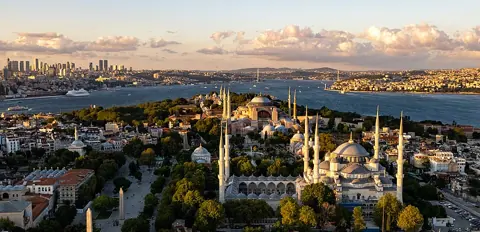
Both bazaars were built to pay for a mosque. The Grand Bazaar Tradesmen's Association says Mehmed II founded the Cevahir and Sandal bedestens to produce income for Hagia Sophia. Fatih Municipality describes the Spice Bazaar as the shop row of the Yeni Cami complex, created to provide income for a charitable foundation. Knowing this explains their layouts. Each is a block of rentable units that funded a religious endowment (vakıf), and the General Directorate of Foundations still has a role in both today.
What is a han, and how is it different from a bedesten?
Turkish uses three words for three kinds of building, and they are easy to mix up.
- Bedesten: the Turkish Language Association (TDK) defines it as a covered market where valuables such as cloth and jewellery were bought and sold. The Istanbul Provincial Culture and Tourism Directorate records that valuables, jewellery and money were kept in iron safes in the walls of both Grand Bazaar bedestens. The İç (Cevahir) Bedesten measures 48 by 36 metres. The Sandal Bedesten measures 40 by 32 metres, with 20 brick domes on 12 piers.
- Han: TDK gives two meanings. One is a roadside building where travellers stayed. The other is a multi-storey city building where people rent a room and work. The Grand Bazaar's hans are the second kind: courtyard blocks of rooms around and between its streets.
- Çarşı (with arasta for a row of shops attached to a mosque complex): the streets of shops themselves.
The association says the bedestens were more than a treasury. They also worked as finance centres where capital built up through trade, and the association still calls the bazaar a reference point for gold and currency prices. The Spice Bazaar has no bedesten or han. It is all çarşı: one arcade of shops. The Culture Portal adds that commercial courts once sat on its upper floors.
How many shops and hans does the Grand Bazaar have?
The answer depends on who is counting and what they count. Official sources give different figures, and none of them is simply wrong.
| Source | Shops | Hans | Area | Gates / streets |
|---|---|---|---|---|
| Management plan, 29 Oct 2024 | 2,385 (2,463 units incl. hans, bedestens) | 14 | not stated | not stated |
| Tradesmen's association | 3,600 | 14 (29 historic names listed) | 45,000 m² covered; 110,868 m² total | 11 gates; 65 streets |
| Istanbul Culture and Tourism Directorate | about 4,000 | 17 | 30,700 m² | 24 gates; 66 streets |
| Culture Portal | 3,600 | not stated | 45,000 m² | not stated |
| Go Türkiye | 4,500 | not stated | 307,000 m² | 61 covered streets |
The management plan's figure is the legal one. It counts the units that will be registered as separate condominium titles, which is why it is the lowest. The association lists 29 han names, including Zincirli, Çuhacı, Mercan, Sorguçlu and Kızlarağası, but gives a total of 14. We could not confirm which of the 29 are counted as the 14, or whether the others no longer exist or now sit outside the covered area. Go Türkiye's area is ten times the Directorate's 30,700 m² and may be a typing error. We could not confirm this.
Who runs the Grand Bazaar today?
The bazaar is part mosque endowment, part private property, and it is currently becoming a condominium. The 2024 management plan names the General Directorate of Foundations, the Istanbul Metropolitan Municipality and Fatih Municipality as owners of registered properties, alongside private owners. It sets up a board with nine elected members and four public representatives: the Governorship, the Metropolitan Municipality, Fatih Municipality and the Regional Directorate of Foundations. It also bans shops from staying closed during trading hours without a reason, and bans goods that block the shared passages.
The plan says the bazaar is open all twelve months of the year. It leaves the exact opening and closing times to an internal directive from the board, which we could not find published. The 08:30–19:00, closed Sundays and religious holidays figure comes from the Ministry of Culture's Culture Portal.
The Spice Bazaar: one arcade, six gates, disputed dates
It was first called the New Bazaar (Yeni Çarşı) or Valide Bazaar. The Culture Portal and the Istanbul Culture and Tourism Directorate both say it became the Egyptian Bazaar in the 18th century. The reason was that it had been built with taxes collected from Egypt, and most of the goods in its shops came from there. The Directorate records how the six gates divided the trades. The Balıkpazarı, Hasırcılar and Ketenciler gates served the aktars (herbalists and spice sellers). The Yeni Camii, Haseki and Çiçek Pazarı gates served the cotton merchants. Fatih Municipality's history counts 88 shops inside the L-shaped arcade and 18 more facing outward onto Tahmis Street.
The official dates do not agree:
- Start: the Governorship of Istanbul and Fatih Municipality date the start of the Yeni Cami complex to 1597, under Safiye Sultan. The Culture Portal and the Directorate date construction of the bazaar to 1660, under Turhan Sultan.
- Opening: the Directorate and the tradesmen's association give 1664. Fatih Municipality and the Governorship say 1663–1664. Türkiye Turizm Ansiklopedisi dates the inauguration of the whole Yeni Cami complex to 30 October 1665.
- Shop count: the Governorship's 2019 article counts 113 shops today. The tradesmen's association says 130 shops on two floors, with 663 people working there.
- Restoration: the Governorship dates the General Directorate of Foundations' restoration to 2013–2018. The Directorate and the Culture Portal give 2015–2018. Those two also record a 1940–1943 restoration, while the Governorship says the Istanbul Municipality restored the bazaar after a 1940 fire.
Which bazaar suits which errand?
Some practical differences follow from the buildings themselves. The Spice Bazaar is a single arcade with six gates, so it is hard to get lost. You can walk the whole thing in one loop. The Grand Bazaar's 11 gates (by the association's count) open onto different neighbourhoods. The association names them: Beyazıt, Çarşıkapı, Çuhacıhan, Kuyumcular, Mahmutpaşa, Nuruosmaniye, Örücüler, Sepetçihan, Takkeciler, Tavukpazarı and Zenneciler. Agree on a meeting gate by name before your group splits up. The association notes that many hans and streets are named after the trades once carried on there.
The Grand Bazaar itself is not named in the UNESCO inscription of the Historic Areas of Istanbul (1985). That listing refers to the Süleymaniye quarter "with Suleymaniye Mosque complex, bazaars and vernacular settlement". The Grand Bazaar's link to Hagia Sophia is historical: the bazaar was built to pay for it. Our Hagia Sophia and Blue Mosque visiting rules cover that visit, and the airports and transit card guide explains the card you will use on the tram and buses between them.
Before you go on the day, check two things: whether it is a Sunday or a religious holiday (the Grand Bazaar will be closed), and the time. The Spice Bazaar's published closing time of 19:30 is half an hour later than the Grand Bazaar's 19:00, so on a split visit it makes sense to do the Grand Bazaar first.