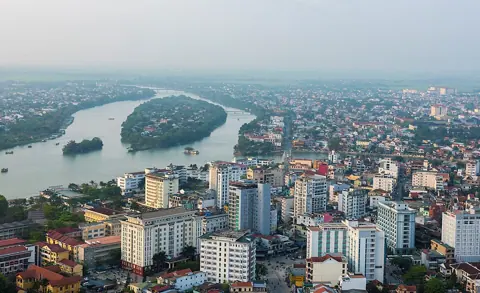
The English word "temple" is doing the work of five separate Vietnamese institutions, and they do not agree with each other about what you may do inside. On one Hue street you can walk from a building where a resident monastic community follows a religious organisation's discipline, into a building owned collectively by a village, into a state heritage monument with a turnstile and a published dress code — and the correct behaviour changes at each doorway.
This matters more in Hue than almost anywhere else in Vietnam, because Hue holds both a dense population of working religious buildings and the ticketed Nguyễn dynasty monuments, and visitors routinely treat the second as though it were the first. The monuments are the ones with written, enforceable rules. The pagodas mostly are not.
This guide covers what the different building types are, what Vietnamese law actually regulates, and what the Hue Monuments Conservation Centre requires at its ticketed sites. It does not cover Catholic churches, Cao Đài or Hòa Hảo premises, individual festival programmes, or the interior liturgy of Buddhist services.
Why does "temple" mislead?
Calling every Vietnamese religious building a temple collapses distinctions that Vietnamese people, and Vietnamese law, keep separate. A chùa is a Buddhist institution with clergy and a parent organisation. A đình is village property. A đền commemorates a specific person or deity. A miếu is often a small roadside or riverside structure. A nhà thờ họ belongs to one extended family. Lumping them together produces a single made-up etiquette that fits none of them.
Vietnam's state broadcaster sets out the functional differences directly. VOV describes the chùa as "nơi tập trung sinh hoạt, tu hành và thuyết giảng đạo Phật" — a place of gathering, monastic practice and Buddhist preaching; the đình as the place of the village tutelary deity, the Thành hoàng, and also "nơi hội họp, bàn việc của dân làng", where villagers met and settled village business; the đền as dedicated to "một vị Thánh hoặc những nhân vật lịch sử được tôn sùng", a saint or a venerated historical figure; and the miếu as a smaller structure for localised spirits, often placed at a village entrance or a riverbank (VOV, Cách phân biệt Chùa, Đình, Đền, Miếu…, published 10 June 2019, checked 11 September 2026).
Notice what that does to the assumption that these are all "Buddhist temples". Only the chùa is Buddhist. A đình is a civic building with a sacred function, and its historical primary use was administrative. A đền may commemorate a general, a scholar or a mother goddess with no Buddhist content at all. The single English word conceals a difference of institution, of ownership and of purpose.
The table below is the practical decoder. Use the Vietnamese name on the gate sign, not the English on your map app, because the gate sign is accurate and the map label frequently is not.
| Vietnamese term | What it is | Who it is for | What is expected of a visitor |
|---|---|---|---|
| Chùa | Buddhist pagoda or monastery; a cơ sở tôn giáo in law | A Buddhist community with resident or visiting clergy | Quiet, covered shoulders and knees, follow the community's own signage; you are a guest in a working religious house |
| Đền | Temple to a deity, saint or venerated historical figure | Devotees of that specific figure, often from far away | Modest dress, no disruption of people making offerings; the main altar may be off limits to casual visitors |
| Đình | Communal house holding the village tutelary deity | The village that owns it, collectively | Ask before entering if it is not obviously open; it is community property, not a public monument |
| Miếu | Small shrine to a local or natural spirit | Immediate neighbourhood or passers-by | Do not enter or rearrange it; look, do not handle; many are actively used daily |
| Nhà thờ họ | Clan ancestral hall for one extended family | One lineage, its descendants | Entry by invitation only; it is private family property despite its formal legal category |
What does the law separate?
The distinction between a pagoda and a deity temple is a legal one in Vietnam, not just a naming quirk, and the relevant text is Article 2 of the Law on Belief and Religion. The law, number 02/2016/QH14, was passed on 18 November 2016 and took effect on 1 January 2018 (Luật Tín ngưỡng, tôn giáo 2016, checked 11 September 2026; the same definitions appear in the published PDF circulated by Sở Nội vụ tỉnh Lạng Sơn, checked 11 September 2026).
Article 2 defines a cơ sở tín ngưỡng as "nơi thực hiện hoạt động tín ngưỡng của cộng đồng như đình, đền, miếu, nhà thờ dòng họ và những cơ sở tương tự khác" — the place where a community carries out belief activity, such as a communal house, a deity temple, a shrine, a clan ancestral hall and other similar facilities. The same article defines a cơ sở tôn giáo as "gồm chùa, nhà thờ, nhà nguyện, thánh thất, thánh đường, trụ sở của tổ chức tôn giáo, cơ sở hợp pháp khác của tổ chức tôn giáo" — comprising pagodas, churches, chapels, Cao Đài temples, mosques, the headquarters of a religious organisation and its other lawful premises.
Read those two lists side by side and the dividing line is the organisation. A cơ sở tôn giáo belongs to a recognised religious organisation with doctrine, canon law, ritual and structure — the law's definition of tôn giáo requires a system of "đối tượng tôn thờ, giáo lý, giáo luật, lễ nghi và tổ chức". A cơ sở tín ngưỡng has no such parent body. The law defines tín ngưỡng as belief expressed through rites bound to custom and tradition, and hoạt động tín ngưỡng as ancestor veneration, worship of sacred symbols, and the commemoration of those who served the country or the community.
The practical consequence for a visitor is about who can answer your question. At a chùa there is an institution, a resident community, and usually someone with the standing to say yes or no. At a đình or a miếu there may be nobody in attendance at all, because the caretaker is a villager and the building is opened for occasions. An empty đình is not an invitation.
Which building expects what?
Expectations differ by building type in ways that are mostly unwritten, which is exactly why they are worth stating carefully. The chùa is the type most used to receiving strangers, since Buddhist pagodas in Vietnam are open to lay visitors as a matter of ordinary practice, and most Hue pagodas of any size see non-Buddhist visitors daily. That familiarity is why pagodas are also the buildings where visitor behaviour is most often, and most quietly, corrected.
A đền is more variable. Some are effectively pilgrimage sites with staff and donation desks; others are small and attended only by a keyholder. Because a đền is dedicated to a particular figure, the ritual life inside can be dense and specific — offerings, spirit mediumship in some traditions, festival cycles tied to that figure's dates — and a visitor wandering in mid-rite is more intrusive than the same visitor at a large pagoda.
The đình deserves the most caution of the group, and for a reason that has nothing to do with religion. It is owned by the village. Vietnamese heritage practice treats the đình as collective community property, and its historical function as a meeting hall means that in many places it is still the village's building for village purposes. Walking into one uninvited is closer to walking into a community centre than into a church.
How do heritage sites differ?
The Nguyễn imperial sites in Hue operate on a different logic from every building above, because they are state-managed heritage monuments rather than active places of worship. They are administered by the Hue Monuments Conservation Centre (Trung tâm Bảo tồn Di tích Cố đô Huế), admission is set by resolution of the Hue City People's Council, and the site has published visitor regulations that staff are authorised to enforce. That is the opposite of the pagoda situation, where almost nothing is written down and almost everything is social.
The confusion is understandable, because the imperial sites are not secular either. Each royal tomb contains a temple hall in which the emperor is venerated, the Đàn Nam Giao was the altar for the state sacrifice to Heaven, and Điện Hòn Chén remains a site of active Mother Goddess worship while also appearing on the ticket schedule. The distinction is not sacred versus profane. It is managed-and-ticketed versus community-run.
This table sets out what actually changes when you cross from one category to the other.
| What changes | Active place of worship | Ticketed Hue heritage site |
|---|---|---|
| Ticketing | No standard admission; donation boxes, no turnstile | Fixed fee by People's Council resolution, e-ticket and gate check |
| Dress | Custom and social expectation; rarely posted, rarely enforced at the gate | Published requirement; staff may end your visit for revealing clothing |
| Photography | Site by site; the altar interior is the usual sensitivity | Handheld generally fine; filming for production and drones need permission |
| Behaviour | Governed by the community present and by what the rite needs | Governed by a written nội quy covering touching, sitting, smoking and noise |
| Who decides | Abbot, caretaker, village or family | The Conservation Centre, under state heritage administration |
What do Hue's rules say?
Hue's imperial monument admission is set by Resolution 55/2025/NQ-HĐND of the Hue City People's Council, signed 25 December 2025 by council chairman Lê Trường Lưu and in force from 4 January 2026. For adults, the Imperial City (Đại Nội) costs VND 200,000 and the tombs of Minh Mạng, Tự Đức and Khải Định cost VND 150,000 each; the tomb of Gia Long is VND 150,000, Đồng Khánh VND 100,000, and a VND 50,000 tier covers Thiệu Trị's tomb, the Museum of Royal Antiquities, Điện Hòn Chén, Cung An Định, Đàn Nam Giao and the tomb of Dục Đức. Children aged 7 to 12 pay VND 40,000 at the Imperial City and VND 30,000 at the three main tombs, and enter the VND 50,000 sites free (Nghị quyết 55/2025/NQ-HĐND, checked 11 September 2026).
Combination tickets are cheaper than the sum of their parts and carry longer validity. The four-site package covering the Imperial City plus Minh Mạng, Tự Đức and Khải Định is VND 530,000 for adults and VND 100,000 for children, valid two days; the all-sites package is VND 600,000 and VND 120,000, valid five days. Those two figures are unchanged from the previous schedule, Resolution 22/2022/NQ-HĐND, which set the same VND 200,000 and VND 150,000 headline prices from 1 January 2023 (Nghị quyết 22/2022/NQ-HĐND, checked 11 September 2026). The Ministry of Culture, Sports and Tourism separately confirmed the VND 50,000 tier for those six sites when it took effect (Bộ VHTTDL, 4 December 2024, checked 11 September 2026). Prices are set by resolution and can be changed by resolution — confirm on the day.
The regulations are more recent than the tariff. On 16 July 2026 the Hue Monuments Conservation Centre published visitor rules for the monuments complex, reported by the Ministry of Culture's own newspaper. Visitors are asked not to wear "trang phục phản cảm, hở hang (như quần cộc, váy ngắn, áo hở vai...)" — offensive or revealing clothing such as shorts, short skirts or bare-shouldered tops — in palace interiors and worship spaces, not to use "thiết bị flycam (thiết bị bay siêu nhẹ)", not to touch, sit or lie on or write on artefacts, not to pick flowers or break branches, and not to smoke. Reporting states that site security may terminate a visitor's tour for breaches (Báo Văn hóa, 16 July 2026, checked 11 September 2026; further detail in Dân trí, 17 July 2026, checked 11 September 2026, which adds that hats are to be removed inside palace buildings, that quiet is required in solemn spaces, and that unauthorised filming, performance, weapons, flammable materials and live animals are prohibited).
We are citing news reports rather than the Centre's own page for one reason, and it should be stated openly: hueworldheritage.org.vn and its e-ticket subdomain did not respond on 11 September 2026 from either connection we tried, so the regulation text could not be read at source. Báo Văn hóa is the newspaper of the Ministry of Culture, Sports and Tourism, which makes it the closest available reporting to the issuing authority, but it is still reporting. Treat the wording above as the substance of the rules rather than their exact legal text.
Where do shoes come off?
Shoe removal at Vietnamese religious buildings is a real and widely observed practice, and this guide could not confirm it from any official published rule. That absence is the honest finding. No provision of the Law on Belief and Religion, the Ministry's tourism code of conduct, the festival decree or the Hue monuments regulations addresses footwear. The pages that state it as a requirement are commercial travel sites, and the brief for this guide excludes them as sources.
What is observable and reportable is the mechanism rather than the rule. Where shoes come off, there is a rack or a heap of sandals at the threshold of the specific hall involved — typically the chính điện, the main worship hall of a pagoda — not at the gate of the compound. The signal is physical and local: a rack means take them off before that doorway; no rack and people walking through in shoes means the hall is not treated that way.
That is the pattern this guide can describe rather than prescribe. At the ticketed Hue monuments, no shoe rule was published in the July 2026 regulations, and visitors walk the Imperial City and the tombs in shoes. At a working pagoda, look at the threshold before you cross it. If you want a rule to follow, follow the rack.
What is custom, not rule?
Almost all of what circulates in English as Vietnamese temple etiquette is custom rather than law, and the distinction is worth stating precisely because the two get presented interchangeably. Vietnamese law regulates three narrow things: what the Ministry asks of tourists as a voluntary code, what the festival decree requires of festival participants, and what a specific managed site publishes as its own regulations. Everything else — where to stand, which foot crosses the threshold, how many incense sticks, which way to bow — is custom, varies by region and by building, and carries no penalty.
The Ministry's code is explicitly a code of conduct, not a regulation with sanctions. Decision 718/QĐ-BVHTTDL of 2 March 2017 issued the Bộ Quy tắc Ứng xử văn minh du lịch, which asks visitors to "mặc trang phục nghiêm túc khi tham quan tại những nơi thờ tự tín ngưỡng tôn nghiêm" — to dress seriously when visiting solemn places of worship — to respect local culture, religion, belief and custom, to follow posted site regulations and signage, and not to carve or draw on walls, statues or stone steles (Quyết định 718/QĐ-BVHTTDL, checked 11 September 2026). Note the phrasing: it asks. It is guidance addressed to visitors nationwide, not an offence schedule.
Festivals are where the law does bite, and only there. Decree 110/2018/NĐ-CP on the management and organisation of festivals, signed 29 August 2018 and effective 15 October 2018, sets out in Article 6 the responsibilities of festival participants, including behaving respectfully, dressing in keeping with Vietnamese custom, and burning incense and votive paper only in designated places (Nghị định 110/2018/NĐ-CP, checked 11 September 2026).
The votive paper question, which visitors ask about constantly, has a concrete answer with a concrete limit. Decree 38/2021/NĐ-CP on administrative penalties in culture and advertising, signed 29 March 2021 and effective 1 June 2021, provides at Article 14(1) for a warning or a fine of VND 200,000 to VND 500,000 for "thắp hương hoặc đốt vàng mã không đúng nơi quy định" — burning incense or votive paper outside the designated place — alongside penalties for language that disturbs the solemnity of the event and for dress inconsistent with Vietnamese cultural tradition (Nghị định 38/2021/NĐ-CP, checked 11 September 2026). The limit matters: Article 14 is headed as violations concerning the organisation of festivals. Outside a lễ hội, the enforceable instrument is the individual site's own regulations, not this fine.
So the working method in Hue reduces to two questions asked at each gate. First, is money being taken against a printed tariff? If yes, you are at a Conservation Centre monument: cover your shoulders and knees, take your hat off indoors, leave the drone in the hotel, and read the nội quy board because it is enforced. Second, if no, is anyone here using the building right now? If yes, you are a guest: dress the same way, keep quiet, do not photograph people mid-offering, look for the shoe rack at the hall door, and put money in the box rather than into anyone's hand.
Neither question requires you to know whether the sign says chùa or đền. But knowing which it says tells you who you would have to ask if you wanted permission for anything — a monastic community, a village, a family, or a government office — and those four answers are not interchangeable.