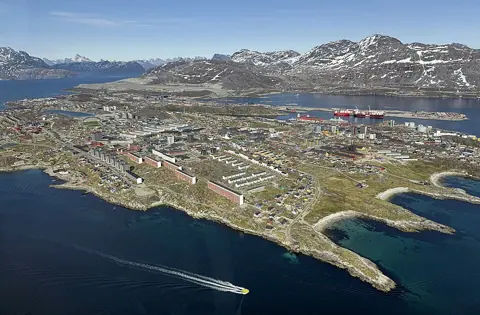
Greenland is part of the Kingdom of Denmark, an EU and Schengen member, but Greenland itself withdrew from what became the EU's predecessor in 1985 and has remained outside the EU, and outside Schengen, ever since. For visitors, that produces a specific, checkable set of consequences rather than a vague "different rules apply."
Outside the EU, outside Schengen, but on the Schengen radar
The Greenland Representation in Denmark states the position directly: "Greenland is not a part of the Schengen agreement. However, the country is covered by the Schengen Information System." That second point is worth understanding on its own terms — Greenland can still be checked against the shared Schengen security and alerts database even though it does not participate in Schengen's border-free travel or common visa policy. The two things, participation in Schengen and inclusion in one of its shared databases, are not the same, and Greenland is a case where they diverge.
The passport and visa rules that follow from this
Because Greenland sits outside Schengen's common visa and entry-document framework, its own document requirements do not simply mirror Denmark's. The Greenland Representation notes that "EU citizens cannot use national ID cards; a passport is mandatory" for entering Greenland — a stricter rule than travel within Schengen itself, where an ID card is often sufficient. It draws one specific exception: "Nordic citizens may enter with just a photo identification document," provided it meets the applicable aviation-safety identification standard.
For travellers who need a visa at all, the Danish Immigration Service is explicit that a standard Schengen visa does not cover Greenland automatically: "A Danish/Schengen visa does not grant permission to enter the Faroe Islands or Greenland." The Immigration Service advises applicants to "state whether or not the visa also should pertain for Greenland" at the time of applying, so the requirement is resolved before travel rather than discovered at the gate.
Why the routing through Denmark matters
Nearly all international travel to Greenland connects through Denmark, and that Danish leg is genuinely inside the Schengen Area and subject to its border and EES rules. A traveller who needs a Schengen visa for the Danish connection and a nationality-dependent additional permission for Greenland itself may need to sort out both before departure, not just one. This is the same structural issue that applies to the Faroe Islands, the Faroe Islands, Denmark's other self-governing territory reached mainly by air and sea, and it is worth checking both requirements together if your itinerary touches either.
Your Schengen 90-day count and Greenland
Because the 90-in-180-day short-stay limit applies to the Schengen Area, and Greenland is outside it, time spent in Greenland does not draw down that allowance. This holds regardless of how long the Greenland portion of your trip runs; only days actually spent inside Schengen territory, including any Danish stopover, count against the limit tracked through the EES.
No EES registration in Greenland itself
Since Greenland does not participate in Schengen, it does not run the EU's Entry/Exit System either. Arriving there does not involve the biometric fingerprint-and-facial-image registration used at Schengen external borders; you go through Greenland's own entry check instead, administered under Danish authority but structurally separate from the Schengen system.
This is a useful distinction to hold alongside the practical question of how you actually get to Greenland and move around it, given how limited the territory's internal transport connections are — the entry-document question and the getting-around question are both shaped by the same underlying fact of Greenland's isolation and self-governing status, but they require separate planning.
The Schengen Information System detail, unpacked
It is worth sitting with the Greenland Representation's specific wording a little longer, because it is easy to misread. Being "covered by the Schengen Information System" means Greenland's authorities can check travellers against the same shared alerts and records Schengen states use, for security and law-enforcement purposes. It does not mean Greenland grants Schengen entry rights, issues Schengen-recognised stamps, or counts toward the Schengen short-stay calculation. Treat the two as entirely separate: one is a background data-sharing arrangement, the other is the actual border-crossing regime that determines what document you need and whether your visit counts against your 90 days.
Why this surprises more travellers than the Faroe Islands version
Greenland's connection to Denmark is often assumed to work the same way a French overseas territory relates to mainland France, or a US state relates to federal law. It does not. Greenland has extensive self-government and sets its own immigration position independent of Denmark's EU and Schengen membership, which is why a Danish passport does not automatically resolve every question about Greenland entry for a non-Danish traveller, and why the Danish Immigration Service maintains a dedicated page just for this distinction.
What to check before you rely on this
Requirements differ by nationality and by whether your routing includes time in mainland Denmark or another Schengen country. Confirm your specific document and visa needs directly with the Danish Immigration Service's Greenland and Faroe Islands visa page or the Greenland Representation in Denmark before booking, rather than assuming a Schengen visa or EU passport alone settles the question.