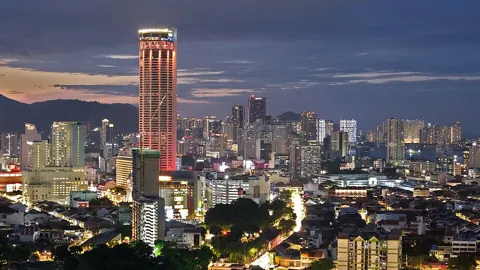
Most visitors to Penang come for the shophouses and stay entirely within a few square kilometres of George Town. That is a reasonable way to spend a few days, and it means missing the thing that makes the state economically remarkable — not because it is hidden, but because it is not open.
This guide covers what each side publishes, and is clear that only one of them can be visited.
The scale of the industrial side
The statistics department's July 2026 state trade release states that "Pulau Pinang remained the leading exporting state, accounting for 48.4 per cent of Malaysia's total exports", with Johor second at 19.1 percent. For full-year 2025 it recorded Penang at 38.1 percent of a national total of RM 1.6 trillion.
That is from a state of about 1.81 million people, roughly five percent of Malaysia's population.
The state investment agency fills in the sector picture. Malaysia's electrical and electronics industry contributed RM 601.6 billion to national exports in 2024, around 40 percent of all exports, of which Penang's own E&E exports were RM 358.1 billion — "contributing to 60% of the nation's total E&E exports". It states that Malaysia is the world's sixth-largest semiconductor exporter and commands roughly 13 percent of the global assembly, testing and packaging market, the majority of it in Penang.
State GDP, from the statistics department's own series, was RM 130.28 billion in 2025 at constant prices, of which manufacturing was RM 61.66 billion — 47.3 percent, which corroborates the investment agency's figure exactly.
Where it is, and why you will not see it
The cluster sits in Bayan Lepas, on the south-east of Penang Island near the airport, reached from the capital by rail or the expressway and then a local transfer, and it is a different part of the island from the heritage core — reachable but not visitable.
The investment agency dates the state's industrial presence to the 1970s, markets "50 Years of Industrial Excellence", and names eight pioneer investors: Intel, Hewlett Packard now Agilent Technologies, Robert Bosch, AMD, Osram Opto Semiconductor formerly Litronix, Renesas formerly Hitachi, Clarion, and National Semiconductor. Its own description of Bayan Lepas is as a place of "built up offices" rather than a destination.
For current investment flows, the federal investment authority recorded Penang fourth among states in 2025 at RM 32.9 billion of approved investment, behind Johor, Selangor and Kuala Lumpur, and fourth again in the first half of 2026 at RM 20.2 billion. Electrical and electronics was the largest manufacturing sub-sector nationally at RM 16.6 billion in that half-year.
The heritage side, which is inscribed
George Town is part of a serial UNESCO property, "Melaka and George Town, Historic Cities of the Straits of Malacca", inscribed in 2008 under criteria ii, iii and iv. The whole property covers 154.68 hectares with a buffer zone of 392.8 hectares, and a minor boundary modification is recorded in 2011.
UNESCO describes the site as representing "500 years of trading and cultural exchanges between East and West in the Straits of Malacca", with George Town representing the British period from the late eighteenth century.
The area figures cover Melaka and George Town together; the split between the two cities is not stated on the UNESCO page.
What you can actually enter
The Penang State Museum Board runs four venues with published hours.
| Venue | Hours | Closed |
|---|---|---|
| Penang State Museum @ Farquhar, No. 1 Lebuh Farquhar | 9am to 5pm daily | Friday, plus Hari Raya Puasa, Hari Raya Aidiladha, Chinese New Year |
| Penang State Museum, 57 Jalan Macalister | 9am to 5pm | Saturday, Sunday, public holidays |
| Automotive Gallery | 9am to 5pm daily | Friday and public holidays |
| Penang State Art Gallery | 9am to 5pm daily | Friday and public holidays |
The Farquhar venue is the one inside the heritage core zone and the practical choice for a heritage day. The board publishes no admission price on any of its pages — a search of its museum, contact and home pages returns no occurrence of a fee, a price or the word admission.
The Friday closure is the detail to plan around. Two of the four venues close on Fridays and the main Macalister Road office closes at weekends, so a Friday or Saturday in George Town has fewer museum options than the list above suggests.
Reading the island as one place
There is a useful way to hold the two halves together without a factory tour. The trading port that UNESCO inscribed and the export cluster that produces nearly half Malaysia's exports are the same phenomenon two centuries apart: an island positioned on a strait, specialising in moving other people's goods.
The shophouses, and the Straits Settlement streets around them, were built on the first version of that. Bayan Lepas is the second. Standing in one while knowing the numbers for the other is most of what a visitor can do, and it is more than most visitors do.
The airport is the third piece. The state investment agency states that as of January 2026 Penang International Airport hosts 29 international airlines serving 28 destinations with 2,639 arriving flights, with RM 1.5 billion of expansion under way targeting 12 million passengers a year by the second quarter of 2028, and cargo capacity above 200,000 tonnes annually as Malaysia's second-largest cargo hub.
What this guide does not cover
No establishment date or area is given for the Bayan Lepas Free Industrial Zone. The Penang Development Corporation's site was blocked behind a challenge page throughout, and the state government's own history page makes no mention of the zone. The commonly cited founding year is not confirmed by any source here and is omitted.
No Penang State Museum admission prices are given, because none are published.
No Penang-specific passenger figures from Malaysia Airports appear; that operator's traffic statistics pages could not be reached, and only a network-wide figure of 104.5 million passenger movements for 2025 was available.
Malaysia's electrical and electronics export figure is quoted as the state investment agency publishes it, attributed by that agency to the statistics department but not confirmed against a department page.
No Penang structure plan, industrial land area or zoned acreage is given; none was retrievable.
No employment figure for Penang's electronics sector is given. The available numbers are projected jobs from newly approved investment, which is a different measure.
The George Town component's own share of the inscribed area is not stated; UNESCO publishes the serial property total only.