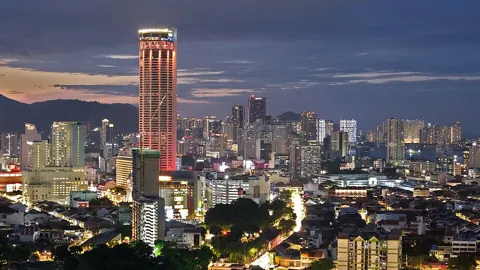
George Town is routinely described as multilingual, and it is. What is harder to find is a number behind that description, because Malaysia does not publish one.
What does the constitution actually say?
That Malay is the national language, with two protective provisos. Article 152(1) provides that "the national language shall be the Malay language and shall be in such script as Parliament may by law provide," subject to provisos that no person shall be prohibited or prevented from using — otherwise than for official purposes — or from teaching or learning any other language, and that nothing in the clause prejudices the right of the federal or any state government to preserve and sustain the use and study of the language of any other community.
English sits in a different position than most visitors assume. Article 152(2) to (5) permit English in both Houses of Parliament, in every state legislative assembly, for all other official purposes, for the authoritative texts of Bills and Acts, and in court proceedings — but each clause opens with "for a period of ten years after Merdeka Day, and thereafter until Parliament otherwise provides."
Sabah and Sarawak have their own protection. Article 161 provides that no Act of Parliament terminating or restricting English for those purposes comes into operation there until ten years after Malaysia Day, and then only when approved by the relevant state legislature.
What is Penang's actual population mix?
Closer to even than any other Malaysian state's, which is the structural reason for George Town's linguistic texture. These are the statistics department's figures for 1 January 2026.
| Group | Penang | Malaysia |
|---|---|---|
| Total population | 1,808,300 | 34,389,400 |
| Malay | 41.3% | 52.7% |
| Other Bumiputera | 0.4% | 11.1% |
| Chinese | 39.1% | 19.9% |
| Indian | 8.6% | 5.8% |
| Other citizens | 0.6% | 0.7% |
| Non-citizen residents | 10.1% | 9.8% |
Read the Chinese row across. Penang is double the national share, and Malay is eleven points below it — the only Malaysian state where the two largest communities are within three percentage points of each other.
Is Penang Hokkien officially recognised?
No, and the checking is worth reporting because the answer is counter-intuitive. Penang's state heritage commissioner gazettes intangible cultural heritage under the State of Penang Heritage Enactment 2011, whose own definition expressly includes language and speech. The register holds 35 gazetted items.
Exactly one is a language — and it is not Hokkien.
| Register item | Domain | Gazetted |
|---|---|---|
| Bahasa Loghat Tanjong | Language and letters | 22 January 2026, Warta 133 |
| Mi Hokkien | Food | 22 January 2026, Warta 133 |
| Budaya Kopitiam | Custom and culture | 22 January 2026 |
| Budaya Nasi Kandar | Custom and culture | 22 January 2026 |
| Perarakan Chingay | Custom and culture | 22 January 2026 |
Bahasa Loghat Tanjong is a Malay dialect. The only occurrence of "Hokkien" in the entire state register is Mi Hokkien, a noodle dish.
At national level the picture is the same. Across all five national heritage declarations — 2007, 2009, 2012, 2015 and 2018 — the only language declared is Bahasa Melayu itself, in the 2012 declaration, item 16. No Chinese or Indian language or dialect appears in any of them.
Why is Malay always the biggest text on a sign?
Because a language certification stands between a business and its advertising licence. Dewan Bahasa dan Pustaka, the national language authority, publishes binding conditions for certifying Malay in advertising, updated 19 August 2026.
Where a language other than the national language is used and is not registered with the companies commission or the intellectual property corporation, that wording must be translated into Malay or made bilingual with Malay given priority in three specific ways: the national language's letter size must be larger than the other language's; its colour must be bright, clear and easily read; and it must be placed above the other-language wording.
| Element | Fee per local authority |
|---|---|
| Signboard certification (papan tanda) | RM 30 |
| Advertisement certification (iklan) | RM 60 |
The division of labour is explicit in the document: the language authority certifies the national language in the advertisement, and the local authority is the body responsible for approving the advertisement licence. For George Town, that local authority is the Penang Island City Council.
So which language should you use?
English first in the heritage core, Malay as the universal fallback, and let the setting tell you the rest. What the state heritage agency documents about the World Heritage Site is the most useful official framing: the inscription's criterion (iii) describes Melaka and George Town as "living testimony to the multi-cultural heritage and tradition of Asia," expressed in "the great variety of religious buildings of different faiths, ethnic quarters, the many languages, worship and religious festivals."
The agency enumerates the communities of the site as the Malays, Chinese, Indians, Straits Chinese or Baba Nyonya, Jawi Peranakan, Arab-Malays and Eurasians, and names Jalan Masjid Kapitan Keling and Lebuh Cannon as where that coexistence is most visible. There are 37 places of worship inside the core and buffer zones.
What this guide does not cover
No figure for languages spoken at home appears here, because none exists officially. The statistics department's open data catalogue holds 366 datasets and not one covers language; its population tables list Date, State, Sex, Age Group, Ethnicity and Population as the only variables; and its census dashboard contains no language field at all. Any percentage you see for Hokkien, Tamil or Mandarin speakers in Malaysia is somebody's estimate.
School figures are also absent. No education ministry statistic breaking schools or enrolment into national, Chinese-medium and Tamil-medium types could be obtained — the ministry's statistics page is empty and the open-data school dataset has only three type values, none of them vernacular.
No official Malaysian statistic or statement on English proficiency was found. And no George Town-level ethnic breakdown is given: the figures above are for Penang state as a whole.
Two legal gaps worth flagging. Whether Parliament has "otherwise provided" under Article 152(2) to (5) could not be checked, because the Attorney General's Chambers legislation server returned errors on every document — so the current operative position on English in courts and Parliament is not stated here. And the Penang Island City Council publishes no advertisement by-law of its own, so the signage rule above is given as the national language authority's condition rather than as a Penang instrument.