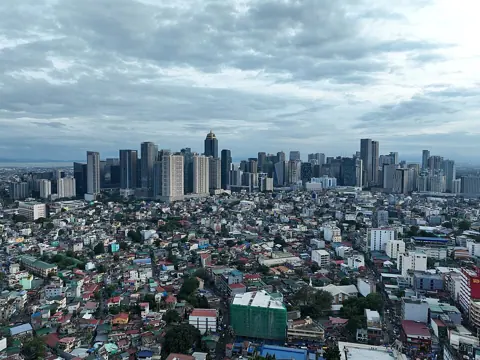
A traveller arriving in Bonifacio Global City at two in the morning finds people on the pavement in office clothes. This is not nightlife. It is a lunch break.
The Philippines' outsourcing sector serves clients in North American time zones, which puts a substantial share of the office workforce in these districts on shifts running roughly from evening to early morning Philippine time. The effect is geographically concentrated rather than citywide, and the concentration follows a piece of tax policy rather than an accident of development.
The policy that put the districts where they are
Outsourcing offices in the Philippines cluster inside zones designated by the Philippine Economic Zone Authority, because locating there carries fiscal incentives. PEZA reported 419 ecozones as of April 2023, of which 297 were IT parks or IT centres — meaning the IT category alone accounts for roughly seven in ten Philippine economic zones.
The most recent itemised list PEZA publishes is dated 30 November 2017, when it counted 262 IT parks and centres. That list gives the geography:
| Area | IT parks / centres (2017) |
|---|---|
| National Capital Region | 155 |
| Makati | 44 |
| Quezon City | 34 |
| Pasig | 23 |
| Taguig | 17 |
| Region VII (Central Visayas) | 39 |
| Cebu City | 25 |
| Region XI (Davao) | 11 |
The 2017 itemisation and the 2023 total do not describe the same moment, and the distribution has almost certainly shifted. What the older list establishes is the shape: a heavy NCR concentration, a secondary Cebu cluster, and a much smaller Davao presence.
What the two largest districts actually are
Bonifacio Global City sits on land that was a military base until the Bases Conversion and Development Act of 1992, Republic Act No. 7227, signed on 13 March 1992, created the mechanism to convert it. The Bases Conversion and Development Authority states that 240 hectares have been developed, with Ayala Land and the Campos group as partners.
The relevant point for a visitor is that BGC was planned in one piece, after 1992, for a use that did not exist in the Philippines when the base was built. That is why it does not look like the rest of Metro Manila: the street grid, the pavement widths and the building setbacks were designed for a workforce that walks between buildings, at a period when the intended tenants were offices rather than factories or housing.
Cebu's equivalent is smaller and more legible on foot. Cebu I.T. Park covers 24.96 hectares under Cebu Property Ventures, adjacent to the 50-hectare Cebu Business Park under Cebu Holdings. Together they form a walkable commercial district of a size that Metro Manila does not offer in a single piece.
In Taguig, McKinley Hill CyberPark offers roughly 17,142 square metres of BPO office space, which gives a sense of the unit size these developments are assembled from.
What the night shift does to the street
The observable effects are ones you can verify by standing there, and this guide states them as observations rather than as measured claims.
Food service in these districts extends later than elsewhere, because a workforce taking its meal break at midnight needs somewhere to take it. Transport demand peaks at hours that do not match the citywide pattern, which is why ride-hailing availability in these districts at three in the morning can be better than in a residential area at the same hour. Convenience retail is denser and keeps longer hours.
Whether to stay in one
For a visitor, the question is whether district activity at night is a feature or a nuisance.
It is a feature if you are arriving from North America with your body clock still on that side of the Pacific, since the district's rhythm will match yours for the first day or two. It is a feature if you want food available at irregular hours without planning.
It is a nuisance if you want quiet, because vehicle movement in these districts does not stop, and because the shift changeover produces concentrated bursts of activity in the small hours.
These districts also tend to be the most expensive accommodation in their cities, since they are the commercial cores. That is a separate consideration from the night shift.
What this guide does not cover
Employment figures for the outsourcing sector could not be verified. Philippine Statistics Authority labour data and Bangko Sentral ng Pilipinas receipts figures were not reachable from primary sources for this guide, so no worker count or revenue figure appears above.
The legal night-shift differential — what employers must pay for night hours, and between which hours it applies — could not be confirmed from Department of Labor and Employment sources and is therefore omitted.
There is no verified inventory of what stays open overnight in any specific district, and no transport schedule information for night hours.
The PEZA itemised geography is nine years old. The 2023 totals confirm the sector grew, but not where.
Nothing here should be read as a safety assessment of any district at any hour.